
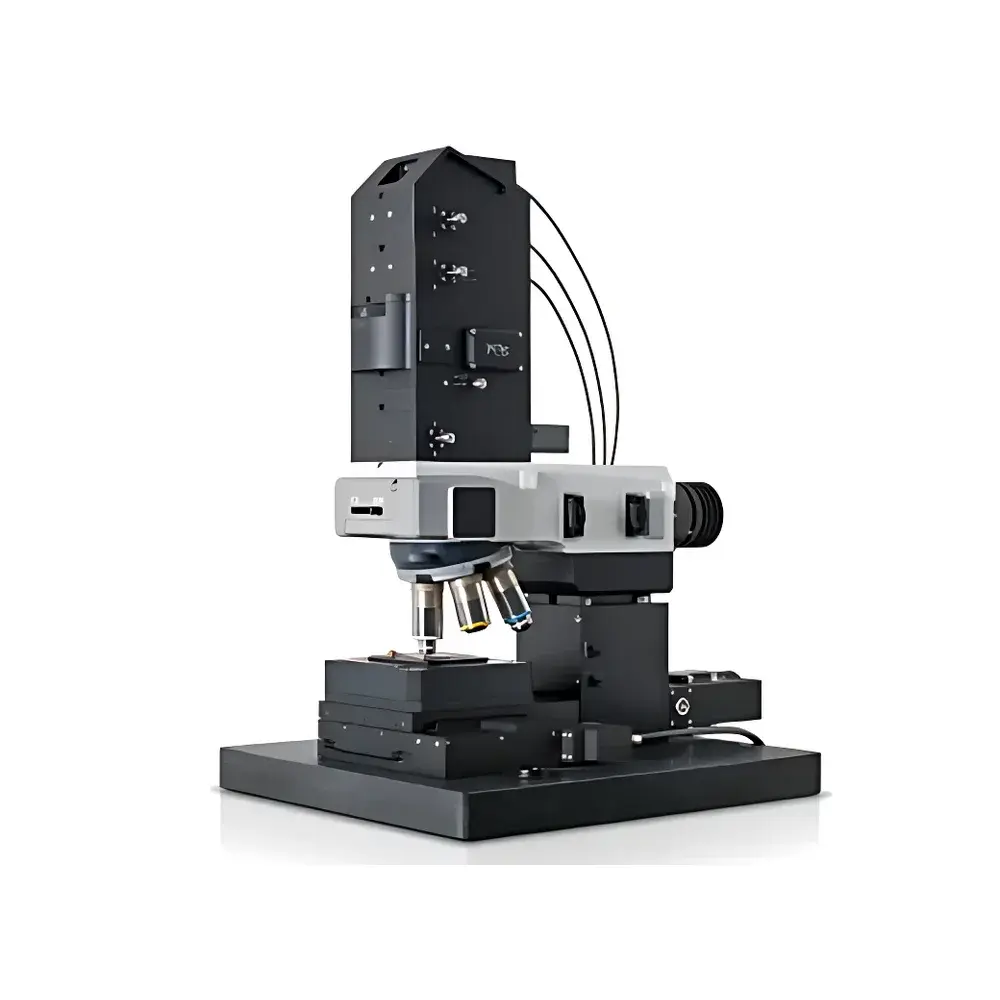
WITec Alpha 300R Confocal Raman Microscope
| Brand | WITec |
|---|---|
| Origin | Germany |
| Model | Alpha 300R |
| Instrument Type | Confocal Raman Microspectroscopy System |
| Spectral Range | 90–9000 cm⁻¹ |
| Spectral Resolution | ≤0.2 cm⁻¹ |
| Spatial Resolution | Lateral 350 nm, Axial 800 nm |
| Minimum Wavenumber | 10 cm⁻¹ |
| Spectral Reproducibility | ≤±0.02 cm⁻¹ |
Overview
The WITec Alpha 300R Confocal Raman Microscope is a research-grade, fully integrated confocal microspectroscopy platform engineered for high-fidelity chemical imaging and quantitative molecular characterization at sub-micrometer spatial resolution. Based on confocal laser scanning principles, the system combines a precision optical microscope with a high-throughput UHTS (Ultra-High Throughput Spectrometer) and fiber-coupled excitation pathways to deliver true point-by-point spectral acquisition in x, y, and z dimensions. Unlike non-confocal or widefield Raman systems, the Alpha 300R employs pinhole-based optical sectioning to reject out-of-focus signal—enabling depth-resolved spectroscopic analysis, artifact-free 3D volumetric mapping, and unambiguous identification of stratified or heterogeneous samples. Its design adheres to fundamental requirements of quantitative vibrational spectroscopy: wavelength-calibrated spectral fidelity, thermally stabilized optics, and mechanical rigidity for long-term measurement repeatability. The system is routinely deployed in academic laboratories, national metrology institutes, and industrial R&D centers where trace-level detection, multi-modal correlative analysis (e.g., Raman + fluorescence + topography), and regulatory-compliant data integrity are essential.
Key Features
- True confocal architecture with motorized or piezo-driven XYZ scanning stages for diffraction-limited spatial resolution (lateral: 350 nm; axial: 800 nm)
- FAST Raman Imaging® as standard—single-spectrum acquisition down to 125 ms (back-illuminated CCD) or 38 ms (front-illuminated CCD)
- ULTRAFAST Raman Imaging® option with EMCCD detector and piezo stage: spectral integration time reduced to 0.76 ms, enabling up to 1,300 spectra per second
- Fiber-coupled UHTS spectrometer series with >70% optical throughput, optimized for UV, VIS, or NIR spectral ranges and designed specifically for low-light Raman applications
- Automated focus stabilization via hardware-based confocal feedback loop, ensuring consistent z-positioning across large-area or time-series acquisitions
- Motorized 6-position objective turret with selectable magnifications (e.g., 50×, 100× oil immersion), LED Köhler illumination, and optional contrast modes (DIC, polarization, darkfield)
- Full software control of multi-region, multi-point, and time-series measurements—including automated stage positioning, spectral triggering, and real-time spectral preview
Sample Compatibility & Compliance
The Alpha 300R accommodates solid, thin-film, powder, biological tissue, and liquid-phase samples mounted on standard microscopy slides or custom substrates. Its modular design supports vacuum-compatible stages, temperature-controlled sample chambers (−196 °C to +600 °C), and electrochemical cells for in situ and operando studies. All spectral data acquisition follows traceable calibration protocols compliant with ISO/IEC 17025 requirements for testing laboratories. Spectral wavenumber accuracy is verified using NIST-traceable polystyrene or silicon reference standards; intensity linearity is validated per ASTM E1840. Data files retain full metadata—including laser wavelength, power, integration time, objective NA, and environmental conditions—ensuring auditability under GLP, GMP, and FDA 21 CFR Part 11 frameworks when paired with WITec’s optional electronic signature and audit trail modules.
Software & Data Management
Control, acquisition, and analysis are unified within WITec’s proprietary Project Series software suite (v6.x), which operates on Windows-based workstations with real-time GPU-accelerated processing. The software implements hierarchical project structures with versioned datasets, supporting lossless storage of raw interferograms (when applicable), calibrated spectra, and hyperspectral cubes (up to 4D: x, y, z, λ). Built-in algorithms include multivariate curve resolution (MCR), principal component analysis (PCA), cluster analysis, and spectral deconvolution using constrained least-squares fitting. Export formats comply with open standards: HDF5 (with NeXus-compatible metadata), ASCII, and JCAMP-DX. Batch processing pipelines support automated baseline correction, cosmic ray removal, and normalization—configurable per experiment and exportable as reusable templates. Raw data integrity is preserved through immutable file hashing and timestamped acquisition logs.
Applications
The Alpha 300R serves as a primary tool for non-destructive, label-free molecular mapping in materials science, pharmaceuticals, geology, and life sciences. Representative use cases include stress/strain quantification in CVD-grown diamond films via peak shift analysis of the 1332 cm⁻¹ band; 3D compositional reconstruction of pollen granules in crystallized honey (1.125 million spectra over 50 × 50 × 50 µm³); polymorph identification in tablet cross-sections; nanoscale phase separation in polymer blends; and redox-state mapping in battery cathode particles. Its compatibility with AFM, SEM, and optical profilometry enables correlative multimodal workflows—e.g., simultaneous topographic and chemical imaging of graphene wrinkles or corrosion pits. In semiconductor metrology, it performs dopant profiling and strain mapping in finFET structures with sub-100 nm lateral registration accuracy.
FAQ
What distinguishes the Alpha 300R from non-confocal Raman systems?
It uses physical pinhole-based optical sectioning to eliminate out-of-focus contributions, enabling quantitative depth profiling and high-contrast 3D chemical imaging—unachievable with widefield or slit-scanning configurations.
Can the system perform simultaneous Raman and fluorescence measurements?
Yes—via fiber-coupled dual-channel detection paths or time-gated acquisition using pulsed lasers; optional fluorescence modules include filter sets for common dyes (FITC, TRITC, DAPI) and lifetime-capable TCSPC upgrades.
Is spectral calibration traceable to international standards?
Yes—wavenumber calibration is performed using NIST SRM 2241 (polystyrene) or SRM 2242 (silicon), with documented uncertainty budgets meeting ISO/IEC 17025 requirements.
What software licenses are included with purchase?
The base package includes perpetual licenses for Project Five (acquisition), Project Six (analysis), and Fityk (peak fitting); optional modules (e.g., PCA, MCR, batch scripting) are available separately.
Does the system support remote operation and data sharing?
Yes—via secure RDP or VNC connections; project files and hyperspectral cubes can be shared via encrypted network drives or cloud-synced repositories with role-based access control.




