
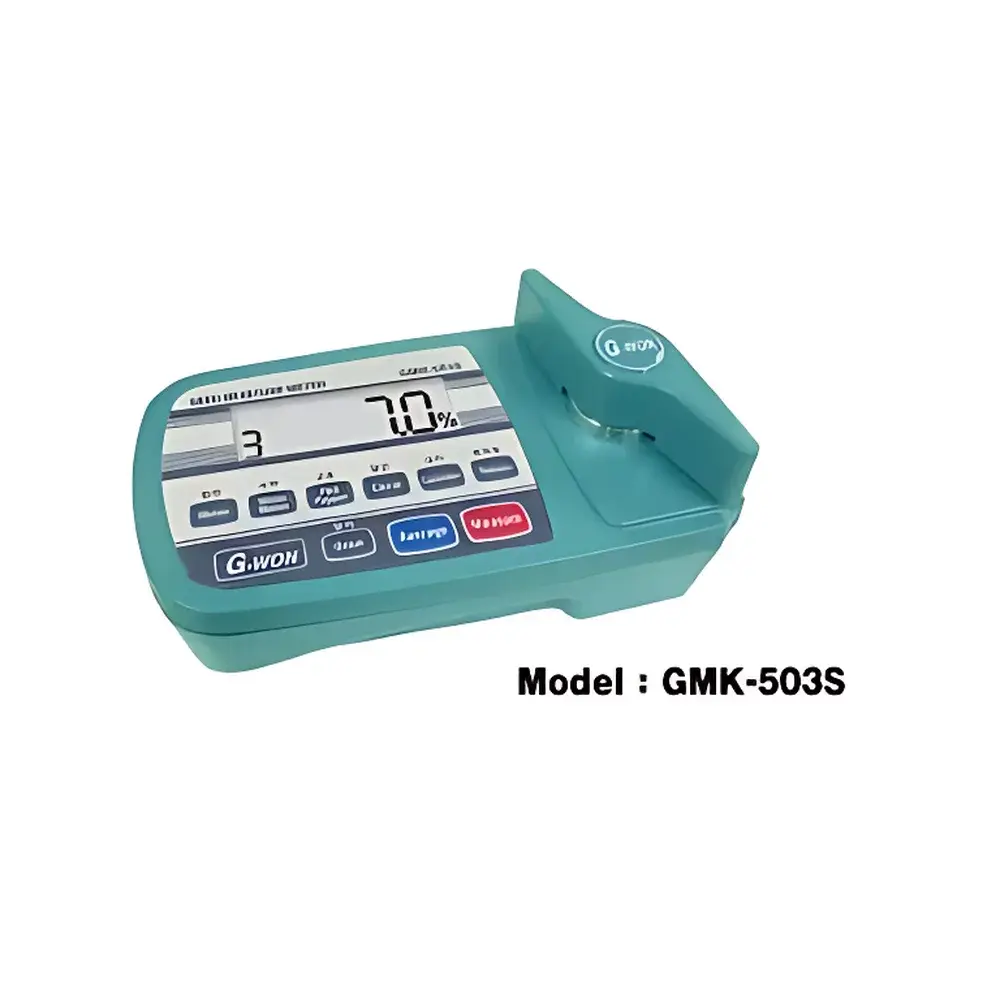
G-WON GMK-503S Capacitance-Based Seed Moisture Analyzer
| Brand | G-WON |
|---|---|
| Origin | South Korea |
| Model | GMK-503S |
| Measurement Principle | Electrical Resistance (Capacitance-Compensated) |
| Accuracy | ±0.5% w/w |
| Sample Types | Seeds & Fresh Horticultural Produce |
| Temperature Compensation | Automatic |
| Display | Large LCD |
| Power Supply | 4 × 1.5 V AA Batteries |
| Dimensions | 164 × 94 × 40 mm |
| Weight | ~1.2 kg |
| Compliance | Designed for ISO 712 and ASTM D4940-aligned field and lab moisture assessment |
Overview
The G-WON GMK-503S Capacitance-Based Seed Moisture Analyzer is a portable, field-deployable instrument engineered for rapid, non-destructive moisture quantification in agricultural seeds and fresh horticultural commodities. Unlike gravimetric oven-drying methods—which require sample preparation, extended drying cycles, and controlled laboratory environments—the GMK-503S employs a calibrated electrical resistance measurement principle with integrated capacitance compensation to infer moisture content based on dielectric properties and bulk conductivity. This dual-parameter approach mitigates errors induced by temperature fluctuations and material density variations, enabling reliable readings across heterogeneous seed lots and high-moisture vegetables. The device operates without consumables or calibration standards beyond initial factory verification, making it suitable for grain elevators, seed certification labs, cooperative extension services, and post-harvest quality control units operating under GLP-aligned workflows.
Key Features
- Automatic temperature compensation algorithm ensures consistent accuracy across ambient conditions ranging from 5 °C to 40 °C—critical for seasonal field use in diverse climatic zones.
- Dedicated pre-programmed calibration curves for 12+ agricultural matrices, including maize, wheat, rice, soybean, tomato, cucumber, carrot, onion, melon, watermelon, red pepper, and spinach—each validated against reference oven-dry methods per ISO 712:2022.
- Large-format LCD display with high-contrast numeric readout supports operation in low-light harvesting environments and enables simultaneous viewing of moisture value, unit identifier (% w/w), battery status, and active crop mode.
- Integrated averaging function computes and displays the arithmetic mean of up to three consecutive measurements—reducing operator-induced variability and improving repeatability in batch sampling protocols.
- Robust mechanical architecture: impact-resistant ABS housing, sealed keypad, and optimized electrode geometry minimize drift during repeated insertion into granular or fibrous samples.
- Low-power design with four standard AA cells provides ≥8 hours of continuous operation; battery level indicator alerts users prior to voltage drop affecting measurement stability.
Sample Compatibility & Compliance
The GMK-503S is validated for direct insertion measurement in intact seeds (e.g., cereal grains, oilseeds, legumes) and homogenized fresh produce tissues where surface moisture is negligible relative to internal water content. Its probe geometry accommodates variable particle sizes while maintaining reproducible electrode contact pressure. While not intended for powdered or paste-like materials, the instrument complies with fundamental metrological requirements outlined in ISO/IEC 17025 for field-portable analyzers used in routine quality assurance. It supports traceability through manual logging of batch IDs, operator initials, and environmental notes—compatible with paper-based or electronic QA records maintained under FDA 21 CFR Part 11–aligned documentation systems when paired with external audit trails.
Software & Data Management
The GMK-503S operates as a standalone instrument without embedded memory or wired/wireless connectivity. All data are recorded manually or transcribed into LIMS-compatible spreadsheets. However, its standardized output format (% w/w, two decimal places) and consistent measurement protocol facilitate integration into digital quality management platforms via secondary capture tools (e.g., barcode-scanned batch entry + manual input). For laboratories requiring automated data flow, third-party USB-to-serial adapters may be used with custom Python or LabVIEW scripts to emulate RS-232 serial output—though no native driver or firmware update capability is provided by G-WON.
Applications
- Pre-storage moisture screening of harvested seeds to prevent mold growth and aflatoxin risk during silo storage.
- In-field validation of drying endpoints for sun-dried or mechanical dehydration processes.
- Quality gate-check at seed processing facilities prior to bagging, coating, or priming operations.
- Extension service support for smallholder farmers assessing viability thresholds before planting.
- Academic agronomy studies comparing varietal differences in post-harvest desiccation tolerance.
- Regulatory sampling for national seed certification programs requiring compliance with national moisture limits (e.g., KSAF, USDA-FSA, or EU Directive 2002/57/EC).
FAQ
Does the GMK-503S require periodic recalibration using certified reference standards?
No—factory calibration is stable under normal handling and storage conditions. Users should verify performance annually using a known reference sample (e.g., air-dried wheat at 12.5% ±0.2% w/w) per ISO 712 Annex B guidelines.
Can the instrument measure moisture in frozen or refrigerated samples?
Measurements below 5 °C are not recommended due to condensation risk and reduced electrolyte mobility; allow samples to equilibrate to ambient temperature before analysis.
Is the GMK-503S compliant with FDA or EU regulatory requirements for food safety testing?
It is not a regulated medical or food-safety device per se, but its measurement methodology aligns with AOAC Official Method 952.12 and ISO 712 for routine moisture determination in agricultural commodities subject to HACCP-based controls.
What maintenance is required to ensure long-term accuracy?
Clean probe electrodes with isopropyl alcohol after each use; inspect for abrasion or residue buildup quarterly; store in dry, dust-free environment with batteries removed during extended idle periods.
Related Products




