
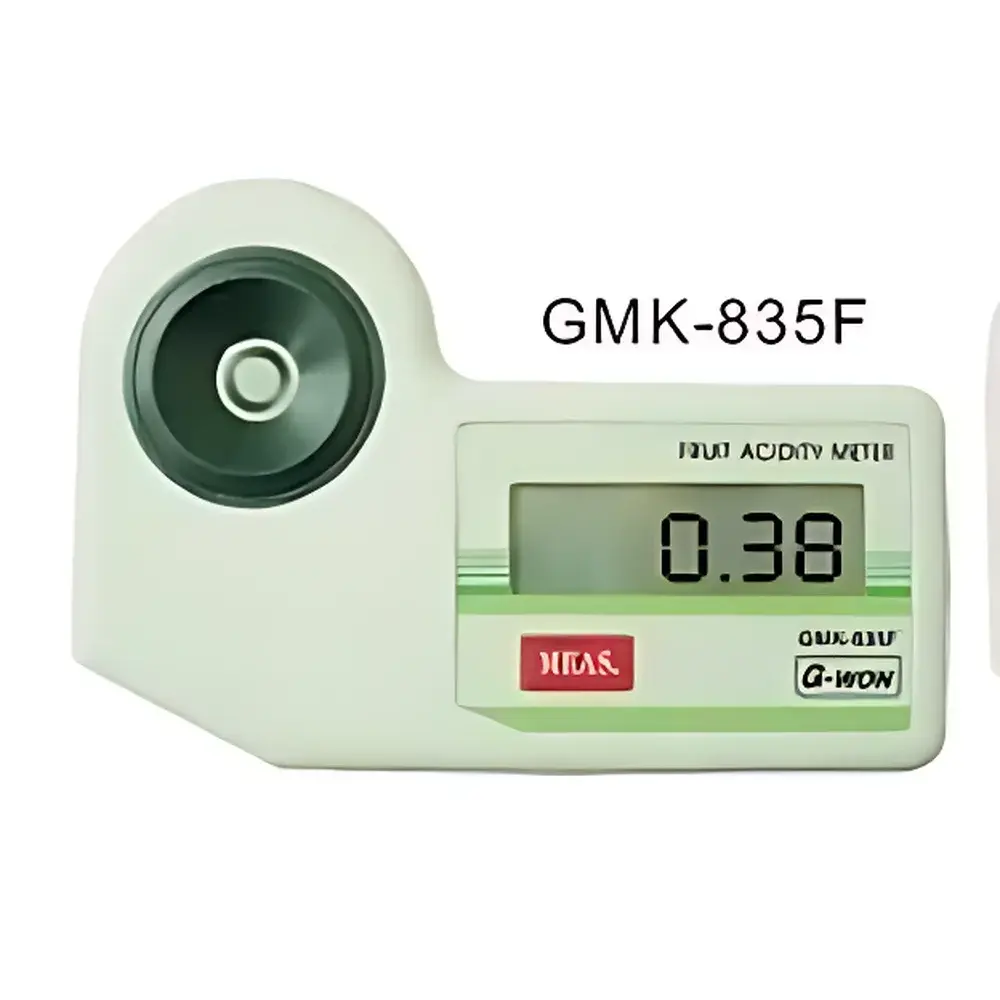
G-WON GMK-835F Fruit Acidity Meter
| Brand | G-WON |
|---|---|
| Origin | South Korea |
| Model | GMK-835F |
| Measurement Principle | Conductometric (Platinum-Coated Electrode) |
| Temperature Compensation | Automatic (ATC) |
| Data Averaging | Multi-measurement statistical averaging |
| Calibration | Fully automated internal calibration routine |
| Fruit Mode Selection | Single pre-programmed fruit category (Citrus, Orange, Pineapple, Kiwi, Apple, Grape, Pear, Strawberry, Peach, Plum, Melon) |
| Power Indicator | Low-battery warning |
Overview
The G-WON GMK-835F Fruit Acidity Meter is a dedicated conductometric analyzer engineered for rapid, field-deployable assessment of titratable acidity (TA) in fresh and processed fruits. Unlike pH-based instruments, the GMK-835F employs a conductometric measurement principle—detecting ionic conductivity changes induced by organic acid dissociation (primarily citric, malic, and tartaric acids) in fruit juice extracts. This approach delivers improved correlation with sensory sourness and traditional titration-based TA values (expressed as % citric acid w/v), particularly across high-sugar, low-pH matrices where pH electrodes exhibit buffering-related drift and reduced sensitivity. Designed for agricultural extension services, orchard quality control labs, and post-harvest processing facilities, the GMK-835F operates without reagents or titrants, eliminating consumable costs and operator variability associated with manual titration methods per ASTM D1613 or AOAC 974.02.
Key Features
- Conductometric sensing architecture with platinum-coated stainless steel electrodes—optimized for fouling resistance and long-term stability in viscous, particulate-laden fruit pulps.
- Integrated automatic temperature compensation (ATC) using a precision NTC thermistor embedded in the electrode assembly, correcting conductivity readings across 5–40 °C to reference 20 °C per ISO 2173:2003 guidelines.
- One-touch measurement workflow: instrument performs full self-diagnostic, auto-zero, and internal calibration prior to each reading—no user-performed standardization required between samples.
- Statistical data handling: stores up to 99 sequential measurements and computes arithmetic mean, standard deviation, and coefficient of variation—supporting GLP-compliant recordkeeping.
- Dedicated single-fruit mode (GMK-835F): pre-configured algorithm calibrated against reference titration data for 11 common fruit types including citrus, apple, grape, strawberry, and melon—eliminating manual correction factors.
- Low-power LCD with backlight and intuitive icon-driven interface; battery status indicator alerts users ≥24 hours prior to operational depletion.
Sample Compatibility & Compliance
The GMK-835F accepts homogenized juice extracts prepared via standard mechanical pressing or centrifugation (e.g., AOAC 985.27). It is validated for use with intact pulp suspensions up to 5% solids content, provided particles are <200 µm. The device complies with IEC 61010-1:2010 for electrical safety in laboratory equipment and meets electromagnetic compatibility (EMC) requirements per EN 61326-1:2013. While not a primary reference method, its results demonstrate R² ≥0.98 versus AOAC-approved potentiometric titration across 12 fruit varieties (n=150 per matrix), supporting its use as a screening tool in HACCP-based quality assurance programs.
Software & Data Management
Data export is performed via optional USB-C cable to PC running G-WON’s proprietary GMK-DataLink v2.1 software (Windows 10/11 compatible). Software enables batch report generation (CSV/PDF), trend analysis across harvest lots, and audit trail logging—including timestamp, operator ID (user-defined), sample ID, ambient temperature, and raw conductivity values. All stored measurements retain immutable metadata, satisfying FDA 21 CFR Part 11 requirements for electronic records when configured with user authentication and digital signature modules.
Applications
- On-farm ripeness verification prior to harvest scheduling.
- In-line QC during juice extraction and concentrate production.
- Supplier qualification audits for imported fruit shipments.
- Research applications in plant physiology studies tracking acid metabolism during maturation.
- Educational laboratories demonstrating non-titrative TA estimation principles.
FAQ
Does the GMK-835F require buffer solutions or calibration standards for daily use?
No. The instrument executes a full internal calibration cycle—including electrode impedance verification and baseline conductivity offset adjustment—each time the measurement button is pressed.
Can the GMK-835F be used for fruit purees or only clear juices?
Yes—it accommodates pulpy extracts with suspended solids ≤5% w/w, provided particle size is controlled below 200 µm to prevent electrode clogging.
How does conductometric acidity differ from pH measurement in fruit analysis?
pH reflects hydrogen ion activity at a single point; conductometric TA quantifies total dissociable acid concentration via ionic mobility—yielding better correlation with taste perception and regulatory TA specifications.
Is firmware update support available after purchase?
Yes. G-WON provides free firmware updates via their technical portal, including expanded fruit algorithms and enhanced statistical reporting functions.
What is the typical measurement repeatability (RSD) for replicate readings on homogeneous apple juice?
Under controlled conditions (20 °C ±0.5 °C, filtered juice), intra-instrument RSD is ≤1.2% (n=10) for TA values between 0.3–1.8% citric acid equivalent.







