
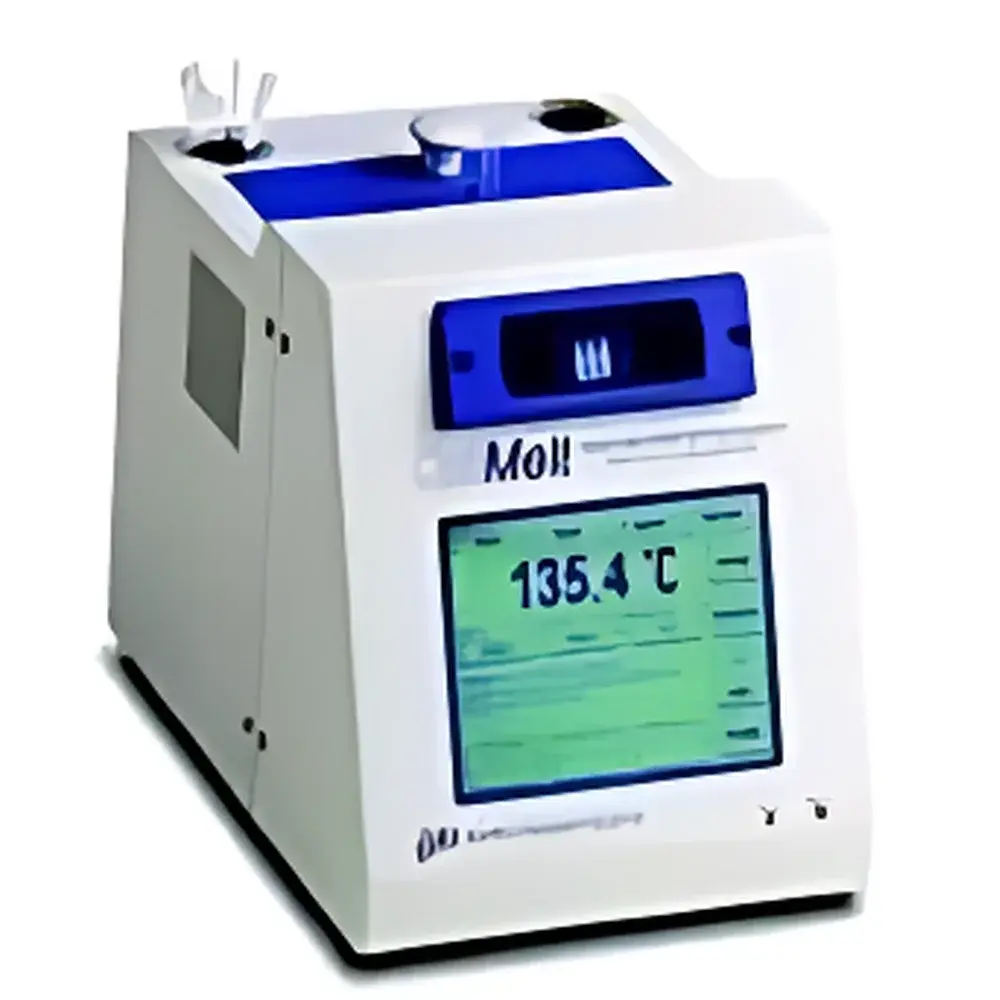
G-WON OptiMelt MPA100 Automated Melting Point Apparatus
| Brand | G-WON |
|---|---|
| Origin | USA |
| Model | MPA100 |
| Temperature Range | −10 °C to 400 °C |
| Heating Rate | 0.1–20 °C/min (adjustable in 0.1 °C/min increments) |
| Temperature Resolution | 0.1 °C |
| Temperature Accuracy | ±0.3 °C at ≤100 °C, ±0.5 °C at ≤250 °C, ±0.8 °C at ≤400 °C |
| Temperature Repeatability | ±0.1 °C |
| Capillary Dimensions | OD 1.4–2.0 mm, length 100 mm |
| Sample Capacity | 3 channels simultaneously |
| Cooling Time | 10 min (350 °C → 50 °C) |
| Heating Time | 10 min (50 °C → 350 °C) |
| Display | Touch-enabled LCD panel |
| Interface | USB 2.0, RS-232 serial port |
| Software | MeltView™ for Windows (USB-connected), supports GLP-compliant data logging and audit trail |
| Power Supply | AC 90–264 V, 50/60 Hz |
| Operating Environment | 0–40 °C, <80% RH non-condensing |
| Dimensions | 20 × 25 × 21 cm |
| Weight | 4.1 kg |
Overview
The G-WON OptiMelt MPA100 Automated Melting Point Apparatus is a precision thermal analysis instrument engineered for pharmaceutical, chemical, and materials laboratories requiring high-reproducibility melting point determination under regulated environments. It operates on the principle of real-time optical monitoring of solid-to-liquid phase transition via digital image analysis—leveraging differential light absorption and reflection changes across a temperature-controlled aluminum heating block. Unlike traditional analog or single-channel instruments, the MPA100 integrates three independent capillary measurement channels, enabling parallel analysis of reference standards and unknown samples within a single run. Its temperature control architecture employs a platinum RTD (Resistance Temperature Detector) sensor embedded directly in the heating module, ensuring traceable calibration against NIST-traceable reference materials and compliance with pharmacopeial requirements including USP <741>, EP 2.2.17, and JP 2.60.
Key Features
- Triple-channel simultaneous measurement for improved throughput and intra-run comparability
- High-resolution digital imaging system with continuous frame capture (up to 30 fps) synchronized to temperature ramping, enabling precise detection of onset, clear point, and melt range endpoints
- Programmable heating rate from 0.1 to 20 °C/min in 0.1 °C/min increments—optimized for both narrow-range crystalline compounds and broad-melting polymers
- Integrated touch-enabled LCD interface allowing standalone operation without PC connection; all method parameters, results, and annotations are stored locally
- Automated endpoint detection with dual-stage acoustic and visual alerts upon stabilization or completion of melt cycle
- GLP-ready firmware supporting user authentication, electronic signatures, and tamper-evident audit trails for all method edits, calibrations, and result exports
- Rapid thermal cycling: 10-minute heating (50 °C → 350 °C) and cooling (350 °C → 50 °C) enabled by optimized aluminum thermal mass and active heat dissipation design
Sample Compatibility & Compliance
The MPA100 accommodates standard thin-wall glass capillaries (OD 1.4–2.0 mm, L = 100 mm), compatible with ASTM E324-16 and ISO 6321-2 procedures for solid organic compound characterization. Each channel accepts independently loaded capillaries, permitting concurrent analysis of control standards and test samples—critical for QC release testing per ICH Q5C and FDA guidance on identity and purity verification. The instrument meets essential regulatory criteria for analytical instrumentation used in GMP environments: it supports 21 CFR Part 11-compliant electronic records when operated with MeltView™ software (including role-based access control, event logging, and secure PDF report generation). Calibration verification is performed using certified reference materials (e.g., caffeine, indomethacin, potassium diphenylacetate), and calibration history—including date, operator ID, and deviation values—is retained for ≥24 months.
Software & Data Management
MeltView™ software (Windows 10/11 compatible, USB-connected) provides full instrument control, real-time video streaming, and post-acquisition analysis tools. Users can define up to 24 reusable methods—each storing target temperature range, ramp rate, dwell times, and annotation markers (up to six per run). All raw thermal profiles, annotated frames, and metadata are archived in a proprietary .mpa binary format with SHA-256 checksum integrity validation. Export options include CSV (for LIMS integration), PDF (with embedded digital signature and timestamp), and image sequences (AVI/MP4). Audit logs record every action—including login/logout events, parameter modifications, calibration executions, and report generations—with immutable timestamps and operator identifiers. Data retention policies align with Annex 11 and ALCOA+ principles.
Applications
- Pharmaceutical quality control: identity confirmation, polymorph screening, and stability-indicating assay support per USP <741>
- Chemical synthesis validation: reaction endpoint monitoring and intermediate purity assessment
- Academic research: thermodynamic profiling of small molecules, co-crystals, and eutectic systems
- Materials science: thermal behavior evaluation of waxes, resins, and low-melting alloys
- Regulatory submissions: generation of auditable, compliant melting point datasets for ANDA, NDA, and CMC sections
FAQ
Does the MPA100 support automatic calibration verification?
Yes—users may initiate a calibration check at any time using built-in reference material libraries; results are logged with pass/fail status and residual error values.
Can I export raw video and temperature data for third-party analysis?
Yes—MeltView™ exports synchronized time-stamped video (MP4) and temperature/time CSV files with millisecond resolution.
Is the instrument suitable for hygroscopic or air-sensitive samples?
The MPA100 does not provide inert atmosphere control; users must pre-seal capillaries under nitrogen or argon prior to loading.
How many calibration points can be stored in memory?
Up to five multi-point calibrations (e.g., 0 °C, 100 °C, 200 °C, 300 °C, 400 °C) may be saved and recalled per instrument profile.
What is the minimum sample mass required per capillary?
Optimal performance is achieved with 1–3 mg of finely powdered, uniformly packed material—consistent with pharmacopeial recommendations.
Does the device comply with ISO/IEC 17025 requirements for accredited testing labs?
When operated with documented SOPs, calibrated reference standards, and maintained audit logs, the MPA100 satisfies metrological traceability and uncertainty estimation requirements outlined in ISO/IEC 17025:2017 clause 6.4.



