
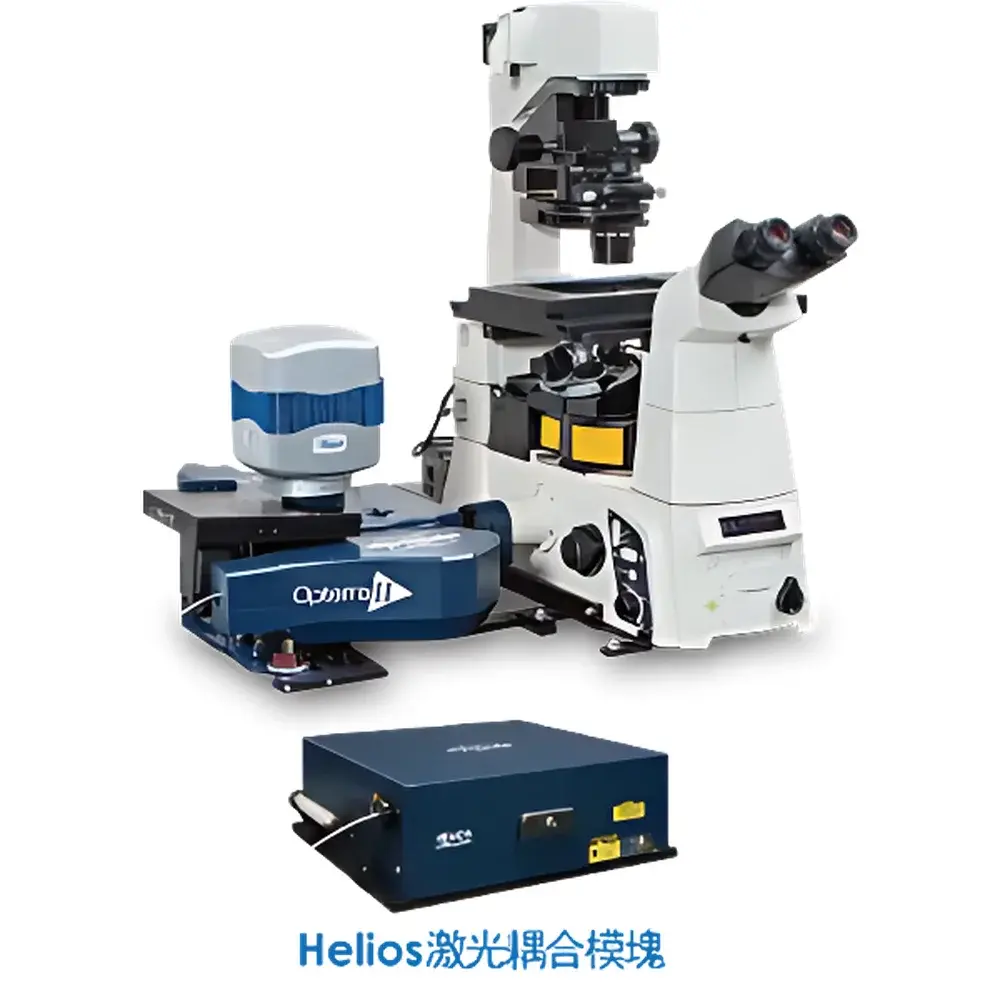
Bruker Opterra II Multipoint Scanning Confocal Microscope
| Brand | Bruker |
|---|---|
| Origin | USA |
| Model | Opterra II |
| Type | Multipoint Scanning Confocal Microscope |
| Application Focus | Live-Cell Quantitative Imaging |
| Optical Architecture | Dual-Galvo Scanning with High-Density Pinhole Array |
| Excitation Compatibility | 405–640 nm Laser Lines |
| Z-Step Resolution | Adjustable down to 100 nm |
| Maximum Z-Stack Acquisition Speed | ≤60 s for 56 slices at 2 µm intervals |
| Field Uniformity | <±1.5% Intensity Variation Across FOV |
| Phototoxicity Profile | Optimized for Extended Time-Lapse Imaging of Sensitive Specimens |
| Compliance | Designed for GLP/GMP-Compliant Workflow Integration |
| Software Platform | Prairie View™ v6.x with FDA 21 CFR Part 11 Audit Trail Support |
Overview
The Bruker Opterra II Multipoint Scanning Confocal Microscope is an engineered solution for high-fidelity, quantitative live-cell imaging. Unlike conventional spinning-disk or single-point scanning systems, the Opterra II employs a dual-galvanometer-based multipoint scanning architecture coupled with a precisely aligned high-density pinhole array. This design enables simultaneous excitation and detection across multiple subregions of the field of view—achieving a fundamental balance among spatial resolution, temporal fidelity, and photon efficiency. The system operates on the principle of optical sectioning via confocal detection, where out-of-focus fluorescence is physically rejected by the pinhole plane, thereby enhancing axial resolution and contrast in thick or scattering specimens. Engineered specifically for longitudinal studies of dynamic intracellular processes—including protein trafficking, ion flux dynamics, microtubule remodeling, vesicle motility, and nuclear architecture—the Opterra II delivers robust performance under low-light, low-phototoxicity conditions essential for maintaining physiological relevance during extended acquisition.
Key Features
- Multipoint scanning architecture with dual-galvo beam steering for parallelized acquisition—enabling up to 30 fps at full-frame 1024 × 1024 resolution without compromising signal-to-noise ratio
- Modular laser combiner supporting up to six solid-state lasers (405, 445, 488, 514, 561, 640 nm) with acousto-optic tunable filter (AOTF) control for precise intensity modulation and rapid wavelength switching
- High numerical aperture objective support (up to 60×, NA 1.4 oil immersion) with motorized correction collar and Z-drift compensation for stable long-term Z-stack acquisition
- Quantitative intensity calibration via built-in photodiode monitoring and reference standard slide validation—ensuring inter-experiment reproducibility required for comparative analysis
- Integrated environmental chamber compatibility (temperature, CO₂, humidity control) for uninterrupted imaging of mammalian cell cultures over durations exceeding 24 hours
- Rugged optical path design with thermally stabilized dichroic mirrors and anti-vibration optical table mounting—minimizing drift-induced misregistration in time-lapse series
Sample Compatibility & Compliance
The Opterra II accommodates a broad range of biological specimens—from dissociated primary neurons and organotypic brain slices to intact zebrafish embryos and murine oviduct sections. Its low-phototoxicity operation mode allows imaging of light-sensitive fluorophores (e.g., GFP variants, Ca²⁺ indicators such as Cal-520, and photoswitchable proteins) without measurable perturbation of cellular physiology. The system meets foundational requirements for regulated research environments: hardware timestamps, user-access logs, and electronic signature support are natively embedded within Prairie View™ software to align with FDA 21 CFR Part 11 compliance. Additionally, instrument configuration records, calibration histories, and audit trails are exportable in PDF/A format for GLP/GMP audit readiness. All optical components comply with ISO 10110 standards for surface quality and wavefront error.
Software & Data Management
Prairie View™ v6.x serves as the unified acquisition, visualization, and analysis platform. It provides synchronized multi-channel time-lapse acquisition with hardware-triggered Z-stack sequencing, ROI-based photobleaching correction algorithms, and batch-processing pipelines for large-volume 4D dataset handling. Metadata embedding follows OME-TIFF specification, ensuring interoperability with ImageJ/Fiji, Imaris, and commercial LIMS systems. Data security protocols include AES-256 encryption for stored acquisitions and role-based access control (RBAC) for collaborative lab deployments. Raw data retention policies can be configured to enforce automatic archiving to network-attached storage (NAS) or cloud repositories compliant with HIPAA and GDPR data sovereignty frameworks.
Applications
- Long-duration tracking of intracellular organelle dynamics in live pancreatic tumor spheroids using 60× oil objectives and large-field tiled acquisition (2 mm × 1.5 mm)
- High-resolution 3D reconstruction of microtubule networks in mitotic HeLa cells, acquired across 56 Z-planes at 2 µm intervals in ≤60 seconds
- Calcium transient mapping in cardiomyocyte monolayers with subcellular spatial resolution and millisecond temporal sampling
- Quantitative colocalization analysis of receptor-ligand interactions in endothelial cells under shear stress conditions
- Developmental imaging of sponge embryo morphogenesis, capturing nuclear envelope reformation and chromatin condensation kinetics
FAQ
What distinguishes the Opterra II from traditional spinning-disk confocals?
The Opterra II eliminates mechanical disk rotation latency and fixed pinhole geometry constraints, instead using digitally addressable galvo scanning to dynamically optimize illumination density and detection efficiency per experimental condition.
Can the system perform FRAP or photoactivation experiments?
Yes—integrated AOTF control enables region-specific laser power modulation with sub-millisecond precision, supporting quantitative photobleaching recovery and optogenetic stimulation protocols.
Is the Opterra II compatible with super-resolution modalities?
While not a super-resolution platform per se, its optical train supports structured illumination microscopy (SIM) add-ons via third-party modules and maintains alignment stability required for multi-modal correlative workflows.
How is calibration traceability maintained across laboratories?
Each system ships with NIST-traceable fluorescence intensity standards and a documented calibration certificate; periodic verification is supported through Bruker’s Certified Service Program.
Does the software support automated analysis of motility or intensity kinetics?
Prairie View includes native kymograph generation, particle tracking (with Brownian motion filtering), and time-series intensity profiling—exportable to MATLAB or Python for custom algorithm integration.



