
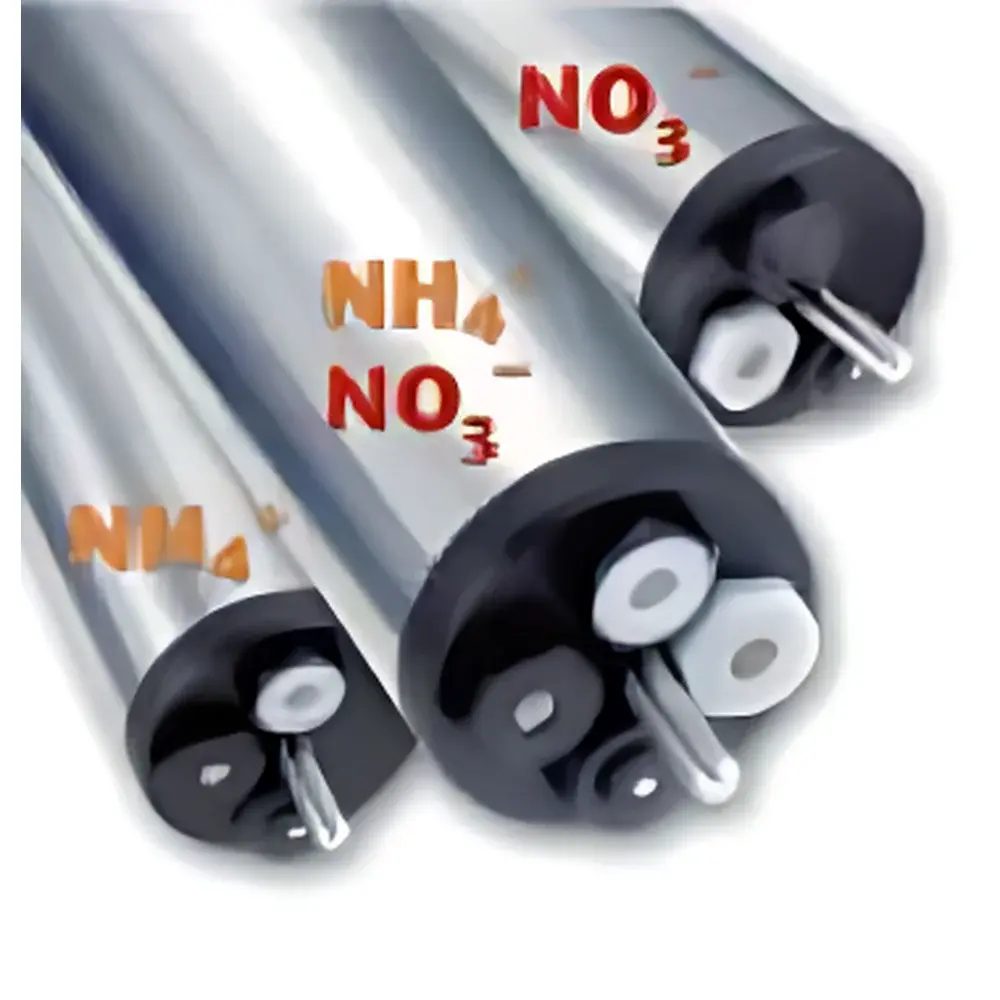
WTW AmmoLyt, NitraLyt & VARiON Online Ammonia Nitrogen and Nitrate Nitrogen Ion-Selective Electrode Sensors
| Brand | WTW |
|---|---|
| Origin | Germany |
| Sensor Models | AmmoLyt, NitraLyt, VARiON |
| Type | Online ISE-based sensor system |
| Measurement Principle | Potentiometric ion-selective electrode (ISE) method |
| Measurement Ranges | NH₄⁺-N: 1–2000 mg/L (1 mg/L resolution) or 0.1–100 mg/L (0.1 mg/L resolution) |
| NH₄⁺ | 1–2580 mg/L (1 mg/L) or 0.1–129.0 mg/L (0.1 mg/L) |
| NO₃⁻-N | 1–1000 mg/L (1 mg/L) or 0.1–100 mg/L (0.1 mg/L) |
| NO₃⁻ | 5–4500 mg/L (1 mg/L) or 0.5–450.0 mg/L (0.1 mg/L) |
| Accuracy | ±5% of reading ±0.2 mg/L |
| Detection Limit | NH₄⁺-N: 0.1 mg/L |
| NO₃⁻-N | 0.1 mg/L |
| Response Time | 0–3 min |
| Compliance | Designed for continuous operation in wastewater treatment environments per DIN EN ISO 5667-3, ASTM D1426, and EPA Method 350.1 |
Overview
The WTW AmmoLyt, NitraLyt, and VARiON series represent a family of robust, online ion-selective electrode (ISE) sensors engineered for continuous, real-time monitoring of ammonium nitrogen (NH₄⁺-N) and nitrate nitrogen (NO₃⁻-N) in municipal and industrial wastewater streams. These sensors operate on the potentiometric principle: the potential difference (ΔE = EISE − ERef) between a selective working electrode and a stable reference electrode is measured under controlled temperature conditions—integrated Pt1000 temperature compensation ensures thermodynamic accuracy across operational ranges. Unlike colorimetric or enzymatic methods, ISE-based detection delivers direct, reagent-free quantification without sample digestion or chemical addition, minimizing maintenance overhead and eliminating consumable costs. Each sensor integrates four functional elements into a single, pressure-resistant, IP68-rated housing: an ion-selective membrane electrode, a double-junction reference electrode with polymer gel electrolyte, an interference-compensating electrode (K⁺-selective for AmmoLyt; Cl⁻-selective for NitraLyt), and a precision temperature sensor. This architecture enables reliable operation in high-salinity, variable-pH, and biofouling-prone environments typical of activated sludge systems and tertiary effluent channels.
Key Features
- True online capability with sub-3-minute response time—optimized for tracking dynamic nitrogen peaks during nitrification/denitrification cycles.
- AmmoLyt sensor incorporates built-in potassium ion (K⁺) interference compensation, critical for accuracy in high-K⁺ influent waters (e.g., landfill leachate or digester supernatant).
- NitraLyt features chloride ion (Cl⁻) compensation logic, ensuring stable NO₃⁻-N readings in seawater-influenced or chlorinated effluents.
- VARiON dual-parameter sensor simultaneously measures both NH₄⁺-N and NO₃⁻-N using a single probe body—reducing installation footprint and calibration synchronization complexity.
- Metal-reinforced sensing membrane resists mechanical abrasion and permits gentle cleaning with soft-bristled brushes—no membrane replacement required under normal service conditions.
- Integrated electrode aging diagnostics monitor characteristic curve drift over time, providing predictive maintenance alerts via IQ SensorNet controller interface.
- One shared compensation electrode can correct multiple co-located AmmoLyt/NitraLyt sensors connected to the same IQ platform—reducing hardware redundancy.
Sample Compatibility & Compliance
These sensors are validated for use in raw sewage, primary/secondary effluent, mixed liquor, and treated discharge streams with suspended solids ≤ 500 mg/L and conductivity up to 20 mS/cm. They comply with international standard methods including ASTM D1426 (ammonia), EPA Method 350.1 (nitrate), and DIN EN ISO 5667-3 (water sampling). The reference system employs a low-drift, polymer-junction Ag/AgCl reference element resistant to sulfide poisoning—a common failure mode in anaerobic zones. All models meet CE marking requirements for electromagnetic compatibility (EMC Directive 2014/30/EU) and environmental protection (RoHS 2011/65/EU). Calibration traceability aligns with GLP principles when paired with WTW’s IQ-LabLink workflow, enabling audit-ready documentation per ISO/IEC 17025 laboratory accreditation criteria.
Software & Data Management
Operation is fully integrated into WTW’s IQ SensorNet ecosystem. The IQ-LabLink calibration protocol eliminates reliance on standard buffer solutions: users collect a field sample, analyze it in-lab via certified spectrophotometric or IC methods, then upload the lab result via USB drive—the controller automatically computes and applies a matrix-specific correction factor that accounts for ionic strength, pH, and background interferents. All calibration events—including timestamps, lab values, applied offsets, and electrode slope diagnostics—are stored with full audit trail functionality compliant with FDA 21 CFR Part 11 requirements when deployed with IQ software version 4.2 or later. Data export supports Modbus TCP, Profibus DP, and analog 4–20 mA outputs for SCADA integration.
Applications
- Real-time control of aerobic/anaerobic zones in activated sludge plants—enabling dynamic aeration optimization based on NH₄⁺-N depletion rate.
- Monitoring denitrification efficiency in anoxic basins via simultaneous NH₄⁺-N and NO₃⁻-N trending (VARiON configuration).
- Effluent compliance verification at discharge points subject to national nutrient limits (e.g., EU Urban Wastewater Treatment Directive Annex I).
- Process troubleshooting in MBR and IFAS systems where rapid nitrogen speciation shifts indicate biofilm imbalance or hydraulic overload.
- Integration with dissolved oxygen (FDO 700 series) and pH probes for multi-parameter process modeling and digital twin development.
FAQ
Do these sensors require daily calibration?
No—thanks to IQ-LabLink’s lab-reference calibration protocol, recalibration intervals typically extend to 2–4 weeks under stable operational conditions. Field verification against grab samples is recommended weekly for QA/QC.
Can AmmoLyt and NitraLyt be used in seawater-influenced wastewater?
Yes—NitraLyt’s Cl⁻-compensation algorithm maintains accuracy up to 10 g/L chloride; AmmoLyt’s K⁺ compensation remains effective up to 500 mg/L potassium.
What is the expected service life of the sensing membrane?
Under routine cleaning and proper storage (wet cap with 3 mol/L KCl), the ISE membrane demonstrates ≥24 months of stable performance in municipal WWTP applications.
Is VARiON suitable for regulatory reporting?
Yes—when operated within specified ranges and calibrated per IQ-LabLink protocol, VARiON meets data quality objectives outlined in ISO 5667-2 for routine monitoring and satisfies reporting thresholds under most national environmental statutes.
How is temperature compensation implemented?
Each sensor embeds a Pt1000 RTD conforming to IEC 60751 Class B, delivering ±0.2 °C accuracy from 0–40 °C—critical for maintaining Nernstian response stability across seasonal variations.
Related Products







