
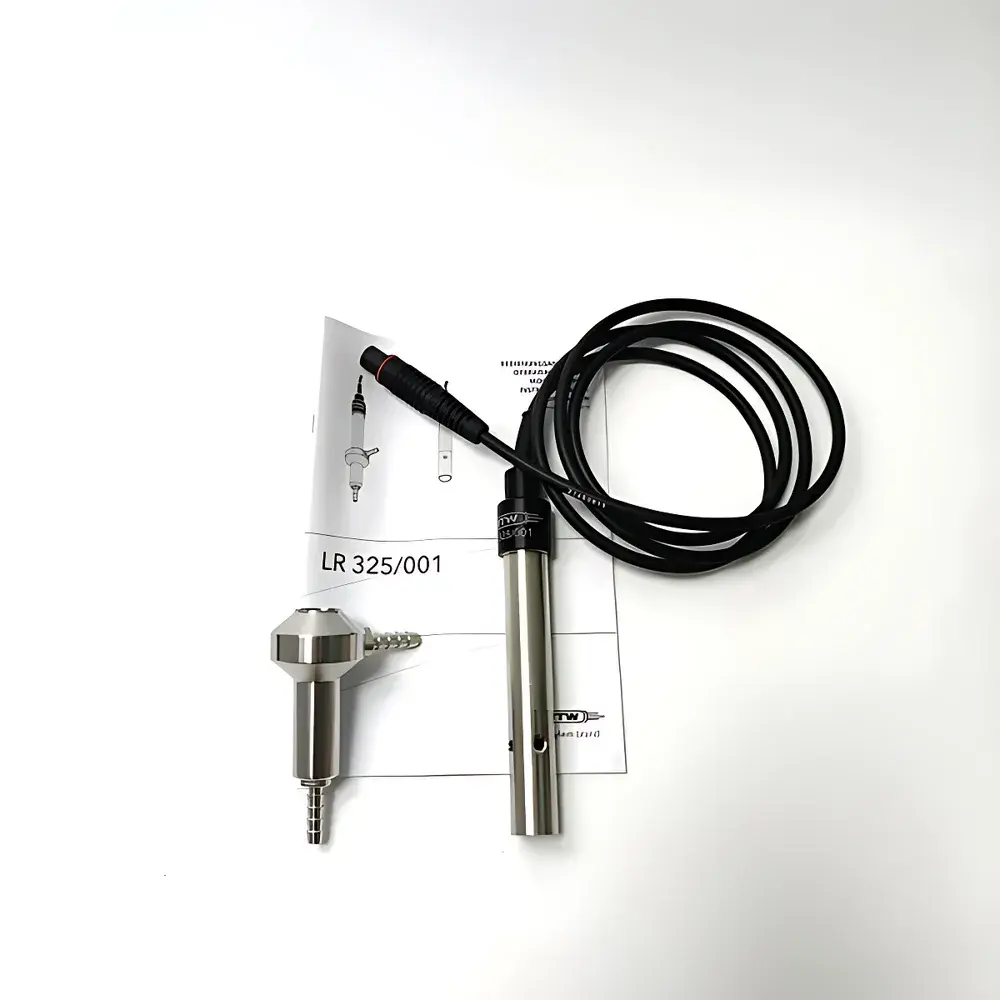
WTW LR 325/001 Ultra-Pure Water Conductivity Electrode
| Brand | WTW |
|---|---|
| Origin | Germany |
| Model | LR 325/001 |
| Detection Parameter | Single (Conductivity) |
| Portability | Portable |
| Application Environment | Laboratory |
| Conductivity Range | 0.0001 µS/cm to 30 µS/cm |
| Electrode Type | Two-Electrode |
| Cell Constant | 0.01 cm⁻¹, ±2% |
| Temperature Sensor | Integrated NTC |
| Temp. Range | 0–100 °C, ±0.2 K |
| Max. Pressure | 2 bar at 20 °C |
| Housing Material | 316Ti Stainless Steel |
| Flow-Cell Configuration | Yes |
| Connector | KI/LF-MIQ/S (505 543) + ADA/AMPH-LAB-LF (303212) |
Overview
The WTW LR 325/001 is a high-precision, two-electrode conductivity sensor engineered specifically for ultra-pure water (UPW) monitoring in critical laboratory, pharmaceutical, and semiconductor-grade water systems. It operates on the principle of conductometric measurement—applying an alternating current across two stainless steel electrodes and measuring the resulting current to determine solution conductivity—corrected in real time via an integrated NTC temperature sensor. With a certified cell constant of 0.01 cm⁻¹ (±2%), the electrode delivers exceptional sensitivity in the sub-microsiemens range, enabling reliable detection of trace ionic contamination down to 0.0001 µS/cm. Its design conforms to fundamental requirements for low-conductivity measurement: minimized polarization effects, stable electrode geometry, and thermally compensated signal output. Unlike general-purpose probes, the LR 325/001 is optimized for low-ionic-strength environments where stray capacitance, cable leakage, and temperature drift significantly impact accuracy—making it suitable for ASTM D5391 (Standard Test Method for Electrical Conductivity of Water), ISO 7888, and pharmacopeial USP purified water verification.
Key Features
- Ultra-low-range capability: validated measurement range from 0.0001 µS/cm to 30 µS/cm—ideal for monitoring Type I ultrapure water per ISO 3696 and EP/USP specifications.
- Integrated NTC temperature sensor with ±0.2 K accuracy across 0–100 °C ensures automatic, linear temperature compensation (ATC) without external calibration.
- 316Ti stainless steel housing and flow-through cell design provide mechanical robustness, chemical resistance, and compatibility with sanitary installation practices.
- Optimized two-electrode architecture with 0.01 cm⁻¹ cell constant minimizes polarization error and enhances long-term stability in deionized and reverse-osmosis effluent streams.
- Rated for continuous operation at up to 2 bar pressure at 20 °C—compatible with inline monitoring in recirculating UPW loops and point-of-use validation stations.
- Standardized KI/LF-MIQ/S (505 543) interface plus ADA/AMPH-LAB-LF (303212) adapter enables seamless integration with WTW IQ Sensor Net transmitters and multi-parameter platforms supporting GLP-compliant data logging.
Sample Compatibility & Compliance
The LR 325/001 is validated for aqueous samples with negligible suspended solids and low organic load—primarily ultrapure water, boiler feedwater, condensate, and purified water used in biopharmaceutical manufacturing. It is not intended for high-conductivity media (>30 µS/cm), viscous solutions, or slurries. The probe complies with key regulatory frameworks governing analytical instrumentation in regulated industries: its analog output and digital handshake protocol support audit-trail-capable data acquisition under FDA 21 CFR Part 11 when paired with compliant WTW IQ transmitters and software (e.g., MultiLab Pilot). Design and materials meet EN 61326-1 (EMC) and EN 61010-1 (safety) standards. For GMP environments, the electrode supports routine IQ/OQ protocols using WTW-certified calibration solutions (e.g., KCl 0.01 mol/L, traceable to NIST SRM).
Software & Data Management
When connected to WTW’s IQ Sensor Net ecosystem—including MIQ/S transmitters and MultiLab Pilot software—the LR 325/001 enables full traceability, automated calibration verification, and configurable alarm thresholds. All measurements are timestamped, tagged with sensor ID and temperature-corrected values, and stored with metadata (operator, location, calibration history). The system supports CSV export, PDF report generation, and direct integration into LIMS via OPC UA or Modbus TCP. Calibration events—including standardization against certified reference solutions—are recorded with electronic signatures and immutable audit trails, satisfying ALCOA+ principles (Attributable, Legible, Contemporaneous, Original, Accurate, Complete, Consistent, Enduring, Available) required under GxP and ISO/IEC 17025.
Applications
- Final polishing loop monitoring in semiconductor fab UPW distribution systems (ASTM F631 compliance).
- Pharmaceutical purified water (PW) and water for injection (WFI) system validation per USP , EP 2.2.38, and JP 2.05.
- Real-time conductivity verification during column regeneration and resin bed rinsing in ion exchange systems.
- Boiler feedwater purity assurance in power generation facilities (ASME PTC 19.11).
- Research-grade water quality control in analytical chemistry labs performing ICP-MS, HPLC, or trace metal analysis.
FAQ
What is the recommended calibration frequency for the LR 325/001 in GMP environments?
Calibration should be performed before each use or at least once per shift when used continuously; full system verification (including temperature sensor and cable integrity) is required daily per internal SOPs aligned with Annex 11 and USP .
Can this electrode be used in pressurized hot water applications?
No—the maximum rated pressure is 2 bar at 20 °C. For elevated temperatures or pressures, consider WTW’s LRD series with higher thermal and mechanical ratings.
Is the 0.01 cm⁻¹ cell constant factory-certified and traceable?
Yes—each LR 325/001 ships with a manufacturer’s certificate of conformance listing the measured cell constant, uncertainty budget, and traceability to national standards (DAkkS-accredited calibration).
Does the electrode require special cabling or shielding?
Yes—use only WTW-supplied shielded coaxial cables (e.g., LF-CABLE-2M) to minimize noise and capacitive coupling, especially below 1 µS/cm. Unshielded or extended third-party cables degrade resolution and reproducibility.
How does the flow-through cell design improve measurement reliability?
It eliminates stagnant boundary layers, ensures uniform flow velocity across the electrode surface, and reduces air bubble entrapment—critical for achieving <±0.5% repeatability in ultra-low conductivity ranges.
Related Products




