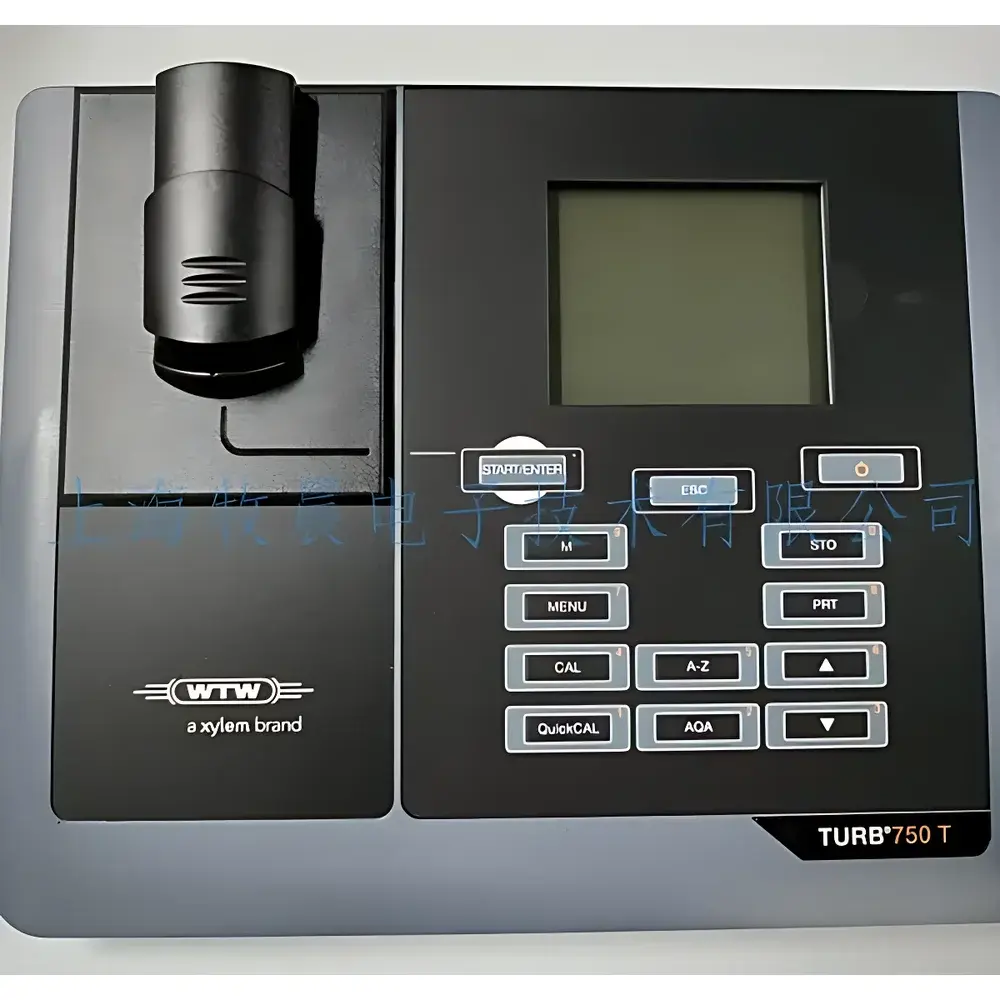
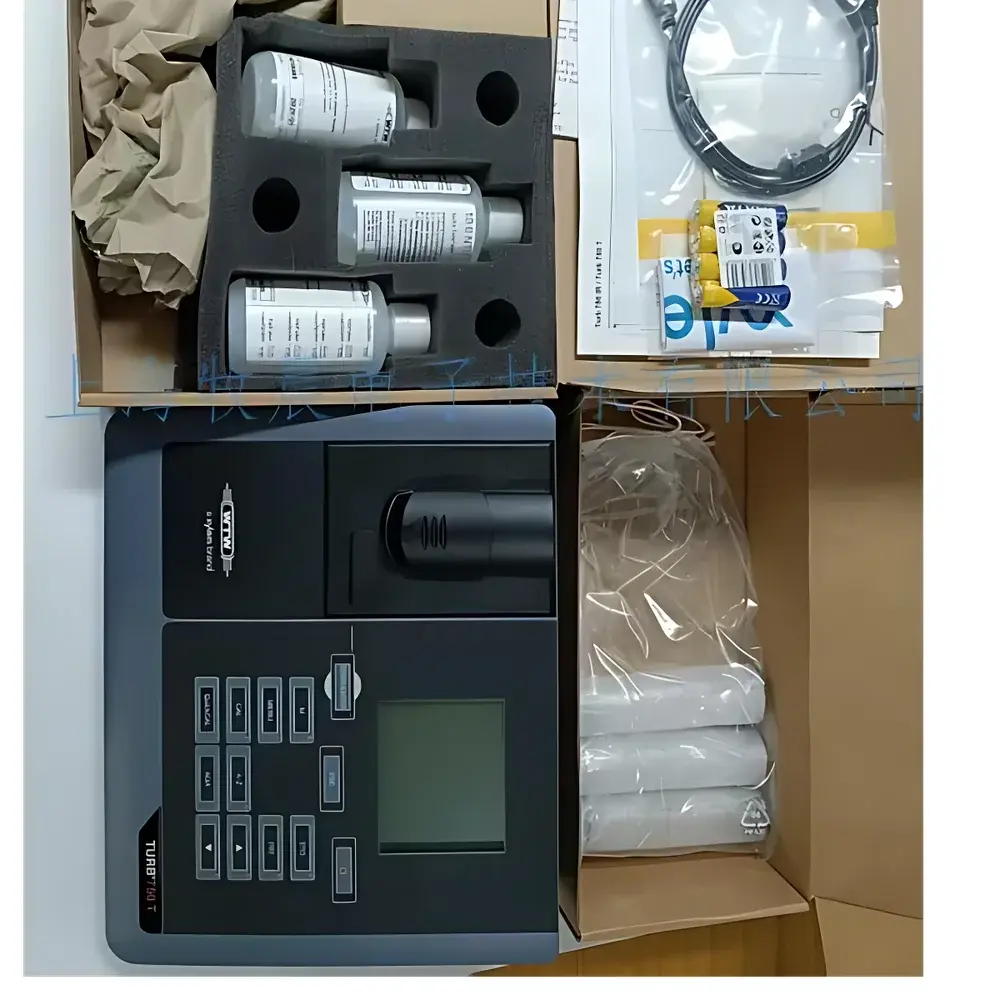
WTW Turb 750T Portable Turbidimeter
| Brand | WTW |
|---|---|
| Origin | Germany |
| Model | Turb 750T |
| Type | Portable |
| Measurement Range | 0–1100 FNU/NTU |
| Resolution | 0.00–9.99 FNU/NTU: 0.01 FNU/NTU |
| 10–99.99 FNU/NTU | 0.1 FNU/NTU |
| 100–1100 FNU/NTU | 1 FNU/NTU |
| Operating Temperature | +5 to +55 °C (41 to 131 °F) |
| Accuracy | ±0.01 FNU/NTU or ±2% of reading |
| Compliance | US EPA Method 180.1 |
| Light Source | Tungsten halogen lamp |
| Detection Principle | Nephelometric measurement at 90° |
| Display | Backlit graphic LCD (160 × 104 pixels) |
| Data Storage | 2500 datasets with calibration protocol, AQA flag, and sample ID |
| Interface | RS232, USB, printer port |
| Software | Turb Data PC software (GLP-compliant, CSV export, LIMS import) |
Overview
The WTW Turb 750T is a portable, high-precision nephelometric turbidimeter engineered for routine and regulatory-grade turbidity measurement in diverse liquid matrices—including drinking water, wastewater, process streams, beverages (beer, wine), pharmaceutical formulations, food suspensions, and aquaculture effluents. It operates in strict accordance with US EPA Method 180.1, utilizing a tungsten-halogen white-light source and 90° scattered-light detection geometry. This optical configuration ensures compliance with established photometric principles for turbidity quantification, delivering traceable, reproducible results across the full 0–1100 FNU/NTU range. Unlike legacy formazin-based standards, the Turb 750T employs AMCO® Clear polymer microsphere reference standards—certified for long-term stability, inter-batch consistency (<1% deviation), and direct traceability to formazin equivalents. Its robust architecture supports field-deployable operation while maintaining laboratory-grade metrological integrity under variable ambient conditions (+5 to +55 °C).
Key Features
- Nephelometric detection at 90° using a calibrated tungsten-halogen lamp, optimized for spectral response matching EPA 180.1 requirements
- Three-tier resolution switching: 0.01 FNU/NTU (0–9.99), 0.1 FNU/NTU (10–99.99), and 1 FNU/NTU (100–1100) — automatically applied based on signal magnitude
- Intelligent Reproducibility & Plausibility Check (IRPC) algorithm for real-time validation of measurement stability and outlier rejection
- Configurable calibration workflows: default 3-point calibration, flexible 2–5 point user-defined calibration, or rapid 1-point verification
- AMCO® Clear calibration kit included (0.02, 10.0, and 1000 FNU/NTU standards), eliminating formazin handling and associated toxicity, degradation, and drift risks
- Backlit graphical LCD (160 × 104 pixels) with intuitive menu navigation and alphanumeric keypad featuring chemically resistant foil construction
- Onboard GLP-compliant data management: 2500 stored datasets including timestamp, sample ID, operator ID, calibration protocol ID, AQA status flag, and IRPC confidence indicator
Sample Compatibility & Compliance
The Turb 750T accepts standard 28 mm diameter borosilicate glass vials (minimum 15 mL volume) with PTFE-coated rubber seals and phenolic caps—designed to minimize surface scatter and eliminate need for immersion oil. Sample temperature must remain below 70 °C to prevent thermal lensing effects or vial deformation. The instrument is CE-marked and validated for use in environments governed by ISO/IEC 17025, USP , and FDA 21 CFR Part 11 when paired with Turb Data software (audit trail enabled, electronic signature support). Calibration intervals and tolerance thresholds are programmable and enforced via AQA (Analytical Quality Assurance) protocols. All measurements comply with US EPA Method 180.1 for regulatory reporting in municipal water and wastewater applications.
Software & Data Management
Turb Data PC software provides full GLP-compliant data handling: instrument identification via serial number, operator authentication, secure CSV export compatible with Excel and LIMS platforms, and structured import/export of calibration records. Each measurement dataset embeds metadata—sample ID, calibration certificate number, AQA pass/fail status, IRPC reliability index, and environmental parameters (ambient temperature, battery level). Data filtering options allow extraction by date range, sample group, or AQA status. Firmware updates are delivered via USB interface. The software supports dual-reporting modes: direct printing from HyperTerminal or formatted PDF generation with embedded instrument certification and traceability statements.
Applications
- Drinking water quality monitoring per EPA and WHO guidelines
- Wastewater treatment plant effluent verification (secondary/tertiary discharge compliance)
- Pharmaceutical suspension clarity testing (USP , EP 2.2.1)
- Beer and wine haze assessment during filtration and stabilization
- Food emulsion stability evaluation (e.g., dairy, sauces, dressings)
- Aquaculture water clarity control for optimal feed conversion and pathogen mitigation
- Industrial process water loop surveillance (cooling towers, rinse baths, boiler feed)
FAQ
Does the Turb 750T meet US EPA Method 180.1 requirements?
Yes — it implements white-light 90° nephelometry with calibrated tungsten-halogen illumination and adheres to all optical, geometric, and procedural specifications defined in EPA 180.1.
Can I use formazin standards with this instrument?
While technically possible, WTW recommends exclusive use of AMCO® Clear standards due to their superior stability, non-toxicity, and certified equivalence to formazin—ensuring long-term calibration integrity and regulatory defensibility.
What is the maximum allowable sample temperature?
Samples must not exceed 70 °C (158 °F) to avoid thermal distortion of the vial or refractive index shifts that compromise scattering geometry.
Is the Turb Data software compliant with 21 CFR Part 11?
Yes — when audit trail, electronic signatures, and role-based access controls are enabled, Turb Data satisfies predicate rule requirements for electronic records and signatures in regulated laboratories.
How many calibration points can be stored onboard?
The instrument stores up to five user-defined calibration points per method, with full metadata (date, operator, standard lot, deviation) retained for each calibration event.