
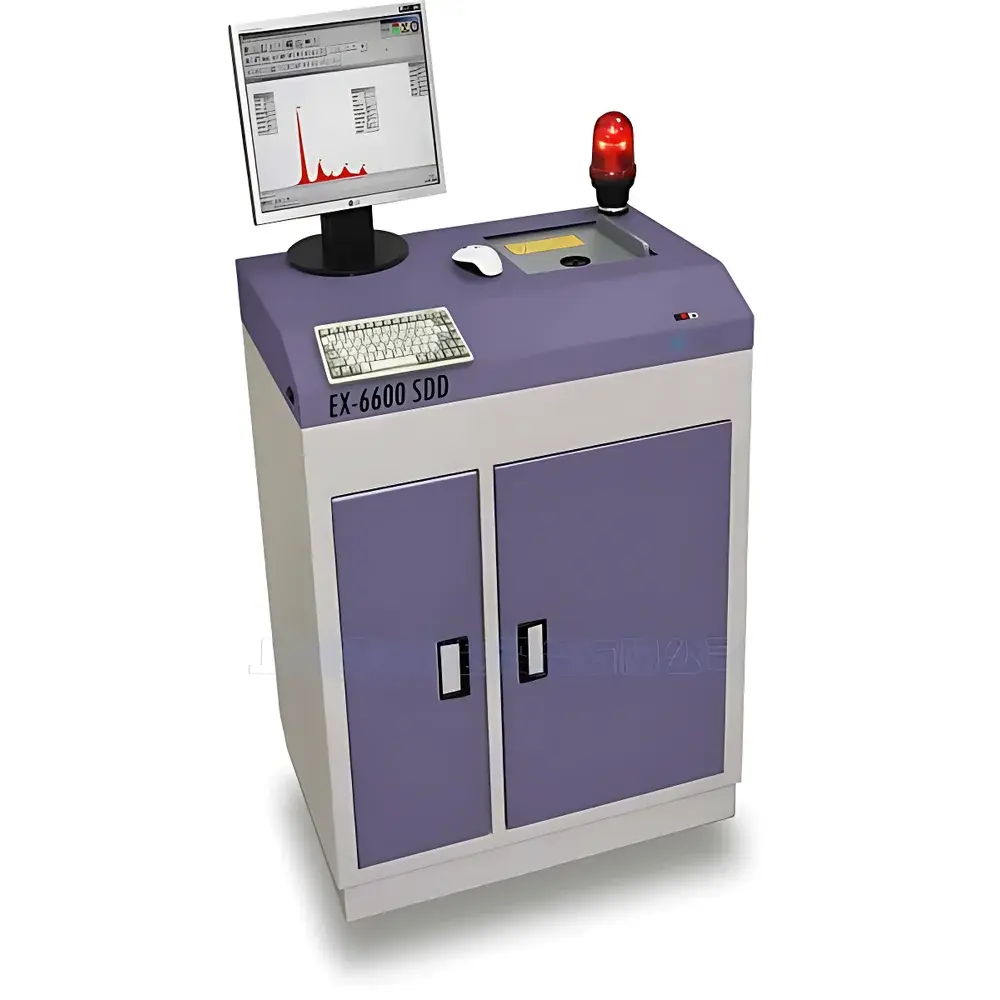
Xenemetrix EX-6600 / X-7600 Advanced Energy Dispersive X-Ray Fluorescence Spectrometer
| Brand | Xenemetrix |
|---|---|
| Origin | Israel |
| Model | EX-6600 / X-7600 |
| Configuration | Benchtop & Floor-standing |
| Elemental Range | C(6)–Fm(100) |
| Detection Limit | 1 ppm |
| Concentration Range | 1 ppm – 100% |
| Energy Resolution | 129 eV (FWHM at 5.9 keV) |
| Repeatability | 0.1% |
| X-ray Tube | Rh anode, 60 kV / 300 W (EX-6600), 60 kV / 400 W (X-7600) |
| Detector | Silicon Drift Detector (SDD), standard or LE variant |
| Filter Set | 8-position motorized primary filters |
| Secondary Targets | 8 selectable targets |
| Sample Environment Options | Air, Vacuum, He purge |
| Sample Chamber Dimensions | Ø178 mm × H32 mm |
| Instrument Dimensions (L×W×H) | 85 × 85 × 105 cm (EX-6600), 85 × 85 × 105 cm (X-7600) |
| Weight | 170 kg (EX-6600), 220 kg (X-7600) |
| Software | nEXt™ quantitative analysis suite with fundamental parameters (FP) algorithm |
Overview
The Xenemetrix EX-6600 and X-7600 are high-performance, benchtop-to-floor-standing Energy Dispersive X-Ray Fluorescence (EDXRF) spectrometers engineered for precision elemental analysis across academic research laboratories, national metrology institutes, and industrial quality control environments. These instruments operate on the principle of secondary excitation via characteristic X-ray fluorescence emission: a high-power Rh-target X-ray tube irradiates the sample, inducing inner-shell ionization; emitted fluorescent photons are energy-resolved by a silicon drift detector (SDD) to yield quantitative elemental composition without chemical dissolution or destructive preparation. Designed for broad-spectrum capability—from light elements (carbon, Z = 6) through transuranics (fermium, Z = 100)—the systems integrate patented Wide-Angle Geometry (WAG) optics, dual excitation modes (direct and secondary target), and vacuum/He-purge compatibility to optimize signal-to-background ratios—particularly critical for low-Z element quantification and trace-level detection down to 1 ppm.
Key Features
- High-power Rh-anode X-ray source: 300 W (EX-6600) and 400 W (X-7600), both operating at up to 60 kV, enabling enhanced excitation efficiency across the full periodic table.
- Dual excitation architecture: Direct tube excitation supplemented by eight programmable secondary targets (e.g., Ni, Ti, Al), selectively enhancing sensitivity for specific analytes while suppressing matrix interference and scatter background.
- High-resolution SDD detection: Standard configuration delivers ≤129 eV FWHM at Mn Kα (5.9 keV); optional ultra-high-resolution SDD (123 eV ± 5 eV) available for demanding multi-element trace analysis.
- Light-element optimized configuration: Optional low-energy SDD (SDD-LE) with thin polymer window enables reliable detection and quantification of C, N, O, F, and Na under He-purge or vacuum conditions.
- Motorized 8-position filter wheel and 8-target changer ensure automated method switching without manual intervention—critical for unattended multi-matrix analysis sequences.
- Integrated computing platform running nEXt™ software: Pre-installed Windows-based system with real-time spectrum acquisition, FP-based quantification, spectral deconvolution, and audit-trail-enabled data handling compliant with GLP/GMP workflows.
Sample Compatibility & Compliance
The EX-6600/X-7600 accommodates solid, powdered, liquid, and thin-film samples up to Ø178 mm × 32 mm height. Optional accessories—including 10- or 20-position autosamplers, sample rotators, vacuum pumps, and He purging modules—extend operational flexibility for high-throughput labs and regulated environments. All systems conform to EU Directive 80/836/Euratom regarding design, shielding, and safety interlocks for ionizing radiation equipment. Hardware and software architecture support 21 CFR Part 11-compliant electronic signatures, audit trails, and user-access controls when configured with appropriate validation packages. The instruments meet ASTM E1621 (standard test method for elemental analysis by EDXRF), ISO 21043 (XRF instrumentation performance verification), and USP / requirements for elemental impurities in pharmaceuticals.
Software & Data Management
nEXt™ is a modular, standards-based analysis platform supporting both empirical calibration and fundamental parameter (FP) quantification. It includes spectral fitting algorithms with peak deconvolution, matrix correction routines, and customizable report templates exportable to PDF, CSV, or XML. The software supports method transfer between instruments, batch processing of multi-sample sets, and integration with LIMS via ODBC. All analytical sessions generate timestamped, user-attributed records with full spectral metadata—ensuring traceability for regulatory submissions. Optional advanced modules include Monte Carlo-based matrix correction, particle-size effect modeling, and certified reference material (CRM) library management aligned with NIST SRM and BAM databases.
Applications
These spectrometers serve diverse analytical missions: environmental monitoring (soil heavy metals, airborne particulate metals), geological surveying (ore grade assessment, REE profiling), materials science (alloy certification, coating thickness & composition), electronics (RoHS/WEEE compliance screening), catalysis research (catalyst loading uniformity), and nuclear safeguards (actinide isotopic ratio estimation). Their ability to quantify light elements under controlled atmospheres makes them suitable for battery cathode R&D (Li, B, F), polymer additive analysis, and archaeological provenance studies (glass, ceramics, pigments). Notable institutional users include the Bhabha Atomic Research Centre (BARC), India—deploying EX-6600 for ambient air metal speciation—and the Indian Institute of Arts’ Physics Department for teaching and research-grade XRF spectroscopy.
FAQ
Does the instrument require liquid nitrogen cooling?
No—the SDD detectors are Peltier-cooled and operate continuously without cryogenic consumables.
Can it analyze carbon in steel or polymers?
Yes, with He-purge or vacuum operation and the optional SDD-LE detector, C (Z=6) quantification achieves sub-100 ppm precision in metallic and organic matrices.
Is method validation support available for regulated industries?
Yes—Xenemetrix provides IQ/OQ documentation templates, GxP-ready software configuration guidance, and third-party qualification support aligned with ISO/IEC 17025 and FDA expectations.
What maintenance is required for long-term stability?
Annual calibration verification using CRMs, periodic Be-window inspection, and routine SDD resolution checks (Mn Kα) constitute the recommended preventive maintenance schedule.
How does secondary target excitation improve detection limits?
By matching the secondary target’s characteristic line energy to the absorption edge of the analyte, signal enhancement exceeds 3–5× compared to direct excitation—especially for mid-Z elements in high-Z matrices (e.g., Cr/Mn/Fe in Ni alloys).




