
XRSIM (2) Industrial Micro-CT Simulation Software
| Origin | USA |
|---|---|
| Manufacturer Type | Authorized Distributor |
| Origin Category | Imported |
| Model | XRSIM (2) |
| Pricing | Available Upon Request |
Overview
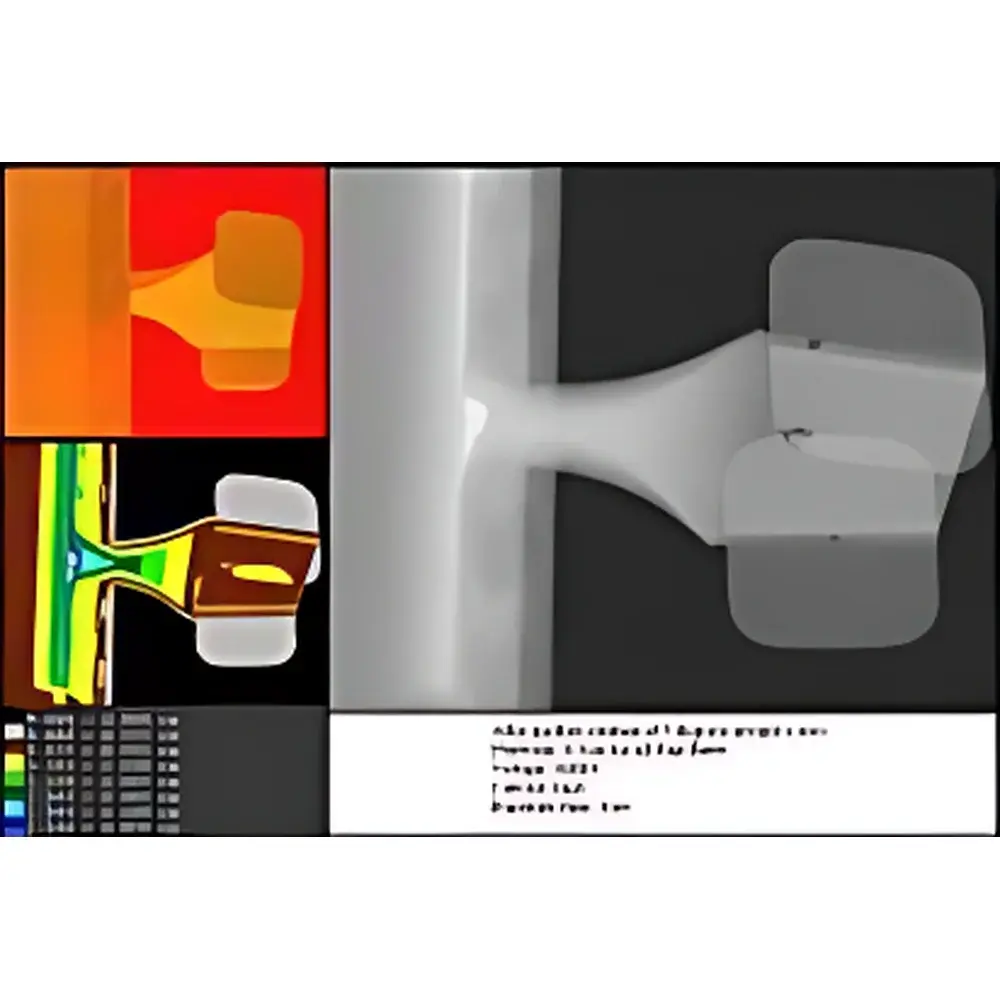
XRSIM (2) is a high-fidelity simulation software platform engineered for industrial micro-computed tomography (micro-CT) system design, protocol optimization, and non-destructive evaluation (NDE) validation. It employs Monte Carlo-based X-ray photon transport modeling combined with geometric ray-tracing to simulate realistic 3D volumetric projections under user-defined acquisition parameters—including source spectrum, detector response, object geometry, material composition, and scanning trajectory. Unlike generic CAD-based visualization tools, XRSIM (2) integrates physics-based attenuation models compliant with the Beer–Lambert law and accounts for polychromatic beam hardening, scatter contribution, and detector quantum efficiency—enabling predictive assessment of image quality metrics such as contrast-to-noise ratio (CNR), spatial resolution (MTF), and artifact susceptibility prior to physical scanning. Developed in close alignment with ASTM E1441 and ISO/IEC 17025 requirements for CT method development, it serves as a critical digital twin enabler for metrology-grade micro-CT workflows in aerospace, additive manufacturing, and electronics packaging.
Key Features
- Physics-driven simulation engine supporting monochromatic and polychromatic X-ray spectra (e.g., tungsten, molybdenum, or custom anode/filter combinations)
- Full 3D object modeling via import of STEP, IGES, or STL files; supports multi-material assignment with density and atomic number mapping
- Configurable geometric CT setups: cone-beam, fan-beam, helical, and laminographic trajectories
- Realistic detector modeling including pixel pitch, fill factor, modulation transfer function (MTF), and noise characteristics (quantum, electronic, readout)
- Built-in reconstruction pipeline compatible with FDK, SART, and iterative regularization methods (e.g., TV minimization)
- Quantitative output reporting: simulated projection datasets (DICOM, TIFF, HDF5), reconstructed volumes (NRRD, VTK), and metrological deviation maps (GD&T overlays)
- Batch processing and parameter sweep automation for sensitivity analysis and uncertainty quantification (UQ)
Sample Compatibility & Compliance
XRSIM (2) accommodates a broad range of sample geometries and material systems relevant to industrial micro-CT applications—including metallic alloys (Al, Ti, Inconel), polymers (PEEK, epoxy composites), ceramics (SiC, Al₂O₃), and multi-layer electronic assemblies. Material definitions adhere to NIST XCOM cross-section databases for energies between 5 keV and 300 keV. The software supports compliance documentation generation aligned with ISO 15788 (CT system qualification), ASTM E2737 (CT data quality metrics), and ASME BPVC Section V, Article 24 (digital radiographic simulation validation). Audit trails for simulation inputs, version-controlled configuration files, and timestamped output logs are maintained to support GLP and GMP environments requiring traceability per FDA 21 CFR Part 11.
Software & Data Management
XRSIM (2) operates on Windows 10/11 (64-bit) with optional Linux server deployment for high-throughput simulation farms. Licensing is node-locked or floating via FlexNet, with optional integration into enterprise license management platforms. All simulation projects are stored in structured directories containing metadata-rich JSON descriptors, enabling automated ingestion into LIMS or PLM systems. Export formats conform to DICOM-CT Part 10 standards for seamless interoperability with commercial reconstruction engines (e.g., VGStudio MAX, Thermo Scientific Avizo) and metrology suites (e.g., Volume Graphics VGSTUDIO, Zeiss INSPECT CT). Version history, change logs, and user attribution are embedded in all exported datasets to satisfy ISO/IEC 17025 clause 7.7 on result validity assurance.
Applications
- Pre-scan optimization of exposure time, source voltage, and detector binning to minimize dose while preserving metrological fidelity
- Virtual qualification of CT system performance against ASTM E1695 reference phantoms (e.g., line-pair, sphere-diameter, contrast-detail)
- Root-cause analysis of reconstruction artifacts (e.g., ring, streak, beam-hardening) through controlled parameter variation
- Validation of dimensional measurement uncertainty budgets per VDI/VDE 2630-2.1 for internal void detection, wall thickness analysis, and GD&T verification
- Training and certification of CT operators using standardized virtual samples with ground-truth geometry
- Supporting regulatory submissions by documenting simulation-based justification for scan protocol selection in medical device or aerospace component inspection
FAQ
Is XRSIM (2) validated against physical micro-CT measurements?
Yes—validation datasets are available from collaborative studies with NIST, PTB, and leading industrial CT labs, covering resolution, contrast, and dimensional accuracy benchmarks.
Can XRSIM (2) simulate dual-energy or phase-contrast CT configurations?
Dual-energy simulation is supported via sequential monoenergetic projections; phase-contrast modeling requires external wave-optics coupling and is not natively included.
Does XRSIM (2) support GPU-accelerated simulation?
Ray-tracing and scatter estimation modules leverage CUDA-enabled NVIDIA GPUs (Compute Capability 6.0+); Monte Carlo photon transport remains CPU-optimized for statistical robustness.
What training and technical support options are provided?
Comprehensive instructor-led workshops, application-specific consulting, and remote troubleshooting are offered by certified engineers with >10 years’ experience in industrial CT metrology.
Is source code access available for research customization?
Source code is proprietary; however, a documented C++ API and Python bindings (via pybind11) enable third-party plugin development for specialized physics models or workflow integration.



