
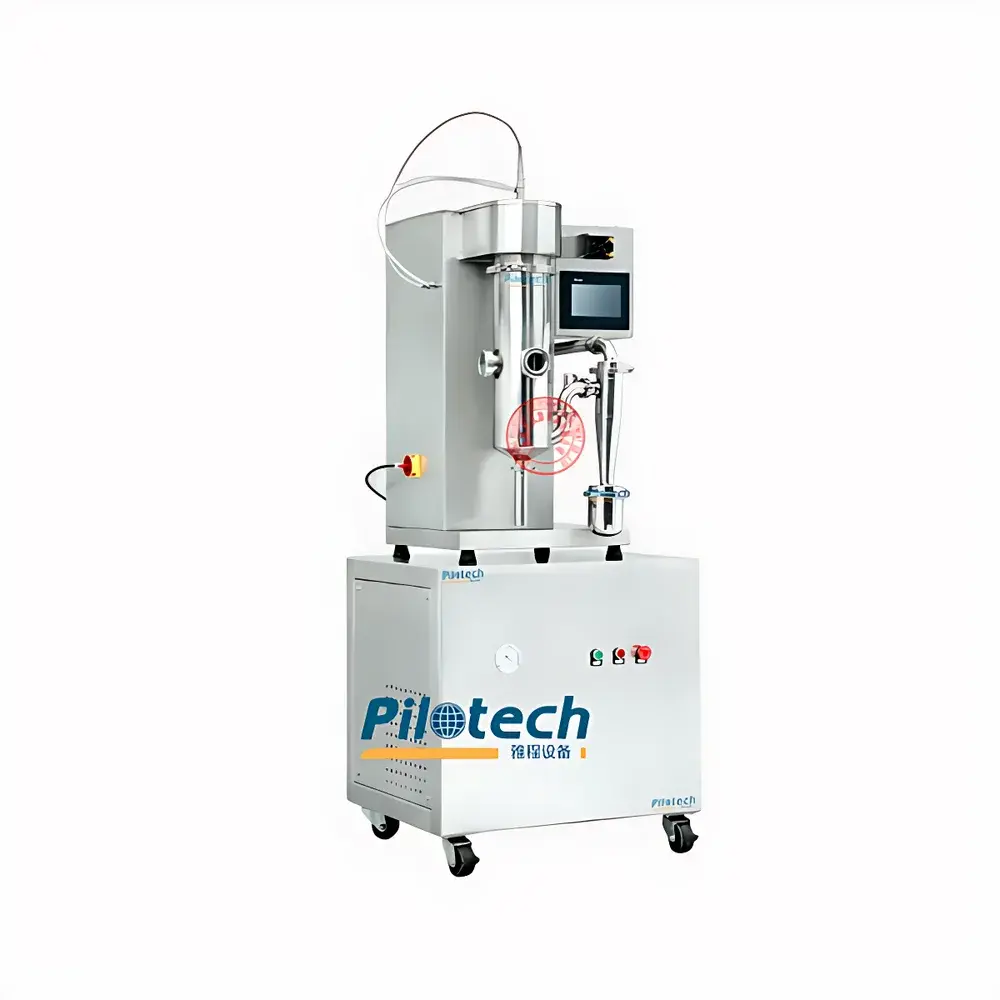
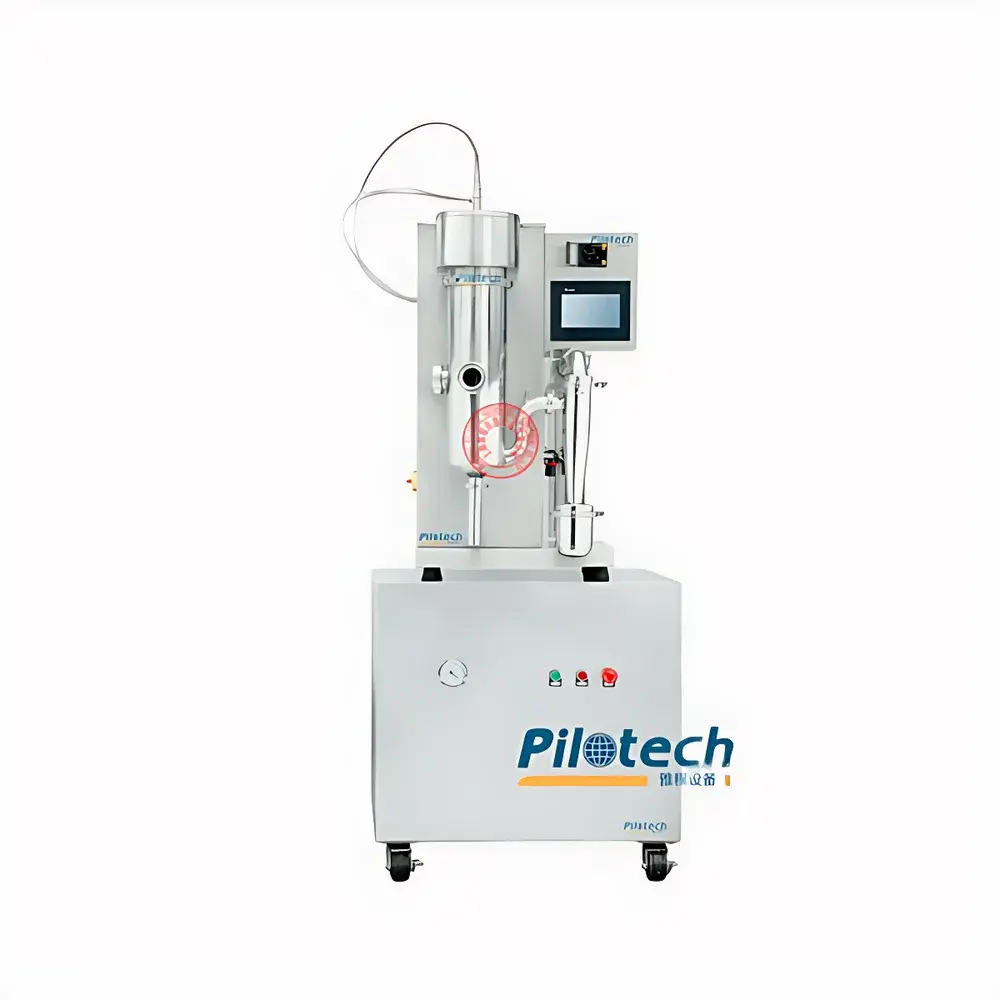
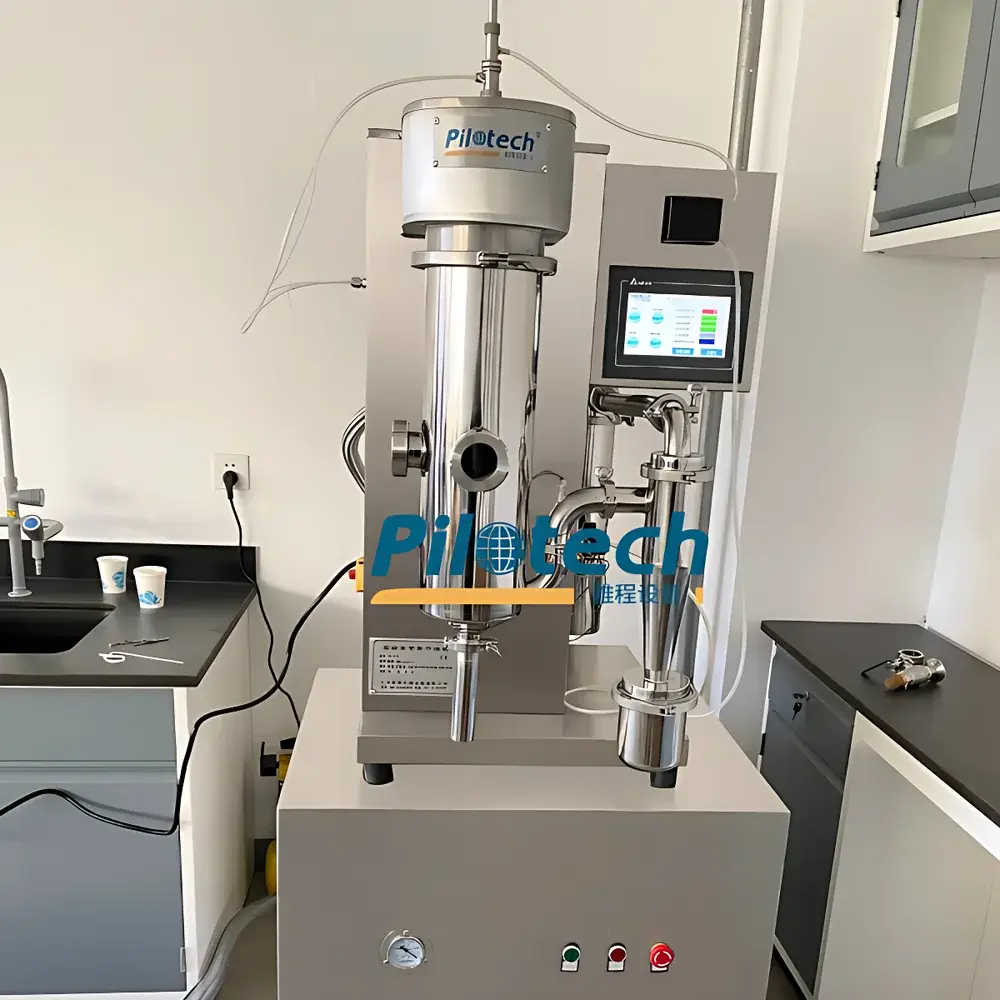
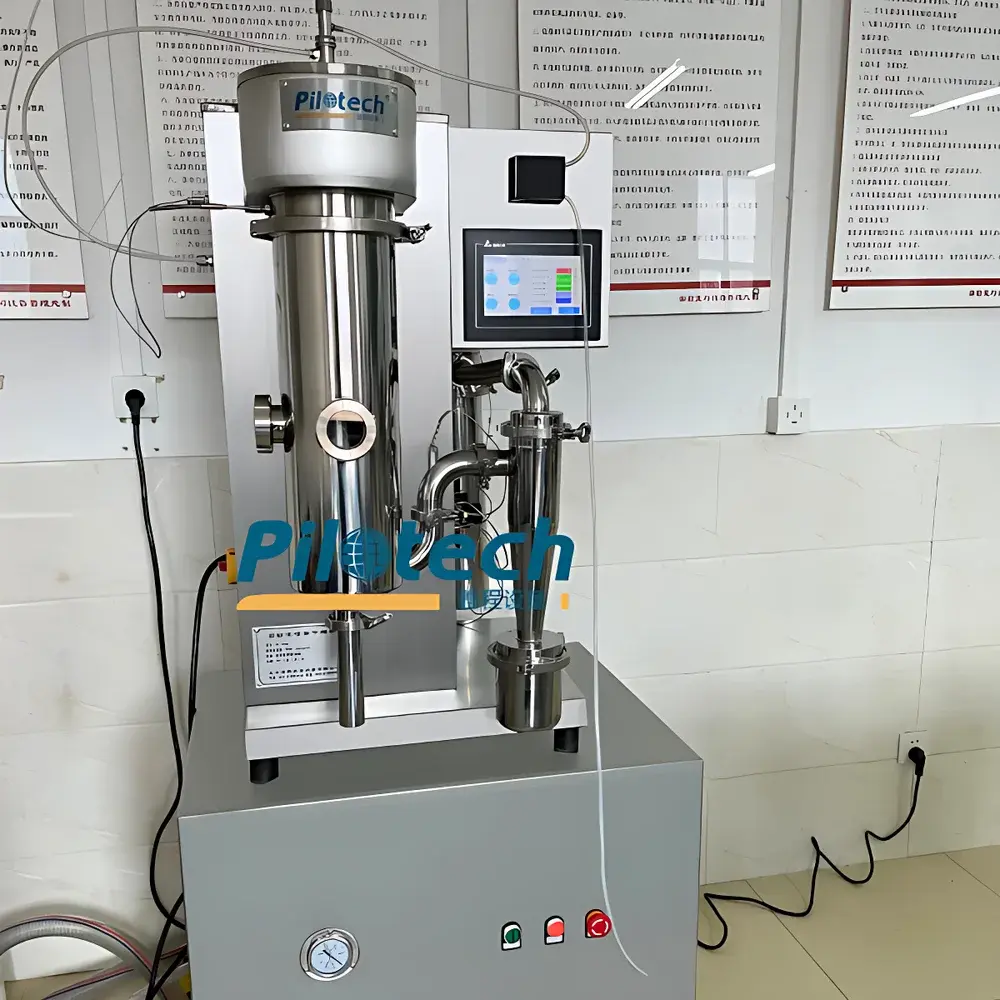
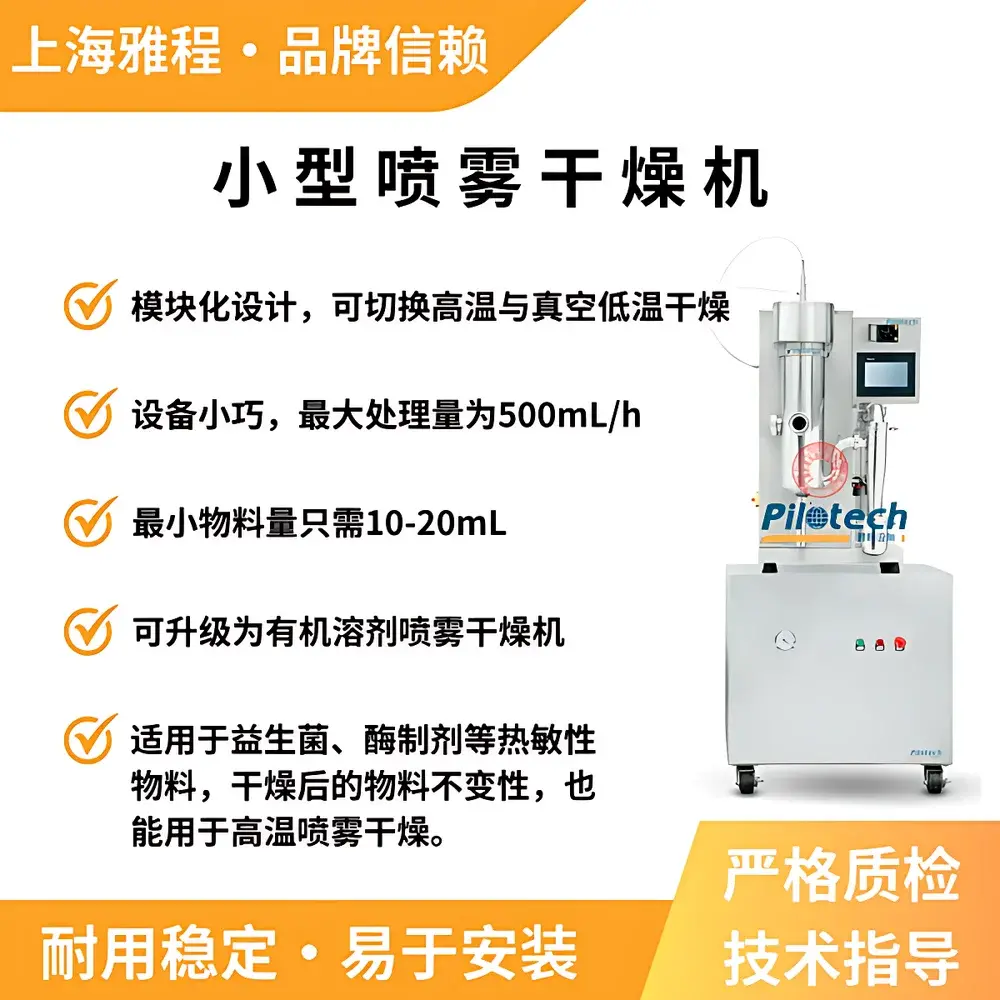
Yacheng / PILOTECH YC-510 Benchtop Vacuum-Assisted Low-Temperature Spray Dryer
| Brand | Yacheng / PILOTECH |
|---|---|
| Origin | Shanghai, China |
| Manufacturer Type | Direct Manufacturer |
| Country of Origin | China |
| Model | YC-510 |
| Maximum Feed Rate | 500 mL/h |
| Inlet Air Temperature Range | 50–200 °C |
| Vacuum Level | −0.08 MPa |
| Particle Size Range | 1–25 µm |
| Temperature Control Accuracy | ±1 °C |
| Nozzle Orifice | 1.0 mm standard (0.5/0.8/1.5/2.0 mm optional) |
| Minimum Sample Volume | 10–20 mL |
| Final Moisture Content | <1% w/w |
| Construction Material | Full 316L Stainless Steel |
| Power Rating | 3.5 kW |
Overview
The Yacheng PILOTECH YC-510 Benchtop Vacuum-Assisted Low-Temperature Spray Dryer is an engineered solution for the gentle, scalable drying of thermolabile and oxidation-sensitive materials under controlled vacuum conditions. Unlike conventional atmospheric spray dryers—where inlet air temperatures typically exceed 120 °C—the YC-510 integrates a modular vacuum system that lowers the boiling point of solvents, enabling rapid solvent evaporation at inlet temperatures as low as 50 °C. This operational principle leverages reduced-pressure thermodynamics: by maintaining a stable vacuum level of −0.08 MPa, water and polar solvents vaporize efficiently below their standard atmospheric boiling points, minimizing thermal degradation, Maillard reactions, and structural denaturation. The system operates on coaxial two-fluid nozzle atomization, ensuring symmetrical droplet formation and uniform residence time distribution within the drying chamber—critical for reproducible particle morphology and residual moisture control (<1% w/w). Designed specifically for laboratory-scale process development, it bridges the gap between feasibility studies and pilot-scale transfer, supporting formulation optimization for biologics, natural extracts, polymeric nanoparticles, and functional food ingredients.
Key Features
- Modular architecture: Independent benchtop spray dryer unit and detachable vacuum module allow seamless switching between standard and vacuum-assisted operation without hardware reconfiguration.
- PID-controlled inlet air temperature regulation with real-time feedback loop; accuracy maintained within ±1 °C across the full 50–200 °C range.
- Coaxial stainless steel two-fluid nozzle (1.0 mm standard orifice; optional 0.5/0.8/1.5/2.0 mm) with vertical adjustability to optimize spray trajectory and wall deposition minimization.
- Full 316L stainless steel construction compliant with ISO 8573-1 Class 3 for particulate and oil-free compressed air compatibility.
- Integrated peristaltic feed pump with continuous flow rate adjustment (0–500 mL/h), enabling precise control over droplet size distribution and drying kinetics.
- 7-inch color LCD touchscreen interface with intuitive Chinese-English bilingual navigation and embedded data logging (timestamped temperature, pressure, feed rate, and runtime).
Sample Compatibility & Compliance
The YC-510 is validated for aqueous-based feedstocks containing heat-labile actives—including enzymes, probiotics, monoclonal antibody fragments, polysaccharide extracts, and amorphous polymers—with solid content ranging from 1% to 30% w/w. Its low-temperature vacuum mode preserves secondary and tertiary protein structure, as confirmed by post-drying circular dichroism (CD) and differential scanning calorimetry (DSC) analysis in peer-reviewed applications. The system conforms to GLP documentation requirements through audit-trail-enabled parameter logging and user-accessible calibration records. While not certified to ISO 22000 or FDA 21 CFR Part 11 out-of-the-box, its architecture supports integration into regulated environments via external electronic lab notebook (ELN) synchronization and manual SOP-driven validation protocols aligned with ICH Q5C and USP .
Software & Data Management
The embedded control firmware stores all operational parameters—including setpoints, actual values, alarms, and event timestamps—in non-volatile memory with CSV export capability via USB port. No proprietary software installation is required; exported logs are compatible with MATLAB, Python pandas, and JMP for statistical process analysis. System diagnostics include real-time vacuum stability monitoring, nozzle clogging detection via pressure differential trending, and thermal runaway prevention logic. Firmware updates are delivered via encrypted USB key with version-controlled release notes traceable to ISO/IEC 17025-compliant internal verification reports.
Applications
- Stabilization of live bacterial cultures (e.g., Lactobacillus, Bifidobacterium) into respirable or oral powder formulations without viability loss.
- Drying of high-sugar botanical extracts (e.g., ginsenosides, anthocyanins) to prevent caramelization and retain antioxidant capacity.
- Production of inhalable insulin or peptide microparticles with narrow aerodynamic diameter distribution (MMAD 1–5 µm) for pulmonary delivery studies.
- Rapid screening of polymer-drug conjugates (e.g., PLGA, chitosan) under varying Tg-dependent drying conditions.
- Preparation of catalyst-support precursors where thermal decomposition of metal nitrates must be avoided.
FAQ
Can the YC-510 handle organic solvents such as ethanol or acetone?
Yes—when configured with explosion-proof vacuum pump and inert gas purging option (N₂ or Ar), the system supports Class I, Division 2 solvent handling per NEC 500 standards. Consult factory for solvent compatibility matrix and ATEX certification pathways.
What is the typical drying residence time inside the chamber?
Under vacuum-assisted operation (50 °C inlet, −0.08 MPa), average droplet-to-particle residence time is 1.8–2.4 seconds, measured via high-speed imaging and validated against computational fluid dynamics (CFD) simulations.
Is remote monitoring supported?
The unit does not feature native Ethernet/Wi-Fi connectivity; however, analog 4–20 mA output signals for temperature and vacuum are provided for integration into centralized SCADA or DCS systems.
How is nozzle cleaning performed between runs?
The coaxial nozzle is fully disassemblable and ultrasonically cleanable. Optional heated nozzle purge function (up to 80 °C) prevents crystallization of high-viscosity feeds during shutdown.
Does the system meet Good Manufacturing Practice (GMP) design principles?
It adheres to GMP Annex 15 engineering principles—smooth surface finishes (Ra ≤ 0.8 µm), drainable geometry, and absence of dead legs—but requires site-specific qualification (IQ/OQ/PQ) to achieve regulatory compliance for clinical manufacturing use.



