
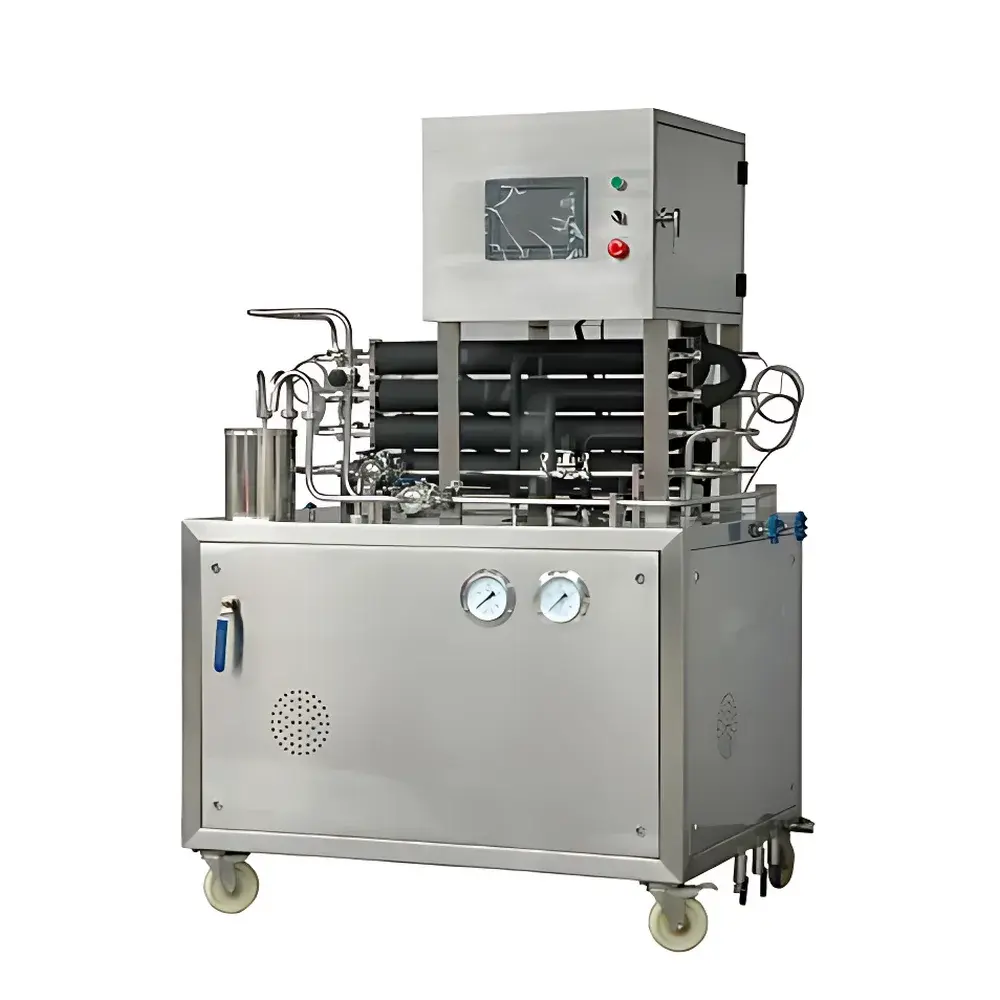
Yacheng YC-02 Pilot-Scale Ultra-High Temperature (UHT) Sterilization System
| Brand | Yacheng / PILOTECH |
|---|---|
| Origin | Shanghai, China |
| Manufacturer Type | OEM Manufacturer |
| Country of Origin | China |
| Model | YC-02 |
| Price | USD 67,500 (FOB Shanghai) |
| Rated Capacity | 20–25 L/h (adjustable flow: 5–50 L/h) |
| Minimum Sample Volume | 3–5 L |
| Sterilization Temperature Range | Up to 150 °C |
| Temperature Control Accuracy | ±0.5 °C (PID-controlled) |
| Sterilization Hold Time Options | 3, 5, 10, 30 s (optional up to 300 s) |
| Maximum System Pressure | 8 bar |
| CIP Flow Rate | 400 L/h |
| Product Transfer Pump | SEEPH (Germany) Sanitary Screw Pump (5–25 L/h) |
| Heating Medium | Integrated Overheated Water Generator |
| Cooling | Dual-stage Tubular Heat Exchangers (tap water final cooling to ~25 °C) |
| SIP Capability | Yes |
| Construction Material | AISI 316L Stainless Steel |
| Dimensions (H×L×W) | 1650 × 1150 × 910 mm |
| Power Rating | 10 kW |
| Control System | PLC with 10.4″ Color Touchscreen HMI |
| Data Export | USB export to Excel (.xlsx), direct print support |
| Compliance | Designed per EHEDG Guideline EL-1, FDA 21 CFR Part 11-ready architecture (audit trail, user access levels, electronic signature optional) |
Overview
The Yacheng YC-02 Pilot-Scale Ultra-High Temperature (UHT) Sterilization System is a fully integrated, bench-to-pilot thermal processing platform engineered for precise simulation of industrial UHT processing conditions in academic laboratories, R&D centers, and ingredient development facilities. It operates on the principle of continuous indirect heating via tubular heat exchangers—preheating, sterilization (holding), and cooling—enabling controlled thermal treatment of liquid foods, dairy formulations, plant-based beverages, flavor emulsions, and functional suspensions. Unlike batch autoclaves or steam-injected systems, the YC-02 replicates true industrial-scale residence time distribution (RTD), temperature-time profiles, and pressure dynamics. Its modular architecture supports both sterile and non-sterile thermal process validation, including thermal death time (TDT) studies, D-value/z-value determination, and shelf-life modeling under accelerated stability protocols. The system complies with fundamental hygienic design principles outlined in EHEDG Guideline EL-1 and ISO 13485-aligned documentation practices for process equipment qualification.
Key Features
- Continuous-flow UHT processing with adjustable hold times (3–300 s) and temperature control from ambient to 150 °C, calibrated to ±0.5 °C across full operating range using real-time PID feedback loops
- SEEPH (Germany) sanitary screw pump with integrated self-CIP capability—eliminates disassembly for cleaning and ensures consistent flow performance across viscosity ranges (1–5,000 mPa·s) and particulate loadings (up to 5 mm fiber/particle size)
- Dual-mode operation: “Quick Mode” enables one-touch startup with animated process visualization; “Manual Mode” permits real-time parameter override during experimentation for kinetic profiling or deviation testing
- Onboard overheated water generator and dual high-temperature circulation pumps ensure stable thermal energy delivery without external boiler dependency
- Tubular preheating (2 stages) and cooling (1 stage) sections constructed from electropolished AISI 316L stainless steel, validated for cleanability per ISO 14159 and ASME BPE surface finish standards (Ra ≤ 0.4 µm)
- Integrated pressure monitoring with digital transducers displayed live on HMI—supports back-pressure regulation via membrane-type control valves and overpressure relief safety circuits
- Optional sterile filling module featuring a 10-L jacketed buffer tank and single-head aseptic valve, equipped with SIP components for terminal sterilization of product contact surfaces
Sample Compatibility & Compliance
The YC-02 accommodates complex fluid matrices including low- to high-viscosity liquids (e.g., skim milk, soy beverage, juice concentrates), suspensions containing insoluble fibers (e.g., fruit pulp, herbal extracts), and oil-in-water emulsions (e.g., vanilla or citrus flavor dispersions). Its wide operational window (flow: 5–50 L/h; pressure: up to 8 bar; temperature: 20–150 °C) allows reproducible thermal treatment of samples ranging from 3 L (minimum test volume) to sustained 25 L/h pilot runs. All wetted parts conform to FDA 21 CFR 177.2600 for food-contact polymers and EU Regulation (EC) No. 1935/2004. The system supports IQ/OQ documentation packages and is compatible with GMP/GLP environments when configured with 21 CFR Part 11-compliant software modules (user authentication, electronic signatures, immutable audit trails).
Software & Data Management
The embedded Siemens S7-1200 PLC and 10.4″ touchscreen HMI run proprietary process control firmware supporting multi-language UI (English default), recipe-based method storage (≥100 protocols), and real-time graphical display of temperature, pressure, flow, and valve positions. All process data—including time-stamped sterilization curves, hold time verification logs, and CIP/SIP cycle reports—are timestamped, digitally signed, and exportable directly to Excel (.xlsx) via USB interface. Data structure follows ASTM E2500-13 guidelines for raw data integrity, enabling seamless integration into LIMS or statistical process analysis tools (e.g., JMP, Minitab). Optional add-ons include OPC UA server for MES connectivity and PDF report generation with digital certification stamps.
Applications
- Thermal process validation for novel plant-based milks, probiotic beverages, and clean-label sauces requiring precise lethality (F0) control
- Accelerated shelf-life testing under defined thermal histories to predict microbial stability and chemical degradation (e.g., Maillard browning, vitamin C loss)
- Development and optimization of aseptic packaging compatibility—evaluating fill temperature effects on container integrity and seal performance
- Regulatory dossier preparation for novel food submissions (EFSA, FDA GRAS, Health Canada), including thermal resistance parameter derivation (D-, z-values) for target microorganisms
- Scale-up correlation studies: correlating lab-scale UHT parameters (T, t, ΔP) with commercial production line outcomes using dimensionless numbers (e.g., Reynolds, Peclet)
FAQ
What is the minimum sample volume required for a valid UHT run?
The system is validated for reliable thermal profiling starting at 3 L; however, ≥5 L is recommended to ensure stable flow dynamics and representative residence time distribution.
Can the YC-02 be used for low-acid food sterilization validation (e.g., pH >4.6)?
Yes—when operated at ≥135 °C for ≥3 s with verified hold time accuracy and pressure-controlled backflow prevention, it meets FDA 21 CFR 113 requirements for thermal process establishment.
Is third-party calibration and qualification support available?
Yacheng provides IQ/OQ documentation templates and collaborates with ISO/IEC 17025-accredited service providers for on-site sensor calibration, RTD mapping, and thermal profile validation.
Does the system support automated cleaning validation (e.g., conductivity-based rinse endpoint detection)?
Standard configuration includes CIP conductivity monitoring; optional upgrade adds turbidity and TOC sensors for enhanced cleaning verification per ASTM E3079-17.
How is traceability ensured for regulatory audits?
All critical process parameters are logged with millisecond timestamps, user ID, and digital signatures. Audit logs record login/logout events, parameter changes, and alarm acknowledgments—fully compliant with ALCOA+ data integrity principles.





