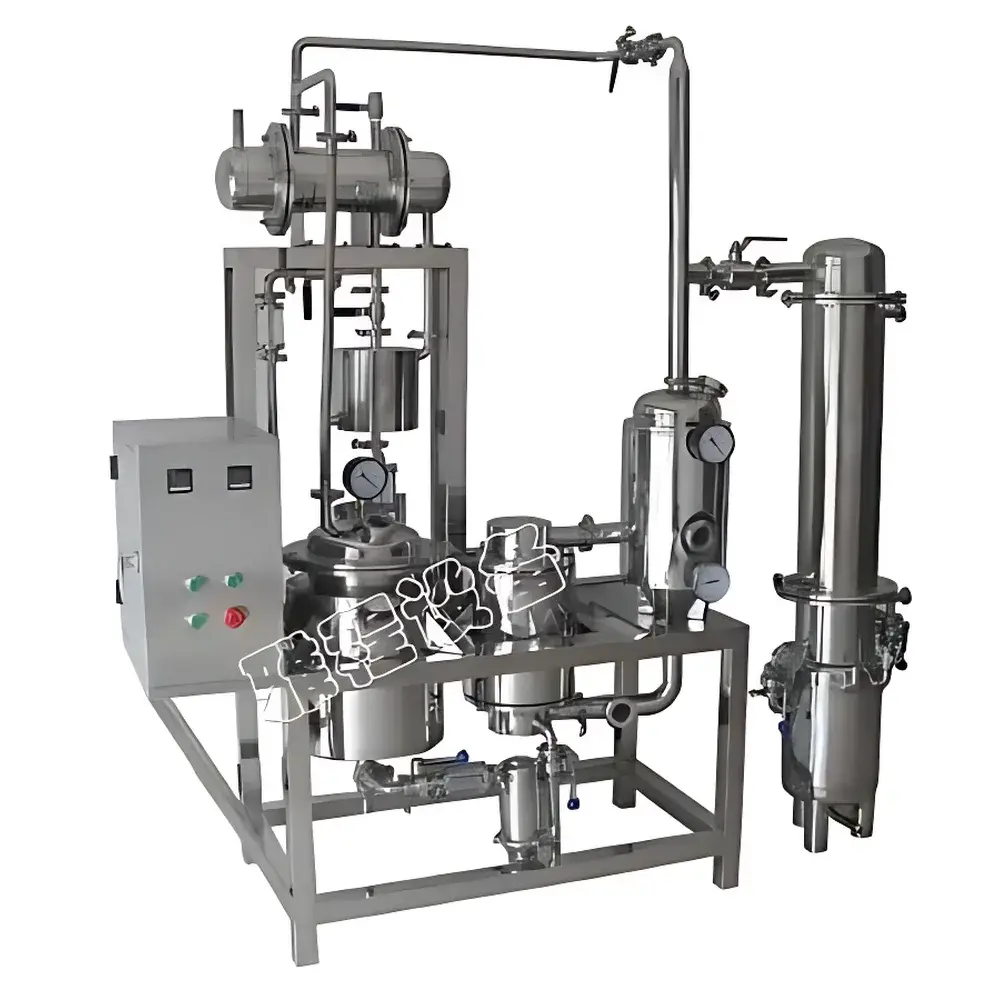
YaCheng YC-020 Pilot-Scale Multifunctional Extraction, Concentration & Solvent Recovery System
| Brand | YaCheng / PILOTECH |
|---|---|
| Origin | Shanghai, China |
| Manufacturer Type | Direct Manufacturer |
| Model | YC-020 |
| Extraction Vessel Volume | 0.025 m³ |
| Batch Feed Capacity | 0.3–5 kg |
| Minimum Feed | 0.3 kg |
| Evaporation Rate (Water) | 4–6 kg/h |
| Evaporator Vacuum Level | –0.08 MPa |
| Temperature Control Accuracy | ±2 °C |
| Heating Power | 4.5 kW @ 380 V |
| Cooling Water Consumption | 1 t/h @ <0.3 MPa |
| Construction Material | SUS304 Stainless Steel |
| Overall Dimensions | 1500 × 800 × 1900 mm |
| Footprint | ~2.4 m² |
Overview
The YaCheng YC-020 Pilot-Scale Multifunctional Extraction, Concentration & Solvent Recovery System is an integrated laboratory-to-pilot processing platform engineered for precise, repeatable, and GMP-aligned handling of thermolabile botanical matrices. It operates on three core unit processes—solid-liquid extraction, vacuum-assisted thin-film evaporation, and condensable solvent recovery—within a single closed-loop architecture. The system employs jacketed extraction via indirect conductive heating (thermal oil circulation), enabling safe operation with flammable solvents such as ethanol or ethyl acetate under both atmospheric and sub-atmospheric conditions. Its modular design integrates a 25-L extraction vessel with an external forced-circulation evaporator, allowing dynamic reflux, continuous concentration, and phase-separated aromatic oil recovery—all without manual transfer or open handling. This architecture eliminates exposure to volatile organics and minimizes thermal degradation through controlled temperature ramping and low-pressure evaporation.
Key Features
- Compact footprint (~2.4 m²) with full functionality: plug-and-play operation requiring only electrical supply (380 V, 4.5 kW), cooling water (1 t/h, <0.3 MPa), and standard lab utilities.
- Double-jacketed SUS304 extraction tank (0.025 m³) with precision PID temperature control (±2 °C) and programmable heating/holding profiles.
- Integrated reflux train comprising vertical condenser, coolant-cooled reflux cooler, and oil-water separator for quantitative recovery of volatile aromatic fractions (e.g., essential oils from herbs).
- Forced-circulation external evaporator with adjustable vacuum (up to –0.08 MPa), achieving concentration endpoints of 1.1–1.38 g/mL (specific gravity) while maintaining low bulk temperature.
- Complete solvent recovery loop: vaporized solvent passes through dedicated condenser-cooler assembly into stainless steel collection vessel; compatible with ethanol, methanol, acetone, and other low-boiling organics.
- Pressure-rated construction: validated for operation across full pressure spectrum—from vacuum (–0.08 MPa) to slight positive pressure—ensuring integrity during solvent distillation and inert gas purging.
- No internal pressure in heating jacket: thermal oil circuit is fully isolated from process zone, eliminating explosion risk during organic solvent processing.
Sample Compatibility & Compliance
The YC-020 accommodates diverse solid botanicals—including dried roots, leaves, flowers, and fruit peels—as well as tea infusions, fruit juices, and fermentation broths. Its non-reactive SUS304 wetted surfaces meet FDA-compliant material standards for food and pharmaceutical contact. While not certified to ISO 9001 or ASME BPVC by default, the system’s documentation-ready instrumentation (digital temperature loggers, vacuum gauges, flow indicators) supports alignment with GLP and GMP audit requirements. Process parameters—including time-stamped temperature, vacuum, and batch weight data—can be manually recorded or exported for 21 CFR Part 11–compatible traceability when interfaced with external LIMS or ELN systems. All valves, sight glasses, and sampling ports are designed to ASTM F2784–19 specifications for sanitary process equipment.
Software & Data Management
The YC-020 operates via hardwired industrial controls with analog/digital instrumentation—no embedded software or touchscreen interface. Critical parameters (vessel temperature, evaporator vacuum, coolant flow status) are displayed on calibrated panel meters with 4–20 mA output capability for third-party SCADA integration. Optional RS-485 Modbus RTU expansion enables connection to LabVIEW, Ignition, or DeltaV systems for automated logging, alarm triggering, and remote supervision. All operational records—including start/stop timestamps, setpoint deviations, and cooling water pressure alerts—are retained in paper-based SOP logs per institutional GLP protocols. No onboard data storage or user authentication is provided; data governance remains the responsibility of the end-user’s quality management system.
Applications
- Preliminary screening of extraction kinetics (e.g., diffusion-limited vs. equilibrium-driven release) using orthogonal solvents (water, 30–95% ethanol, glycerol/water mixtures).
- Process development for herbal injectables and standardized phytomedicines under Chinese Pharmacopoeia (ChP) and European Pharmacopoeia (Ph. Eur.) guidelines.
- Recovery and purification of heat-sensitive volatiles (e.g., limonene, eugenol, linalool) from citrus peel or clove bud extracts.
- Concentration of enzyme-rich fruit juice extracts (e.g., pineapple bromelain, papaya papain) below 45 °C to preserve activity.
- Solvent recycling studies supporting green chemistry metrics (E-factor, PMI) in academic and contract research settings.
- Validation of cold maceration vs. hot reflux protocols for polyphenol yield optimization in tea and berry extracts.
FAQ
What is the minimum batch size supported by the YC-020 system?
The system is validated for feed quantities as low as 0.3 kg per batch, making it suitable for high-value botanicals or early-stage formulation trials.
Can the unit perform alcohol precipitation (e.g., ethanol-induced polysaccharide flocculation)?
Yes—the sealed architecture permits controlled addition of precipitant solvents post-extraction, followed by vacuum-assisted decantation or filtration via optional auxiliary modules.
Is the evaporator compatible with viscous extracts above 1.2 g/mL density?
The forced-circulation design maintains turbulent flow even at elevated viscosities; however, sustained operation above 1.35 g/mL requires periodic mechanical cleaning of the evaporator tube bundle to prevent fouling.
Does the system include validation documentation (IQ/OQ/PQ templates)?
No factory-provided qualification packages are included; users must develop site-specific protocols aligned with their internal quality system and regulatory scope (e.g., USP , ISO/IEC 17025).
What maintenance intervals are recommended for the vacuum pump and thermal oil heater?
Vacuum pump oil replacement every 500 operating hours; thermal oil analysis (oxidation, acidity) annually or after 2,000 h runtime—per ASTM D92 and D97 test methods.