
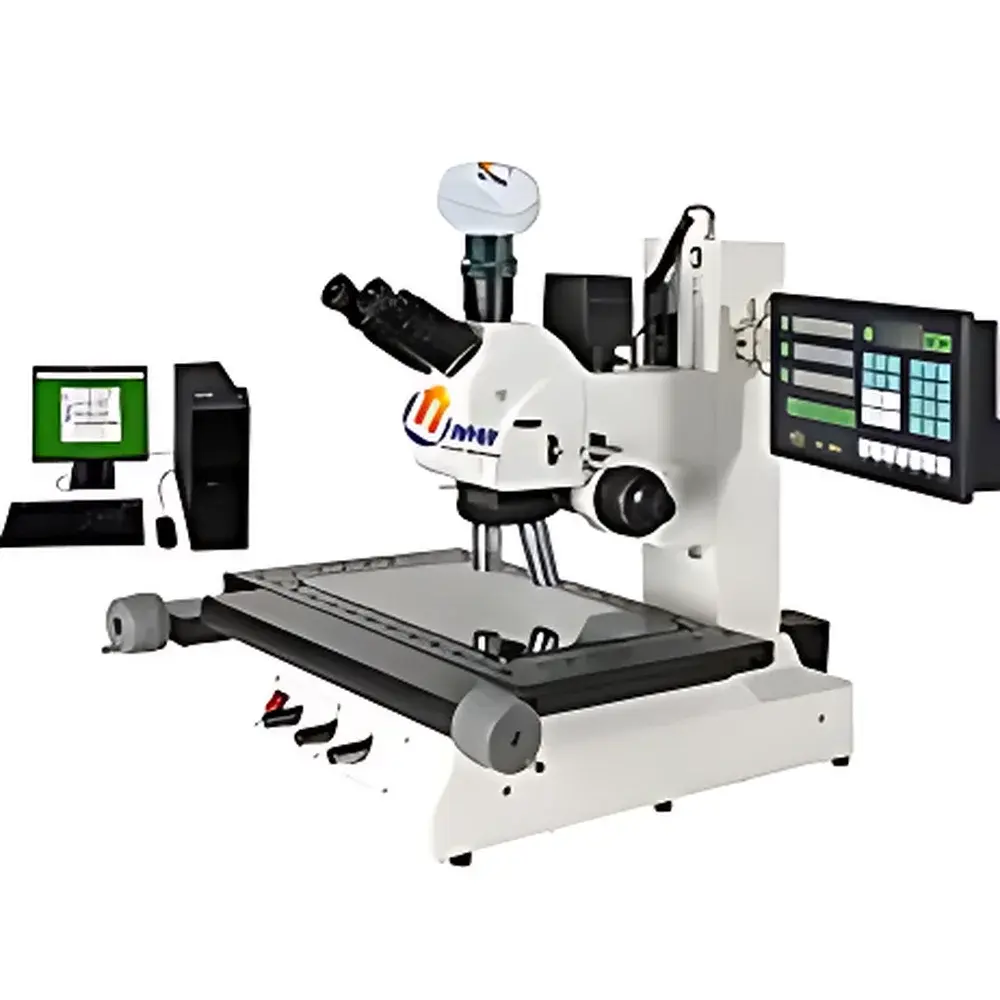
YANRUN 11XB-PC Research-Grade Inverted Metallurgical Microscope with Polarizing, Darkfield & Reflected/Transmitted Illumination
| Brand | YANRUN |
|---|---|
| Origin | Shanghai, China |
| Manufacturer Type | Direct Manufacturer |
| Product Category | Domestic (China) |
| Model | 11XB-PC |
| Configuration | Inverted |
| Eyepieces | Widefield 10× (23 mm FOV), Graticule Eyepiece 10× (20 mm FOV) with 0.1 mm Divisions |
| Objectives | Infinity-Corrected Plan Apochromatic Long Working Distance: 5×/0.15 (WD 44 mm), 10×/0.30 (WD 44 mm), 20×/0.35 (WD 44 mm), 50×/0.50 (WD 44 mm) |
| Nosepiece | Four-Position Revolving Turret with DIC Slot and Centering Adjustment |
| Stage | 290 × 290 mm Mechanical Stage with 100 × 100 mm Travel Range and X/Y Rapid-Drive Mechanism |
| Focus System | Coaxial Coarse/Fine Focus |
| Fine Focus Graduation | 2 µm per Division |
| Z-Axis Vertical Travel | 150 mm |
| Illumination | Köhler Surface Illumination (12 V/50 W Halogen, AC 85–230 V, Continuous Brightness Control) + Telecentric Outline Illumination (12 V/50 W Halogen, AC 85–230 V) |
| Polarization System | Rotatable Analyzer (0–360°), Removable Polarizer and Analyzer |
| Display Interface | 0.5 µm Resolution Measurement Capability, Zero-Set Function, Axis Orientation Flip, Data Export (TTL-compatible Output) |
| Calibration Standard | 0.01 mm Stage Micrometer |
| Included Accessories | Main Unit, Trinocular Head (Upright Image, 30° Inclined, Interpupillary Adjustment 50–75 mm), Pair of 10× Eyepieces, Full Objective Set (5×, 10×, 20×, 50×), Two 12 V/50 W Halogen Lamps, Full Polarizing Kit, CCD Camera (Standard), 0.5× C-Mount Adapter, Documentation Set (Certificate of Conformance, Warranty Card, Manual) |
Overview
The YANRUN 11XB-PC is a research-grade inverted metallurgical microscope engineered for high-fidelity microstructural analysis of opaque, polished, and etched metallic specimens — including alloys, castings, welds, and additive-manufactured components. Its inverted optical architecture positions the objective lenses beneath the specimen stage, enabling stable, vibration-resistant observation of large, heavy, or irregularly shaped samples commonly encountered in industrial metallurgy labs and failure analysis centers. The system integrates three complementary illumination modalities: reflected brightfield (Köhler-optimized), transmitted light (for semi-transparent or thin-sectioned materials), and darkfield — all supported by precision polarization optics. This multi-modal capability allows users to resolve grain boundaries, phase distributions, inclusion morphology, dislocation networks, and interfacial defects with enhanced contrast and quantitative repeatability. The microscope adheres to ISO 10967 (Metallographic Microscopy — Terminology and Definitions) and supports compliance with ASTM E3, ASTM E112 (grain size determination), and ISO 643 (microstructure classification), making it suitable for accredited quality control laboratories operating under GLP or internal QA/QC protocols.
Key Features
- Inverted configuration with 150 mm vertical clearance and 100 × 100 mm motor-ready mechanical stage — optimized for bulky specimens up to 10 kg and compatible with thermal stages or environmental chambers.
- Infinity-corrected plan apochromatic long-working-distance objectives (5× to 50×) deliver flat-field imaging, chromatic aberration correction across visible spectrum, and consistent 44 mm working distance — critical for safe operation with immersion media or protective covers.
- Dual halogen illumination system: surface Köhler illumination with adjustable aperture and field diaphragms ensures uniform intensity and optimal resolution; telecentric outline illumination eliminates perspective distortion for precise dimensional metrology.
- Full polarizing module with rotatable analyzer (0–360° calibrated scale) and removable polarizer/analyzer elements enables birefringence evaluation, stress-induced dichroism mapping, and anisotropic phase identification — essential for aluminum, titanium, and nickel-based superalloys.
- Coaxial coarse/fine focus mechanism with 2 µm fine-focus graduation and backlash-free micrometer drive ensures sub-micron focusing repeatability across extended acquisition sessions.
- Trinocular head with upright-image optics and 30° inclined eyepieces (interpupillary range: 50–75 mm) provides ergonomic viewing and seamless integration with digital imaging systems via C-mount interface.
Sample Compatibility & Compliance
The 11XB-PC accommodates standard metallographic mounts (30 mm, 40 mm, 50 mm diameter) and custom fixtures up to 120 mm in height. Its robust stage design supports both manual and motorized Z-axis extension options for future automation. The system complies with IEC 61000-6-3 (EMC emissions) and IEC 61000-6-2 (immunity), and its electrical safety conforms to IEC 61010-1 for laboratory equipment. While the base configuration includes a standard CCD camera and 0.5× adapter, optional upgrades include high-resolution CMOS sensors (up to 12 MP), USB 3.0 or GigE interfaces, and hardware-triggered acquisition synchronized to TTL signals — facilitating integration into automated inspection lines governed by ISO/IEC 17025 or automotive IATF 16949 workflows.
Software & Data Management
Though the standard package does not include proprietary image analysis software, the microscope’s analog/digital video output (composite video + TTL trigger) is fully compatible with third-party platforms such as Olympus cellSens, Zeiss ZEN Core, or open-source tools like FIJI/ImageJ. All measurement functions — including linear distance, area, particle count, and grain size (ASTM E112-compliant intercept method) — are accessible via external software when paired with the included 0.01 mm stage micrometer and calibrated pixel scaling. For regulated environments, optional audit-trail-enabled software modules support 21 CFR Part 11 compliance through electronic signatures, user access controls, and immutable metadata logging — meeting documentation requirements for aerospace NADCAP or medical device ISO 13485 audits.
Applications
- Quantitative metallography: grain size distribution, phase fraction analysis, inclusion rating (ASTM E45), and carbide network assessment in tool steels and stainless grades.
- Failure analysis: crack propagation path mapping, fatigue striation measurement, and brittle/ductile fracture mode differentiation.
- Weld metallurgy: HAZ characterization, fusion line delineation, and porosity quantification in arc, laser, and electron beam welds.
- Advanced manufacturing: microstructure verification of LPBF and EBM additively manufactured parts, including melt pool geometry and residual stress-induced birefringence patterns.
- Research & development: in-situ thermal cycling studies (with optional stage), corrosion product layer thickness measurement, and intermetallic compound identification using polarization contrast.
FAQ
Is the 11XB-PC compliant with ISO or ASTM standards for metallographic analysis?
Yes — its optical performance, illumination geometry, and stage calibration meet the foundational requirements of ISO 10967, ASTM E3, and ASTM E112. When used with traceable calibration standards and validated software, it supports full compliance in accredited testing laboratories.
Can the microscope be upgraded to support automated image acquisition and reporting?
Yes — the trinocular port, TTL synchronization signal, and standardized C-mount interface allow integration with motorized stages, autofocus modules, and LIMS-connected software suites. Optional high-resolution cameras and analysis packages are available for GxP-aligned workflows.
What is the maximum specimen weight and height supported?
The inverted design accommodates specimens up to 10 kg in mass and 120 mm in vertical profile, with full Z-axis travel (150 mm) and unobstructed stage access for mounting jigs or heating elements.
Does the system support DIC (Differential Interference Contrast)?
Yes — the four-position nosepiece includes dedicated slots for DIC prisms, and the optical path is pre-aligned for rapid insertion of Nomarski-style contrast enhancement modules without realignment.
Are replacement halogen lamps and calibration standards supplied with traceable certification?
Standard delivery includes two 12 V/50 W halogen lamps and a 0.01 mm stage micrometer. NIST-traceable calibration certificates for the micrometer and optional lamp spectral output reports are available upon request for metrological validation.



