
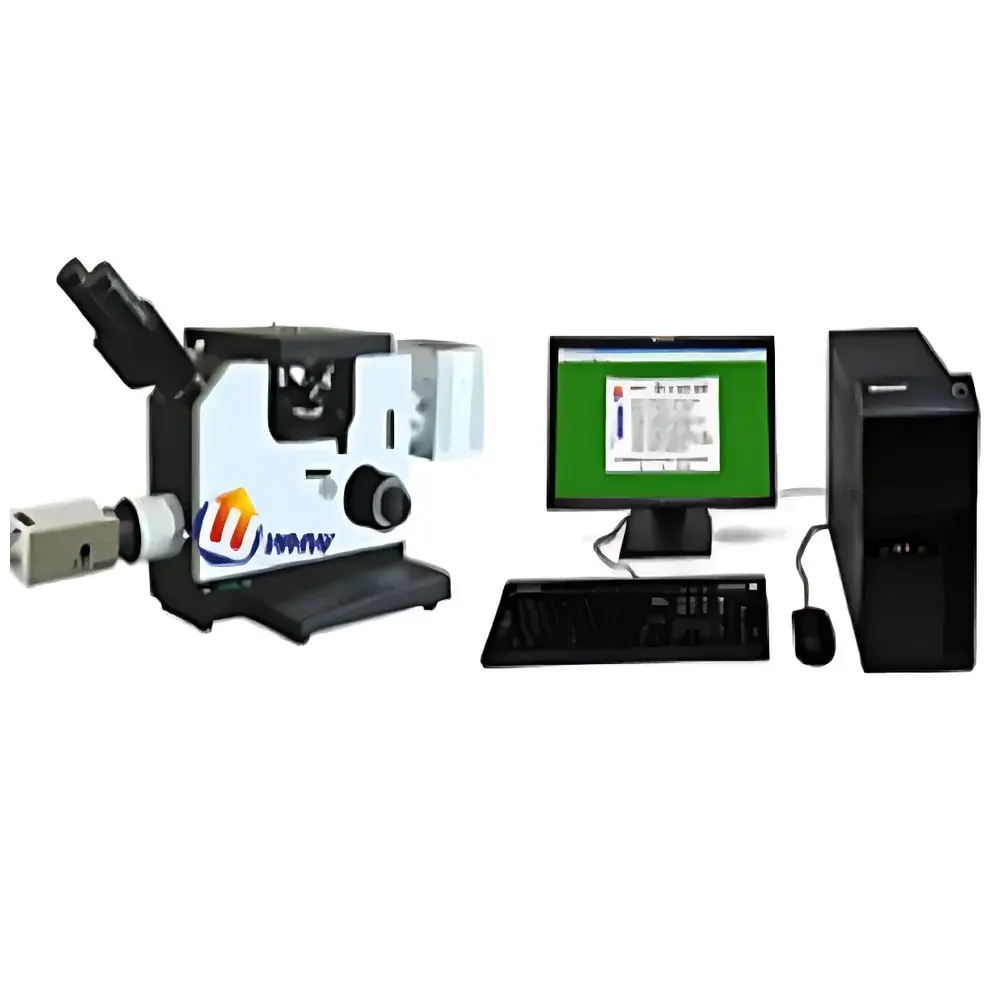
YANRUN AMM-8D Large-Scale R&D Digital Inverted Horizontal Metallurgical Microscope
| Brand | YANRUN |
|---|---|
| Origin | Shanghai, China |
| Manufacturer Type | Direct Manufacturer |
| Product Category | Domestic |
| Model | AMM-8D Large-Scale R&D Digital Inverted Horizontal Metallurgical Microscope |
| Mounting Configuration | Inverted |
| Image Analysis System | Not Included (Optional Add-on) |
| Optical Total Magnification | 40×–400× |
| Optional Total Magnification (with Auxiliary Lenses/Cameras) | 25×–1000× |
| Eyepieces | Wide-Field WF10X (Φ18 mm) |
| Objective Lenses | 4×, 10×, 20×, 40× (Standard) |
| Optional | Plan Achromatic 2.5× (NA 0.07), 100× (Oil Immersion) |
| Coaxial Coarse/Fine Focus Travel | 15 mm / 0.002 mm (2 µm) per Division |
| Mechanical Stage | Dual-Layer, 180 × 155 mm Platform, 75 × 50 mm Travel Range |
| Illumination | Reflected Halogen Lamp, 6 V / 30 W, Continuously Adjustable Brightness |
| Power Supply | 220 V AC, 50 Hz |
Overview
The YANRUN AMM-8D is a high-stability inverted horizontal metallurgical microscope engineered for rigorous materials science research, failure analysis, and industrial quality control laboratories. Its inverted optical architecture positions the objective lenses beneath the specimen stage—enabling direct observation of large, heavy, or irregularly shaped metallographic samples (e.g., castings, weldments, heat-treated components, or mounted cross-sections up to 50 mm in height) without mechanical interference from focusing mechanisms or condenser assemblies. The system operates on the principle of reflected brightfield and optional darkfield illumination, optimized for opaque, polished, and etched metallic surfaces. Designed with a rigid cast-aluminum base and precision-machined optical pathway, the AMM-8D ensures long-term mechanical stability and minimal thermal drift—critical for extended imaging sessions and comparative microstructural documentation across time or sample batches.
Key Features
- Inverted horizontal configuration with 45° inclined trinocular head, accommodating both binocular viewing and simultaneous digital imaging via C-mount port.
- Wide-field WF10X eyepieces (Φ18 mm field number) provide ergonomic observation and consistent depth-of-field across magnifications; optional wide-angle 10X (Φ20 mm) and Huygens 5X eyepieces support specialized low-magnification survey work.
- Four standard plan achromatic objectives (4×, 10×, 20×, 40×) deliver high contrast and minimal chromatic aberration at metallurgical working distances; optional 2.5× (WD 35 mm) and oil-immersion 100× objectives extend analytical flexibility for macro-structural screening and fine precipitate resolution.
- Coaxial coarse/fine focusing mechanism with 15 mm vertical travel and 0.002 mm (2 µm) fine-focus graduation enables precise Z-axis positioning—essential for focus stacking and serial sectioning workflows.
- Dual-layer mechanical stage (180 × 155 mm) with 75 × 50 mm translation range and calibrated vernier scales supports repeatable coordinate-based navigation and multi-site correlation across large specimens.
- Adjustable 6 V / 30 W halogen illuminator with continuous intensity control ensures optimal contrast for diverse surface conditions—from as-polished aluminum alloys to deeply etched ferritic-pearlitic steels—without spectral shift or thermal loading.
Sample Compatibility & Compliance
The AMM-8D accommodates specimens up to 50 mm in height and 180 mm in width, making it suitable for bulk metallography, weld bead analysis, coating thickness evaluation, and inclusion rating per ASTM E45 or ISO 4967. Its inverted design eliminates the need for sample inversion or complex mounting adapters, reducing preparation-induced artifacts. The optical train conforms to ISO 8578 (metallurgical microscope performance standards) and supports calibration traceability per ISO/IEC 17025 when used with NIST-traceable stage micrometers and resolution test targets. While the base configuration does not include image analysis software, all optional digital imaging packages are compatible with third-party metrology platforms compliant with ASTM E1245 (quantitative metallography) and USP (digital imaging validation).
Software & Data Management
The AMM-8D is supplied with standardized C-mount interface (1× magnification) for integration with USB3.0 or HDMI digital cameras (not included). When configured with optional video/image processing systems, it supports TIFF/RAW acquisition, multi-channel brightness/contrast mapping, and annotation with scale bars and metadata (magnification, objective, exposure time). All digital configurations maintain audit-trail-ready file naming conventions and can be integrated into laboratory information management systems (LIMS) supporting GLP/GMP workflows. For regulated environments, optional software modules comply with FDA 21 CFR Part 11 requirements—including electronic signatures, user access controls, and immutable acquisition logs.
Applications
- Microstructural characterization of ferrous and non-ferrous alloys (grain size measurement per ASTM E112, phase fraction analysis).
- Weld inspection and heat-affected zone (HAZ) evaluation in structural steel and aerospace titanium alloys.
- Failure analysis of fracture surfaces, fatigue striations, and corrosion morphology.
- Coating adhesion assessment, porosity quantification, and interfacial reaction layer thickness measurement.
- Quality assurance in foundry, forging, and additive manufacturing processes—particularly for post-build microstructure verification.
- Academic and industrial R&D requiring reproducible, publication-grade photomicrography under standardized illumination conditions.
FAQ
Is the AMM-8D compatible with fluorescence or polarized light modules?
No—the standard configuration is optimized for reflected brightfield and darkfield illumination only. Polarization capability requires factory-installed analyzer/rotator accessories; fluorescence is not supported due to lack of excitation light source and filter turret.
What is the maximum specimen weight the stage can support?
The dual-layer mechanical stage is rated for static loads up to 15 kg; dynamic stability is maintained for specimens up to 8 kg during stage translation and focusing operations.
Can the microscope be calibrated for quantitative measurements?
Yes—when paired with a certified stage micrometer and NIST-traceable reference standards, the system supports calibration of pixel-to-micron ratios and magnification verification per ISO 9276-1 and ASTM E1382.
Does the AMM-8D meet CE or UL safety certification requirements?
The instrument complies with IEC 61000-6-3 (EMC emissions) and IEC 61010-1 (electrical safety for laboratory equipment); CE marking is available upon request for EU-market delivery.
Is remote operation or motorized focus available as an option?
Motorized Z-drive and programmable stage control are available as OEM-integrated upgrades, enabling automated tile-scan acquisition and batch-mode imaging protocols.



