
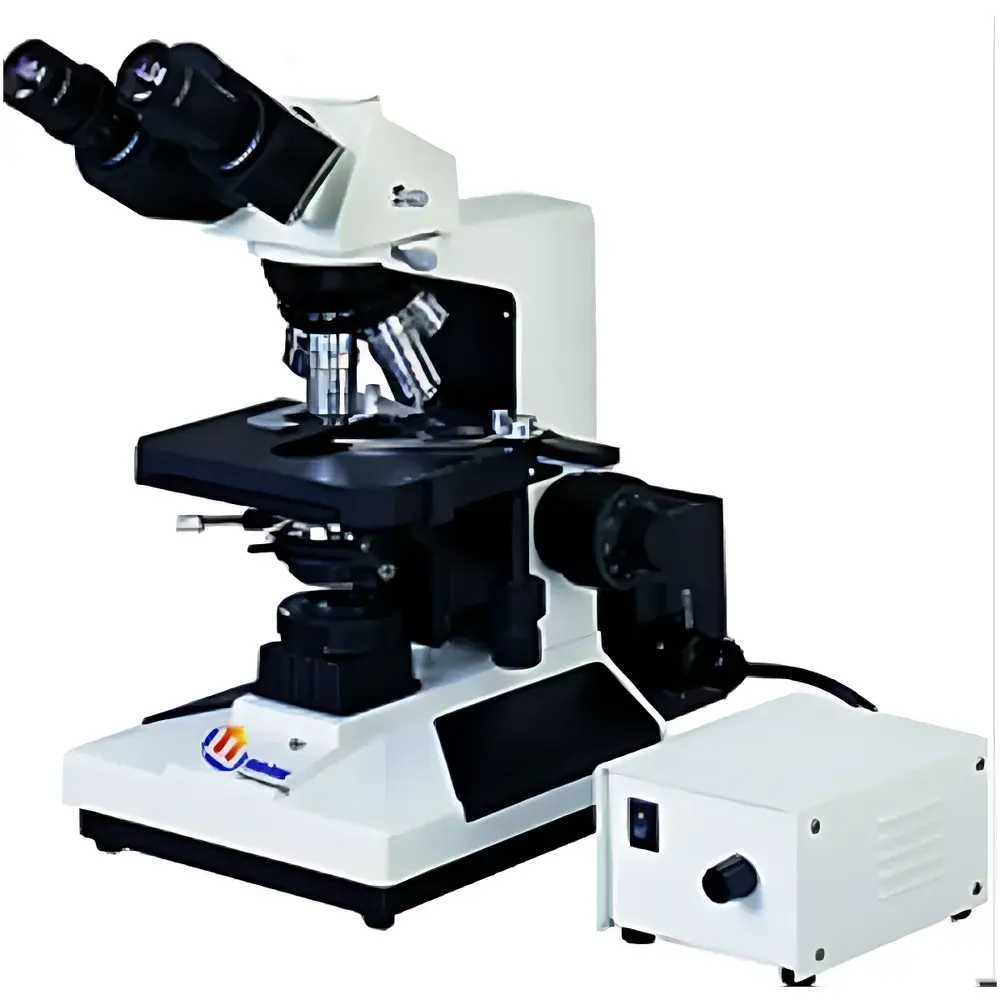
YANRUN BI-22 Biological Inverted Microscope
| Brand | YANRUN |
|---|---|
| Origin | Shanghai, China |
| Manufacturer Type | Direct Manufacturer |
| Product Category | Domestic (China-made) |
| Model | BI-22 Biological Inverted Microscope |
| Instrument Type | Inverted Microscope |
| Eyepiece Configuration | Binocular |
| Magnification Range | 40×–1000× |
| Eyepieces | Wide-field WF10× (Φ20 mm) |
| Objectives | Plan Achromatic 4×/0.10, 10×/0.25, 20×/0.40, 40×/0.65 (spring-loaded), 100×/1.25 (spring-loaded, oil immersion) |
| Interpupillary Adjustment | Adjustable binocular head, inclined at 30° |
| Focusing Mechanism | Coaxial coarse/fine focus with adjustable coarse tension, locking mechanism, and limit stop |
| fine focus graduation | 2 µm |
| Nosepiece | Quintuple revolving nosepiece with inward ball-bearing centering |
| Stage | Dual-layer mechanical stage (160 mm × 140 mm), travel range: 75 mm × 50 mm |
| Condenser | Abbe condenser, N.A. 1.25, vertically adjustable |
| Illumination | 12 V / 20 W halogen lamp with brightness control |
| Filters | Blue filter and ground glass |
| Collector | Halogen-compatible collector |
| Optional Accessories | Phase contrast kits (PH-I/PH-II condensers, PHP objectives), LED power adapters (9 V / 500 mA, 110 V or 230 V input), polarizing system (360° rotatable polarizer, push-pull analyzer), infinity-corrected optical pathway components, USB/VIDEO trinocular phototube |
Overview
The YANRUN BI-22 Biological Inverted Microscope is an engineered solution for routine and advanced life science observation, particularly suited for live-cell imaging, tissue culture monitoring, and long-term specimen assessment in adherent and suspension cultures. Its inverted optical architecture places the objective lenses beneath the specimen stage and the condenser above—enabling direct access to cell culture vessels (e.g., Petri dishes, flasks, and multi-well plates) without disturbing sample integrity or sterility. The microscope employs a finite-conjugate optical path with plan achromatic objectives and wide-field eyepieces, optimized for high-fidelity contrast, flatness of field, and chromatic correction across the visible spectrum. Designed for reproducible daily use in academic teaching labs, QC environments, and preclinical research settings, the BI-22 integrates Köhler illumination for uniform intensity distribution and minimizes thermal load on living specimens via its regulated 12 V / 20 W halogen source.
Key Features
- Binocular viewing head inclined at 30°, with interpupillary adjustment and diopter compensation for ergonomic extended observation.
- Coaxial coarse/fine focusing system featuring independently adjustable coarse-tension control, mechanical lock, upper/lower limit stops, and 2 µm fine-focus graduation—ensuring precise Z-axis positioning and repeatability.
- Quintuple nosepiece with inward ball-bearing centering for stable, repeatable objective alignment and minimal lateral drift during magnification changes.
- Dual-layer mechanical stage (160 mm × 140 mm) offering 75 mm × 50 mm travel range—compatible with standard cultureware and enabling accurate coordinate-based navigation.
- Abbe condenser (N.A. 1.25) with vertical adjustment and built-in iris diaphragm for optimal resolution and contrast control under brightfield conditions.
- Köhler illumination system with integrated blue filter and ground-glass diffuser—delivering even, glare-free illumination across the entire field of view.
- Modular design supporting seamless integration of phase contrast, polarization, and digital imaging accessories without optical realignment.
Sample Compatibility & Compliance
The BI-22 accommodates standard biological specimens housed in glass-bottom dishes, plastic-bottom multi-well plates, and T-flasks—making it suitable for time-lapse imaging of mammalian, insect, and plant cell lines. Its working distance at 10× and 20× objectives supports observation through up to 1.2 mm of vessel bottom thickness. While not certified for ISO 13485 or FDA 21 CFR Part 11 out-of-the-box, the platform meets foundational optical performance criteria aligned with ISO 8578 (microscopes — requirements and tests) and ASTM E2821 (standard guide for selection and use of microscopes in biological applications). When configured with phase contrast optics and calibrated eyepiece reticles, the system supports quantitative morphometric analysis compliant with GLP documentation workflows.
Software & Data Management
The BI-22 supports digital output via optional USB or analog VIDEO phototubes, enabling connection to third-party acquisition software (e.g., ImageJ-compatible drivers, NIS-Elements Lite, or open-source Micro-Manager). No proprietary firmware or closed SDK is embedded; all imaging functions are hardware-controlled via external capture devices. Metadata—including objective identification, magnification, and illumination state—is manually logged per acquisition session. For audit-trail compliance, users are advised to pair the microscope with timestamped image repositories and electronic lab notebooks (ELNs) that meet 21 CFR Part 11 requirements for electronic records.
Applications
- Monitoring confluence, morphology, and motility in adherent cell cultures (e.g., HeLa, NIH/3T3, primary fibroblasts).
- Assessing viability and proliferation in suspension cultures (e.g., hybridomas, lymphocytes) using trypan blue exclusion assays.
- Phase contrast imaging of unstained live specimens—including bacteria, protozoa, and early embryonic stages—without fixation or staining artifacts.
- Qualitative evaluation of transfection efficiency, GFP expression, and subcellular localization in transiently transfected cells.
- Educational demonstration of mitotic stages, cytoskeletal dynamics, and organelle movement in undergraduate and graduate laboratories.
- Pre-screening prior to higher-resolution modalities such as confocal or super-resolution microscopy.
FAQ
Is the BI-22 compatible with oil immersion objectives?
Yes—the 100×/1.25 NA spring-loaded objective is designed for immersion oil (Type A or B) and delivers maximum resolution at 400 nm wavelength.
Can I upgrade to infinity-corrected optics?
Optional infinity-corrected components—including matched eyepieces, objectives (4×–100×), and phase contrast condensers—are available as factory-validated add-ons.
Does the microscope support darkfield or fluorescence imaging?
Darkfield capability is achievable with optional dry or wet darkfield condensers; however, the BI-22 lacks built-in fluorescence excitation sources or dichroic filters—fluorescence requires external epi-illumination modules.
What is the warranty and service coverage?
YANRUN provides a 24-month limited warranty covering manufacturing defects; technical support and calibration services are available through authorized regional distributors.
Is the halogen illumination replaceable with LED?
Yes—two LED power adapter options (110 V and 230 V input, 9 V / 500 mA output) are offered for retrofitting with compatible cold-white LED modules, reducing heat emission and extending service life.





