
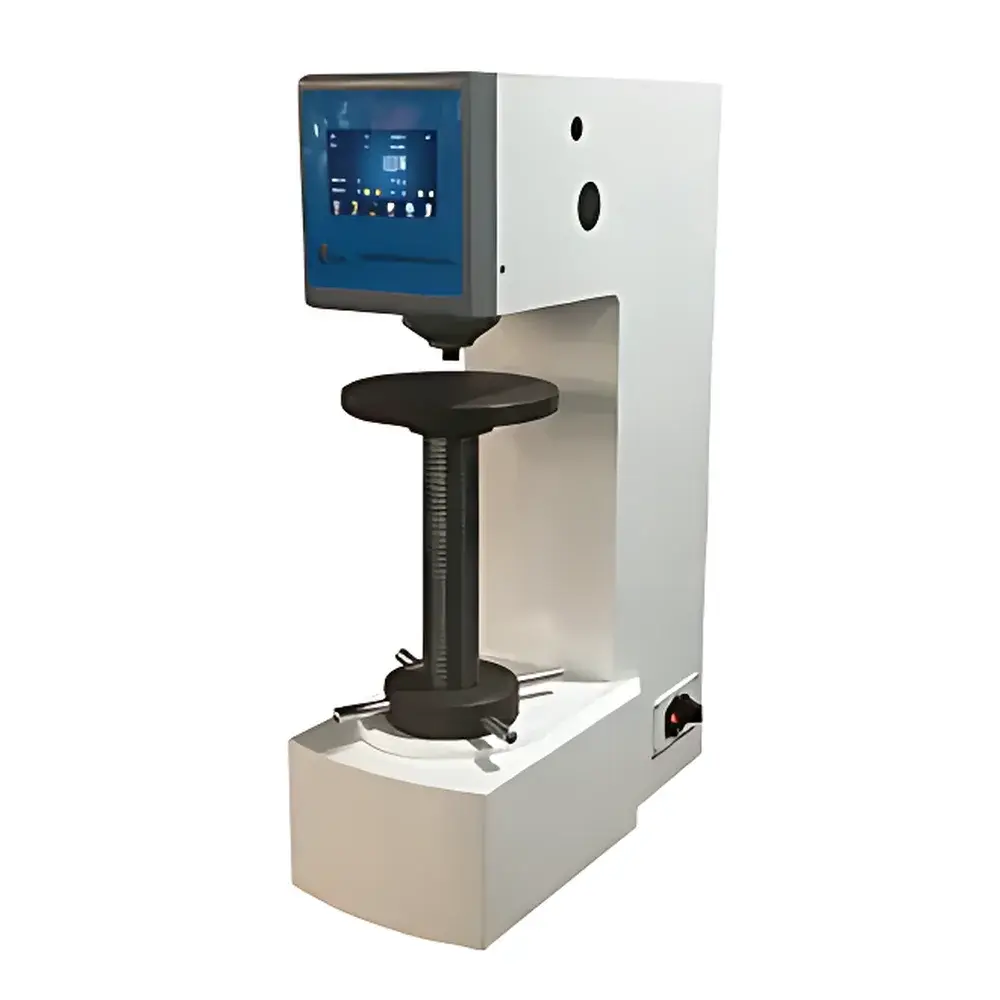
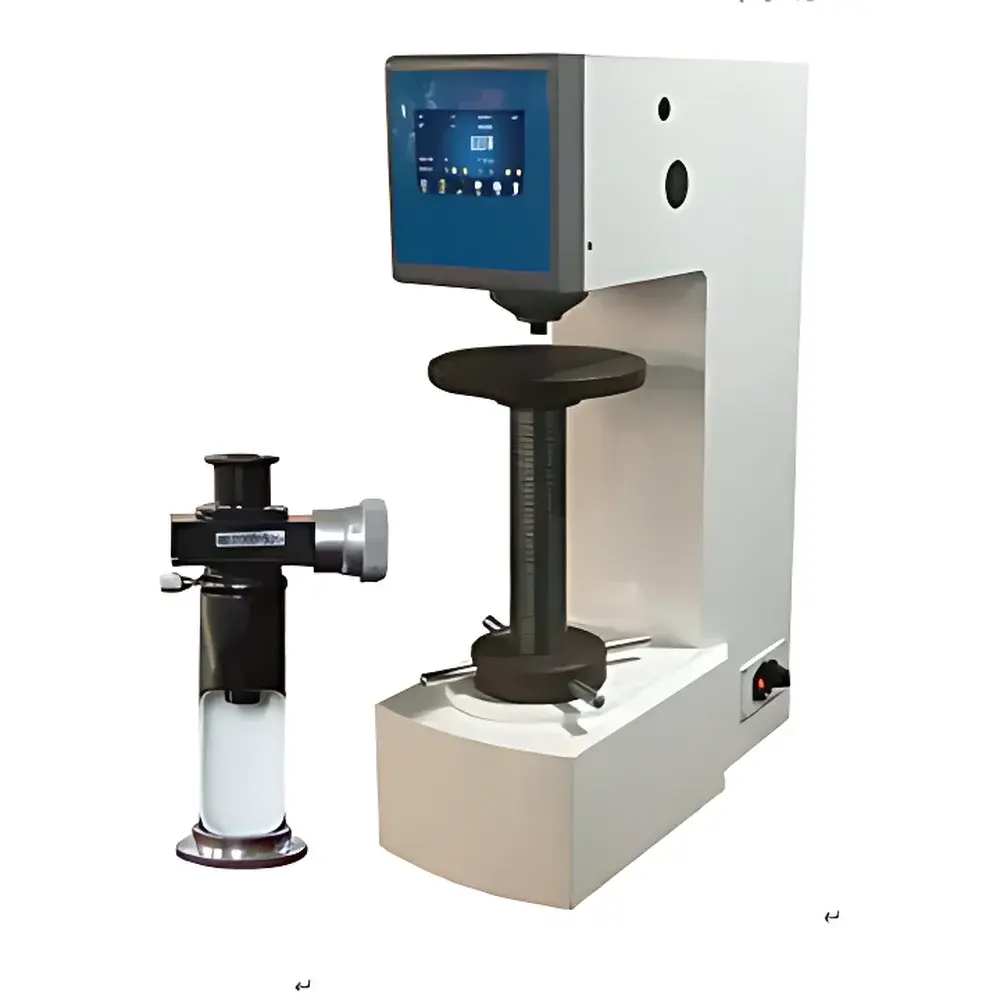
YANRUN HBE-3000C Digital Display Brinell Hardness Tester
| Brand | YANRUN |
|---|---|
| Origin | Shanghai, China |
| Manufacturer Type | Manufacturer |
| Product Type | Brinell Hardness Tester |
| Model | HBE-3000C |
| Measuring Range | 8–650 HBW |
| Test Forces | 62.5 kgf, 100 kgf, 125 kgf, 187.5 kgf, 250 kgf, 500 kgf, 750 kgf, 1000 kgf, 1500 kgf, 3000 kgf |
| Maximum Specimen Height | 220 mm |
| Depth from Indenter Center to Column | 155 mm |
| Test Space (H × D) | 235 mm × 155 mm |
| Indenter Diameters | 2.5 mm, 5 mm, 10 mm tungsten carbide balls |
| Eyepiece Magnification | 20× |
| Micrometer Eyepiece Resolution | 0.01 mm |
| Load Application | Motor-driven, closed-loop electronic force control |
| Dwell Time | 1–60 s (adjustable in 1 s increments) |
| Data Storage | Up to 30 test records |
| Hardness Scale Conversion | HRA, HRB, HRC, HRD, HEF, HK, HV, HR15N/30N/45N, HR15T/30T/45T, HBW |
| Compliance | GB/T 231.2, JJG 150 |
| Power Supply | AC 220 V |
| Dimensions (W × D × H) | 520 × 230 × 750 mm |
| Weight | ~130 kg |
Overview
The YANRUN HBE-3000C Digital Display Brinell Hardness Tester is a precision mechanical testing instrument engineered for reliable and repeatable Brinell hardness measurements in industrial quality control laboratories, metallurgical research facilities, and academic materials science departments. Based on the standardized Brinell indentation principle—where a hardened tungsten carbide ball indenter is applied under controlled static load for a defined dwell time—the HBE-3000C measures the permanent deformation diameter to calculate hardness according to HBW = 0.102 × (2F) / [πD(D − √(D² − d²))], where F is applied force (kgf), D is indenter diameter (mm), and d is measured impression diameter (mm). As the method producing the largest indentation among common hardness tests, Brinell testing delivers high statistical representativeness across heterogeneous microstructures—particularly advantageous for cast irons, forged steels, non-ferrous alloys (e.g., aluminum, copper, lead), and annealed or normalized low-to-medium strength materials. The HBE-3000C eliminates manual lookup tables via its integrated digital interface, enabling direct hardness computation from user-entered d-values with traceable calibration per GB/T 231.2 and verified metrological performance per JJG 150.
Key Features
- Motor-driven, closed-loop electronic loading system replaces traditional dead-weight mechanisms—ensuring precise, reproducible force application across all 10 selectable test loads (62.5–3000 kgf) without mechanical drift or inertia artifacts.
- 20× calibrated eyepiece with 0.01 mm micrometer resolution enables accurate optical measurement of indentation diameters; dual-scale crosshair reticle supports rapid alignment and consistent reading protocol.
- Full-color capacitive touchscreen interface follows intuitive Windows-style navigation logic—allowing direct entry of measured d-values, immediate HBW calculation, and real-time unit conversion across 14 international hardness scales (including HR, HV, HK, and N/T series).
- Configurable dwell time (1–60 s, adjustable in 1 s increments) supports compliance with ASTM E10, ISO 6506-1, and GB/T 231.1 requirements for material-specific hold durations.
- Robust cast-iron frame with vibration-damped base ensures mechanical stability during high-force indentation; maximum specimen height of 220 mm and 155 mm column clearance accommodate bulky forgings, billets, and irregularly shaped components.
- Onboard storage retains up to 30 complete test records—including load, dwell time, indenter size, d-value, calculated HBW, and timestamp—enabling offline review and basic trend analysis without external software.
Sample Compatibility & Compliance
The HBE-3000C accommodates flat, curved, or irregular specimens within its 235 mm vertical and 155 mm depth working envelope. Standard accessories include large and medium flat anvil plates, a V-block for cylindrical samples, and three certified reference hardness blocks (low/mid/high range) traceable to national standards. The instrument complies with GB/T 231.2 (Chinese national standard for Brinell hardness verification) and JJG 150 (calibration regulation for hardness testers), ensuring metrological validity for internal QC reporting. While not inherently 21 CFR Part 11 compliant, raw test data export capability (via USB or manual transcription) permits integration into validated LIMS or ELN systems under GLP/GMP environments when paired with documented SOPs and audit trail procedures.
Software & Data Management
The embedded firmware—developed in ANSI C and architected using modular real-time control principles—executes deterministic load ramping, dwell timing, and arithmetic HBW computation without reliance on external OS dependencies. All operational parameters (load selection, dwell duration, indenter ID, operator ID field) are retained in non-volatile memory. Test results display in SI-compatible units and may be manually exported for inclusion in Excel-based reports or laboratory databases. No proprietary desktop software is required; however, users may implement third-party data aggregation tools via serial/USB interface protocols (RS-232 or CDC ACM class) for batch reporting in regulated settings.
Applications
- Metallurgical foundries: Routine hardness verification of gray iron, ductile iron, and aluminum-silicon castings prior to machining or heat treatment.
- Forging plants: Incoming inspection of hot-forged carbon steel billets and alloy steel components where microstructural homogeneity must be confirmed.
- Non-ferrous production: Quality assurance of extruded copper alloys, brass sheets, and lead-acid battery grid alloys where Brinell’s large impression mitigates grain-boundary bias.
- Academic labs: Teaching fundamental mechanical property relationships—e.g., correlating HBW with tensile strength (σUTS ≈ 3.45 × HBW for steels) or evaluating annealing response in cold-worked aluminum.
- R&D centers: Screening candidate materials for structural applications where indentation plasticity reflects bulk yield behavior better than shallow-penetration methods.
FAQ
What indenter sizes are supported, and how are they selected?
The HBE-3000C accepts interchangeable tungsten carbide balls of 2.5 mm, 5 mm, and 10 mm diameter—selected manually based on material type and expected hardness range per ISO 6506-1 guidelines.
Is calibration certification included with shipment?
Each unit ships with a factory calibration report referencing traceable hardness blocks; formal ISO/IEC 17025 accreditation requires third-party verification at user site.
Can the instrument perform automatic d-value measurement?
No—it relies on operator-input d-values measured optically via the 20× micrometer eyepiece; automated image analysis is not integrated.
What maintenance intervals are recommended?
Annual verification of force accuracy and indenter geometry is advised; routine cleaning of optical paths and mechanical guides should occur after every 500 tests.
Does the device support network connectivity or remote operation?
No Ethernet or Wi-Fi interface is provided; communication is limited to local USB or RS-232 for data transfer only—not remote control.



