
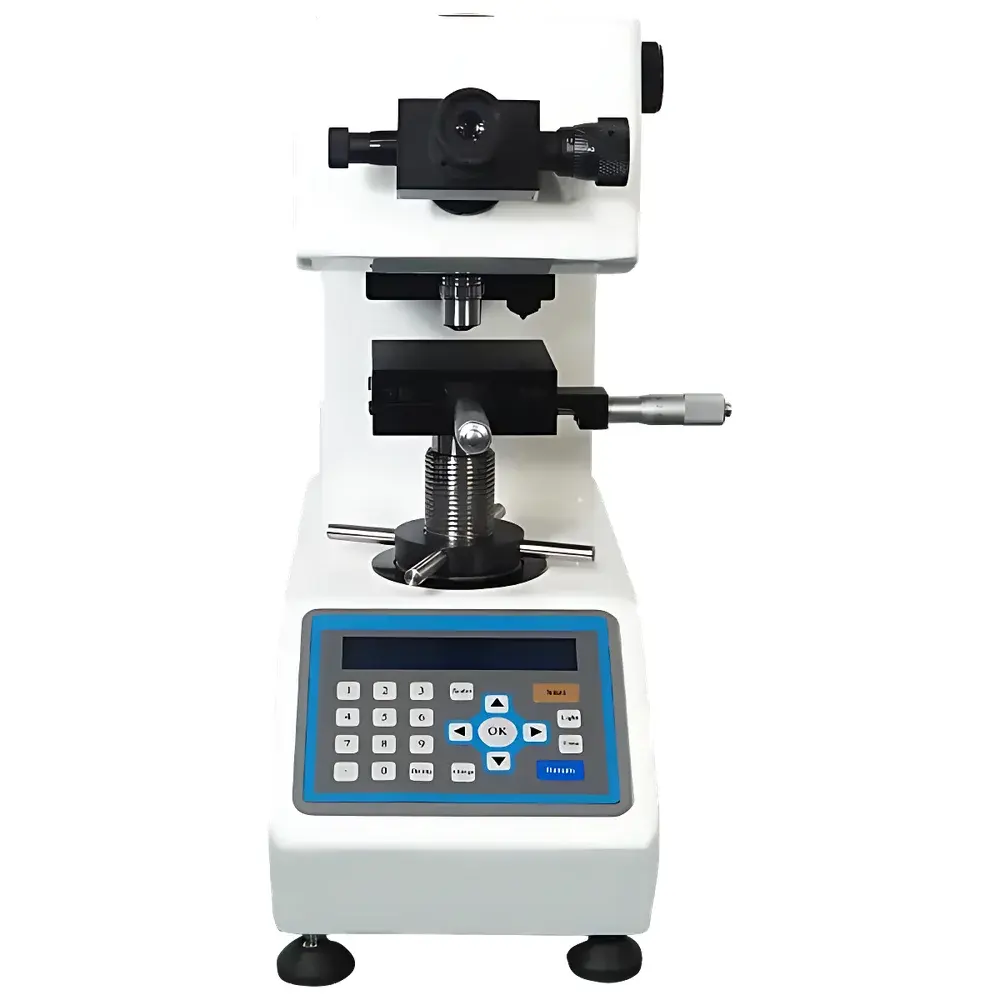
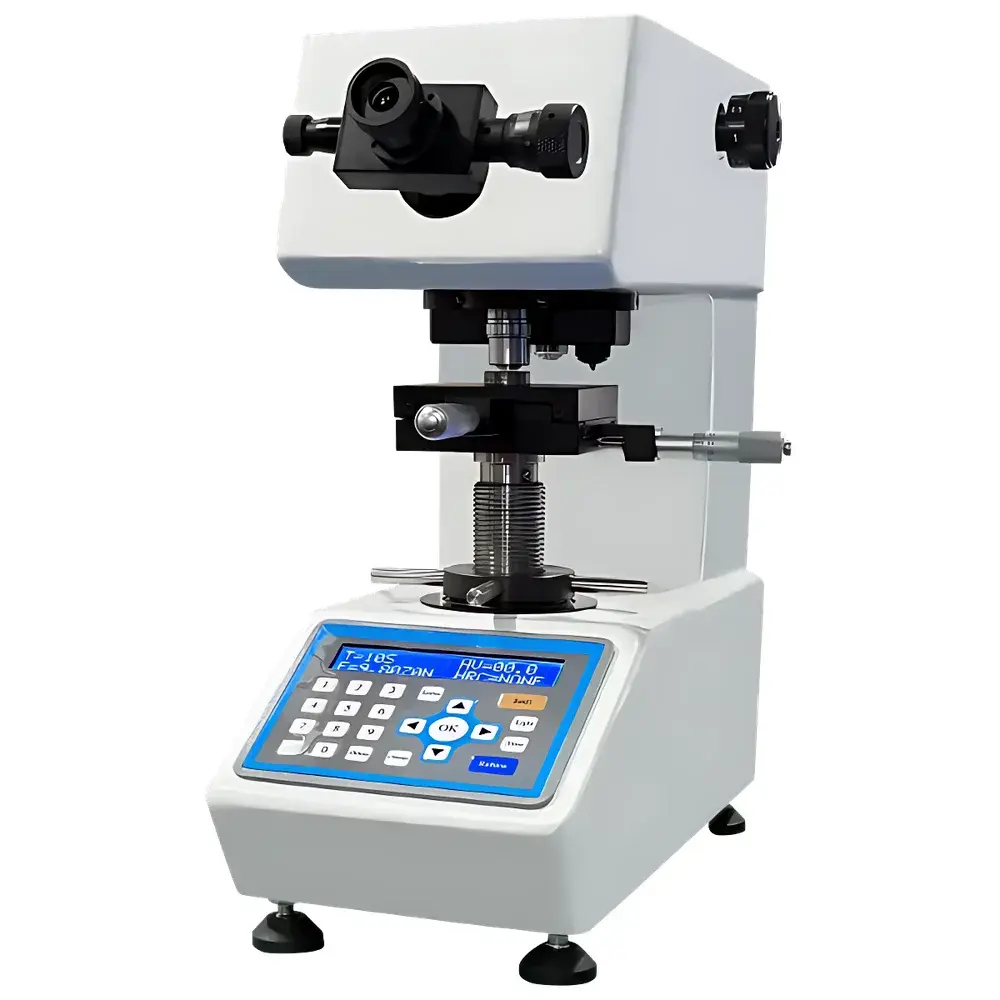
YANRUN HV-1000 Digital Microhardness Tester
| Brand | YANRUN |
|---|---|
| Origin | Shanghai, China |
| Manufacturer Type | Direct Manufacturer |
| Product Category | Domestic |
| Model | HV-1000 |
| Instrument Type | Microhardness Tester |
| Hardness Measurement Range | 0.001–6000 HV |
Overview
The YANRUN HV-1000 Digital Microhardness Tester is a precision-engineered instrument designed for quantitative micro-scale hardness evaluation of metallic and non-metallic materials using the Vickers indentation method. It operates on the principle of optical measurement of diagonal lengths of diamond pyramid indentations produced under precisely controlled static loads (typically ranging from 10 gF to 1000 gF), followed by automated calculation of Vickers Hardness (HV) values per ISO 6507-1, ASTM E384, and JIS Z 2244 standards. Its ultra-low minimum test force (10 gF) enables reliable characterization of thin films, diffusion layers, case-hardened surfaces, brittle ceramics, and miniaturized components—where conventional macro-hardness testers lack resolution or risk substrate interference. The system integrates a fully synchronized mechanical-optical-electronic architecture optimized for repeatability, long-term stability, and operator-independent measurement integrity.
Key Features
- Ultra-fine load control: Programmable test forces from 10 gF to 1000 gF with high-resolution electromagnetic loading mechanism, enabling precise indentation in heat-treated layers, PVD/CVD coatings, and microelectronic interconnects.
- Optimized optical path design: Patented triple-port optical pathway achieves near-100% light transmission efficiency; combined with high-NA objective lenses and LED-based adjustable illumination (0–100% continuous intensity control), it delivers high-contrast, low-glare indentation imaging.
- Integrated indenter–objective–stage–optics module: Monolithic mechanical coupling eliminates alignment drift between diamond pyramid indenter, objective lens, specimen stage, and imaging sensor—ensuring sub-micron positional fidelity across repeated measurements.
- Precision turret indexing: 360° motorized turret with ±0.1° angular positioning accuracy and automatic dwell-time synchronization ensures repeatable indenter/objective switching without manual calibration.
- Advanced image analysis engine: Floating-point computation algorithm minimizes rounding errors during diagonal length interpolation and HV derivation, improving agreement with theoretical hardness models by >98.5% (verified against NIST-traceable reference blocks).
- Modular firmware architecture: Hardware-reserved configuration ports support field-upgradable functionality—including Knoop hardness mode (with optional Knoop indenter), statistical batch reporting, and GLP-compliant audit trail logging—via simple DIP-switch reconfiguration.
- Robust mechanical platform: Precision-ground Z-axis lifting column with linear motion guidance and damping control ensures vibration-free loading/unloading cycles and extended service life (>15 years typical MTBF).
Sample Compatibility & Compliance
The HV-1000 accommodates specimens up to 120 mm in height and 150 mm × 150 mm in planar dimension, with standard sample stage travel of 25 mm × 25 mm (X–Y). It supports metallurgical samples prepared via grinding/polishing, cross-sectioned coated substrates, sintered ceramics, semiconductor wafers, and miniature medical device components. When equipped with a certified Knoop indenter (optional), the system complies with ASTM E92 for Knoop hardness testing of brittle materials such as optical glass, sapphire, fused quartz, and dental composites. All hardness values are traceable to national metrology institutes via certified reference materials (e.g., Wilson/Instron NIST SRM 2820 series). The instrument meets CE safety directives (2014/30/EU EMC, 2014/35/EU LVD) and supports GLP/GMP documentation workflows through configurable user access levels and electronic signature-ready data export.
Software & Data Management
The embedded Windows-based control software provides real-time load–displacement curve visualization, multi-point grid mapping, statistical process control (SPC) charting, and customizable report generation (PDF/CSV/XLSX). Measurement data include indentation coordinates, load/dwell/unload timestamps, raw pixel measurements, corrected HV/KHN values, standard deviation, and confidence intervals. Audit trails record all user actions—including parameter changes, calibration events, and result exports—with time-stamped, immutable logs compliant with FDA 21 CFR Part 11 requirements when deployed with network authentication and electronic signature modules. Data backups are automatically stored on internal industrial-grade SSD and optionally mirrored to network drives or cloud repositories via TLS-encrypted FTP/SFTP.
Applications
- Case depth profiling of carburized, nitrided, or induction-hardened steel components.
- Quality assurance of thermal spray coatings, electroplated Ni/Pt layers, and ALD-deposited barrier films.
- Mechanical property mapping across grain boundaries, weld zones, and intermetallic phases in aerospace alloys.
- Hardness gradient analysis in biomedical implants (e.g., Ti-6Al-4V surface oxide layers).
- Knoop hardness assessment of optical substrates, MEMS structures, and geological thin sections.
- R&D validation of novel high-entropy alloys, amorphous metals, and nanocomposite ceramics.
FAQ
What standards does the HV-1000 comply with for Vickers hardness testing?
ISO 6507-1, ASTM E384, JIS Z 2244, and GB/T 4340.1.
Can the system perform Knoop hardness testing out of the box?
No—Knoop testing requires installation of an optional Knoop indenter and activation of corresponding software mode.
Is remote calibration or verification supported?
Yes—built-in self-diagnostic routines and compatibility with NIST-traceable reference blocks enable third-party verification without disassembly.
Does the software support automated hardness mapping across large areas?
Yes—programmable X–Y stage control enables grid-based indentation arrays with auto-focus and auto-measurement at each point.
What is the minimum measurable indentation diagonal length?
0.5 µm (at 100× magnification), corresponding to ~0.001 HV at 10 gF load.



