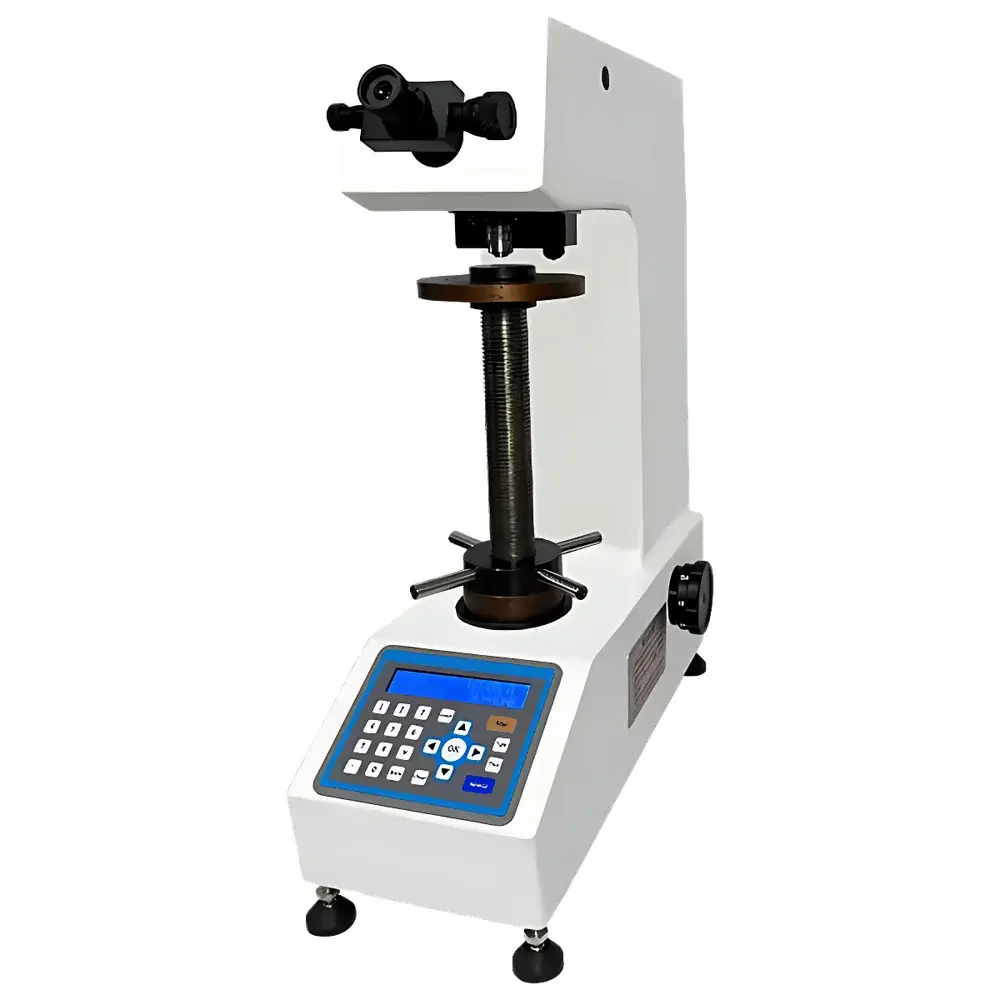
YANRUN HV-30 Vickers Hardness Tester
| Brand | YANRUN |
|---|---|
| Origin | Shanghai, China |
| Manufacturer Type | Direct Manufacturer |
| Country of Origin | China |
| Model | HV-30 |
| Test Force Range | 0.2–50 kgf (1.96–490.3 N) |
| Loading Method | Fully Automatic (Load-Hold-Unload) |
| Standards Compliance | GB/T 4340, ISO 6507 |
| Measuring Resolution | 0.06 µm (with 20× objective), 0.12 µm (with 10× objective) |
| Max Specimen Height | 235 mm |
| Distance from Indenter to Chamber Wall | 130 mm |
| Optical System | Dual-magnification turret (10× observation / 20× measurement for 5–10 kgf |
| Total Magnification | 100× (observation), 200× (measurement) |
| Hold Time Adjustment | 0–60 s (1 s increments) |
| Display | LCD with real-time force indication |
| Hardness Range | 8–3000 HV |
| Power Supply | AC 220 V / 50 Hz |
| Dimensions (L×W×H) | 570 × 220 × 680 mm |
| Net Weight | 46.0 kg |
| Software Integration | Optional PC-based analysis module with hardness conversion tables and GLP-compliant data logging |
Overview
The YANRUN HV-30 Vickers Hardness Tester is a precision-engineered micro/macro-hardness testing system designed for reliable, repeatable indentation hardness evaluation in quality control, materials R&D, and failure analysis laboratories. It operates on the fundamental principle of Vickers hardness testing—applying a precisely controlled diamond pyramid indenter (136° apex angle) under standardized test forces onto a polished specimen surface, followed by optical measurement of the resulting diagonal impressions. The instrument supports both microhardness (0.2–10 kgf) and macrohardness (10–50 kgf) regimes, enabling consistent characterization across diverse material classes—from thin-film coatings and IC substrates to bulk alloys and ceramics. Its dual-magnification optical path, calibrated digital measurement system, and full automation of loading/unloading cycles ensure compliance with internationally recognized metrological requirements defined in ISO 6507-1 and GB/T 4340.1.
Key Features
- Fully automated test cycle: motorized load application, dwell time control (0–60 s in 1 s steps), and unloading—minimizing operator influence and enhancing inter-test reproducibility.
- Dual-objective turret configuration: 10× objective for rapid specimen positioning and general observation; 20× objective (for 5–10 kgf range) delivering 200× total magnification and sub-0.06 µm measurement resolution for high-precision micro-indentation analysis.
- High-stability mechanical architecture: one-piece cast aluminum frame with automotive-grade baked enamel finish ensures long-term dimensional stability and resistance to environmental wear.
- Intuitive front-panel interface: real-time LCD display shows selected test force, active hardness scale (HV/HK), dwell duration, and calculated hardness value—eliminating manual transcription errors.
- Multi-force capability: six selectable test force levels per range (0.2–50 kgf across four calibrated ranges), accommodating applications from ultra-thin PVD coatings to structural steel forgings.
- Hardness scale conversion: built-in reference tables support direct conversion between Vickers (HV), Knoop (HK), Rockwell (HRB/HRC), Brinell (HB), and Shore scales per ASTM E140 guidelines.
Sample Compatibility & Compliance
The HV-30 accommodates specimens up to 235 mm in height and 130 mm lateral clearance from the indenter axis—enabling testing of small components, wafer fragments, layered composites, and heat-treated surfaces without re-fixturing. It is routinely deployed for hardness profiling of case-hardened gears, nitrided tool steels, anodized aluminum, sintered carbides, optical glasses, and biomedical ceramics. All mechanical and optical subsystems conform to ISO 6507-2 (verification of hardness testers) and GB/T 4340.2 (verification of Vickers hardness test blocks). When equipped with optional software, the system supports audit-trail generation and electronic signature functionality aligned with FDA 21 CFR Part 11 and GLP/GMP documentation standards.
Software & Data Management
An optional Windows-compatible software package extends the HV-30’s capabilities beyond standalone operation. The application enables image capture of indentations via USB-connected CCD camera, semi-automated diagonal measurement using edge-detection algorithms, statistical reporting (mean, SD, CV%), and export to CSV or PDF formats. Calibration certificates, user access logs, and test parameter histories are stored with timestamping and immutable metadata—facilitating internal QA audits and external accreditation reviews (e.g., ISO/IEC 17025). Raw measurement data retains traceability to NIST-traceable hardness reference blocks used during daily verification.
Applications
- Quality assurance of surface treatments: carburizing, nitriding, chroming, and thermal spray coatings.
- Mechanical property mapping of welded joints and heat-affected zones (HAZ).
- Thin-film hardness validation for MEMS devices, semiconductor packaging, and optical thin films.
- Research-grade indentation testing in metallurgy, ceramic engineering, and polymer science labs.
- Failure analysis investigations requiring localized hardness gradients correlated with microstructural features.
- Educational use in materials science curricula for hands-on demonstration of hardness–strength relationships.
FAQ
Does the HV-30 comply with international calibration standards?
Yes—it meets the performance verification criteria outlined in ISO 6507-2 and GB/T 4340.2, and its force application accuracy is certified within ±1.0% of nominal value across all test force ranges.
Can the instrument perform Knoop hardness testing?
Yes—the same diamond pyramid indenter is used for both HV and HK measurements; users select the HK scale via the control panel, and the system applies appropriate calculation coefficients per ASTM E384.
Is remote software control supported?
The optional PC software supports USB-based bidirectional communication for parameter setting, real-time status monitoring, and automated report generation—but does not support Ethernet or wireless protocols.
What maintenance is required for long-term accuracy?
Annual verification using certified reference hardness blocks is recommended; routine cleaning of the optical path and indenter tip with lint-free swabs and analytical-grade ethanol is sufficient for daily operation.
Is the HV-30 suitable for testing brittle materials like glass or sapphire?
Yes—its low-force microhardness capability (down to 0.2 kgf) and precise dwell time control minimize crack propagation, enabling valid hardness assessment of fragile or low-toughness substrates.