
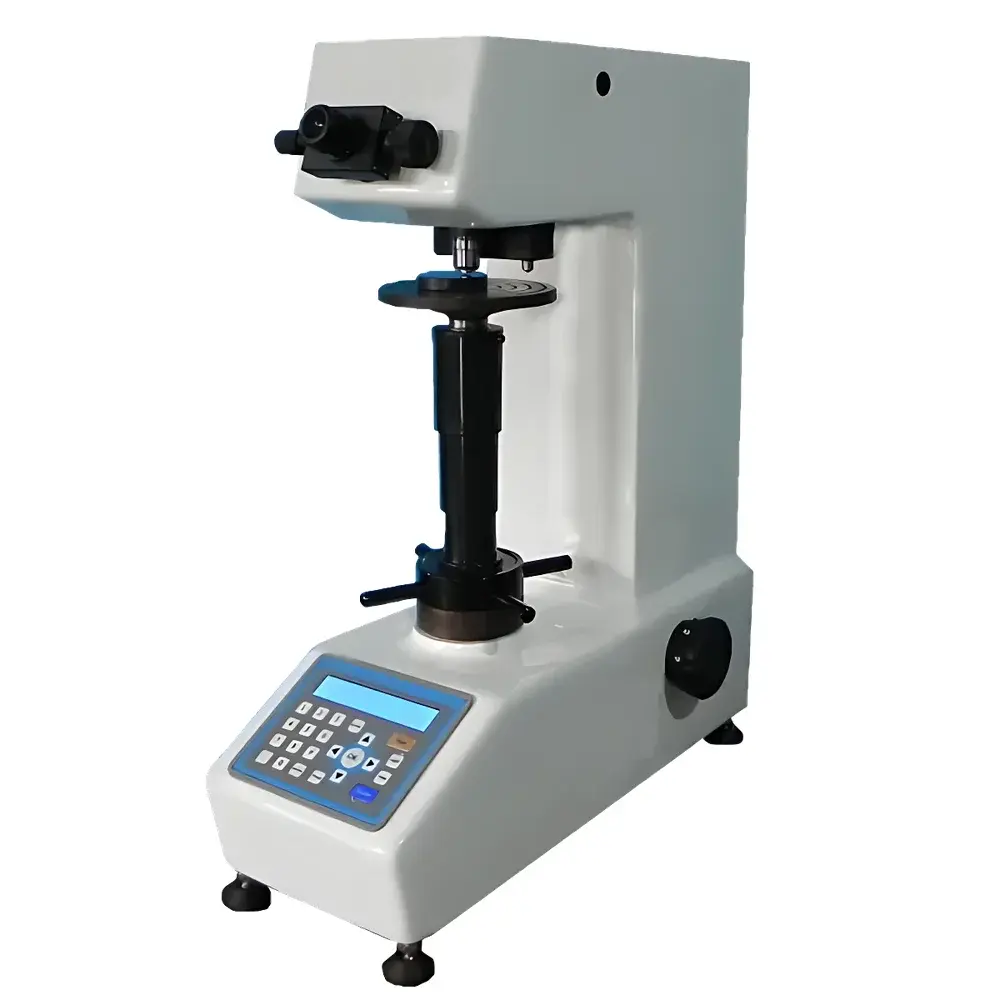
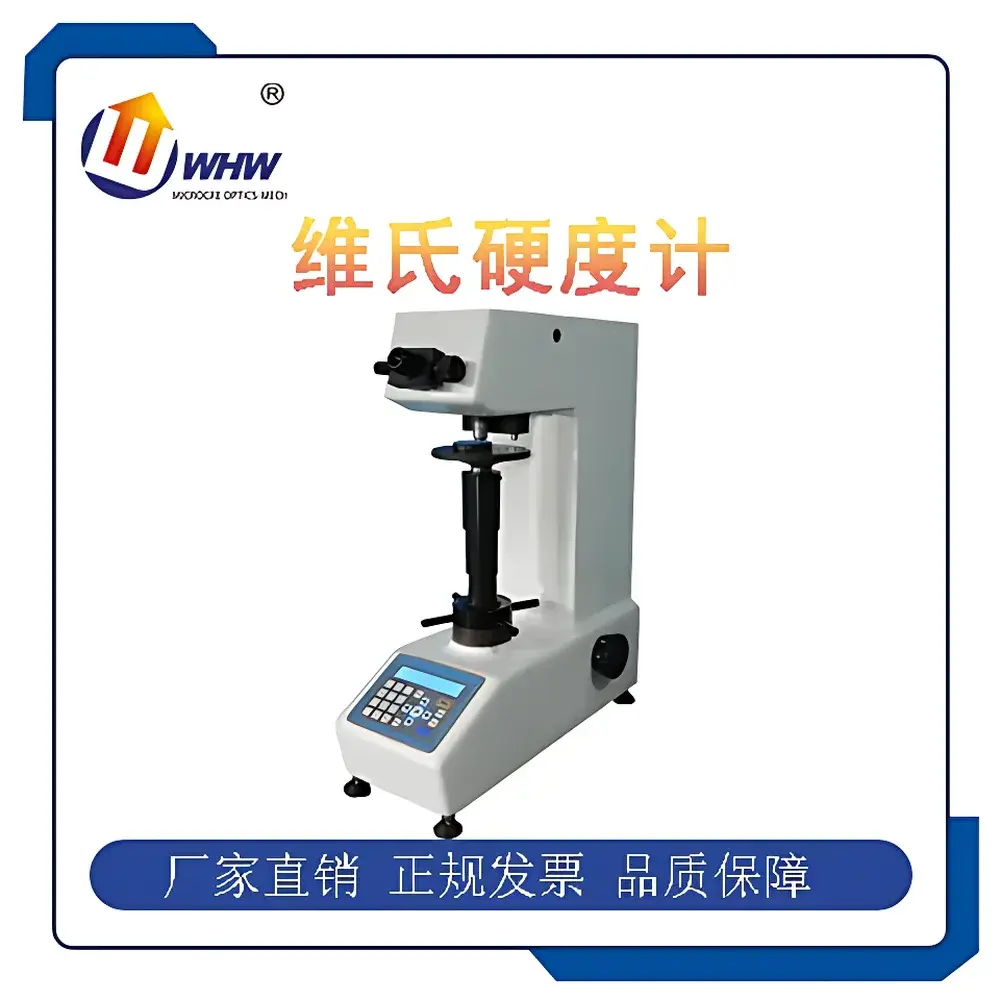
YANRUN HV-5/10/30/50 Vickers Hardness Tester
| Brand | YANRUN |
|---|---|
| Origin | Shanghai, China |
| Manufacturer Type | OEM Manufacturer |
| Country of Origin | China |
| Model | HV-5/10/30/50 |
| Instrument Type | Vickers Hardness Tester |
| Measurement Range | 0.001–6000 HV |
| Test Forces | 0.2–50 kgf (HV-5: 0.2–5 kgf |
| HV-10 | 0.3–10 kgf |
| HV-30 | 1–30 kgf |
| HV-50 | 1–50 kgf) |
| Objective Magnifications | 10× (observation), 20× (measurement) |
| Eyepiece | 10× mechanical eyepiece |
| Total Magnification | 100× (observation), 200× (measurement) |
| Minimum Detection Unit | 0.25 µm |
| Indentation Measurement Method | Manual micrometer drum reading with automatic hardness calculation |
| Dwell Time | 0–99 s (1-s increments) |
| Max Specimen Height | 220 mm |
| Distance from Indenter to Column | 130 mm |
| Dimensions (H×W×D) | 680 × 216 × 565 mm |
| Power Supply | AC 220 V / 50 Hz |
| Compliance | GB/T 4340.2, JJG 151 |
Overview
The YANRUN HV-5/10/30/50 Vickers Hardness Tester is a precision-engineered electromechanical instrument designed for quantitative micro- and macro-scale hardness evaluation of metallic, ceramic, thin-film, and brittle materials. It operates on the fundamental principle of Vickers indentation hardness testing—applying a precisely calibrated diamond pyramid indenter (136° included angle) under controlled static load, followed by optical measurement of the resulting diagonal impressions in the specimen surface. The resulting hardness value (HV) is calculated per ISO 6507-1 and ASTM E384 as HV = 0.1891 × F/d², where F is the applied test force (kgf) and d is the arithmetic mean of two perpendicular diagonal lengths (mm). This model series supports four distinct force ranges—HV-5 (0.2–5 kgf), HV-10 (0.3–10 kgf), HV-30 (1–30 kgf), and HV-50 (1–50 kgf)—enabling seamless transition between microhardness assessment of coatings and macrohardness verification of bulk components. Its integrated optical path features dual-magnification objectives (10× for observation, 20× for measurement) and a 10× mechanical eyepiece, delivering 100× and 200× total magnification respectively—optimized for high-contrast, parallax-free indentation imaging.
Key Features
- Automated force application and dwell control: Fully programmable loading/unloading sequence with dwell time adjustable from 0 to 99 seconds in 1-second increments—ensuring strict adherence to ISO 6507-1 and GB/T 4340.2 timing requirements.
- Dual-hardness display & cross-scale conversion: LCD interface simultaneously displays Vickers (HV) and Knoop (HK) values, with real-time conversion to Rockwell (HRA, HRB, HRC, HRD, HRF), Brinell (HBW), and superficial Rockwell (HR15N–HR45T) scales—validated against ASTM E140 reference tables.
- Manual turret indexing with auto-force recognition: Rotating turret enables rapid objective and indenter positioning; force selection via mechanical dial automatically registers selected kgf value—eliminating manual input errors and enhancing repeatability.
- Adjustable LED illumination system: Independent brightness control ensures optimal contrast for both reflective and low-diffuse specimens—including ceramics, sapphire, tempered glass, and nitrided steel surfaces.
- Direct digital readout with zero-reference calibration: Micrometer drum eyepiece provides 0.25 µm resolution; measured diagonals are entered manually and converted in real time—bypassing manual interpolation from ASTM E92 or ISO 6507-2 lookup tables.
Sample Compatibility & Compliance
The HV-5/10/30/50 accommodates a broad spectrum of specimen geometries and material classes: thin sections (≥0.3 mm), case-hardened layers (e.g., carburized or nitrided steels), PVD/CVD coatings (TiN, CrN, DLC), optical substrates (fused silica, BK7), geological specimens (corundum, quartz), and biomedical ceramics (zirconia, alumina). Maximum specimen height is 220 mm; V-block, flat, and centering stages support cylindrical, irregular, and miniature samples. All models comply with national verification regulation JJG 151 and GB/T 4340.2 for metrological traceability. While not inherently 21 CFR Part 11 compliant, the system supports GLP/GMP-aligned documentation when paired with optional HMAS software (see Software section). Calibration is performed using certified reference blocks traceable to NIM (National Institute of Metrology, China) standards.
Software & Data Management
The base instrument operates via embedded firmware with local LCD-based control—requiring no external PC for routine operation. Optional HMAS (Hardness Measurement Analysis System) software extends functionality to automated image capture, multi-point mapping, statistical reporting (mean, SD, CV%), and export to CSV/PDF formats. HMAS supports timestamped audit trails, user access levels, and electronic signature capability—facilitating compliance with internal QA protocols and pre-audit readiness for ISO/IEC 17025 laboratories. Image metadata includes test force, dwell time, operator ID, date/time stamp, and calibration certificate ID—enabling full traceability per ISO/IEC 17025 Clause 7.7.
Applications
This tester serves critical roles across R&D, production QC, and third-party certification labs: evaluating heat treatment uniformity in aerospace alloys (e.g., Ti-6Al-4V, Inconel 718); quantifying case depth in gear teeth per SAE J429; validating coating adhesion integrity via step-load indentation arrays; assessing brittleness transitions in tempered martensite; and verifying hardness gradients in functionally graded materials (FGMs). Its 0.001 HV lower detection limit enables reliable characterization of ultra-soft phases (e.g., annealed Cu, Sn-Pb solder), while the 6000 HV upper range covers tungsten carbide, cubic boron nitride, and single-crystal diamond tooling—making it suitable for both metallurgical research and industrial process validation.
FAQ
What standards does this instrument meet?
It conforms to GB/T 4340.2 (Chinese national standard equivalent to ISO 6507-2) and JJG 151 (national verification regulation for hardness testers).
Can it measure Knoop hardness?
Yes—the same indenter and optical system support HK measurements per ASTM E384, with automatic calculation and display alongside HV values.
Is the microscope eyepiece calibrated for direct measurement?
The 10× mechanical eyepiece incorporates a precision micrometer drum with 0.25 µm graduation; calibration is verified using certified stage micrometers prior to each test session.
Does it support automated indentation imaging?
Not natively—the base model requires manual eyepiece reading. However, optional digital camera integration (via C-mount adapter) enables live imaging and post-capture analysis when used with HMAS software.
What maintenance is required for long-term accuracy?
Annual verification using certified hardness reference blocks and optical alignment checks (per GB/T 4340.2 Annex B) are recommended; indenter tip inspection under 400× magnification should occur after every 500 indentations on hardened steel.



