
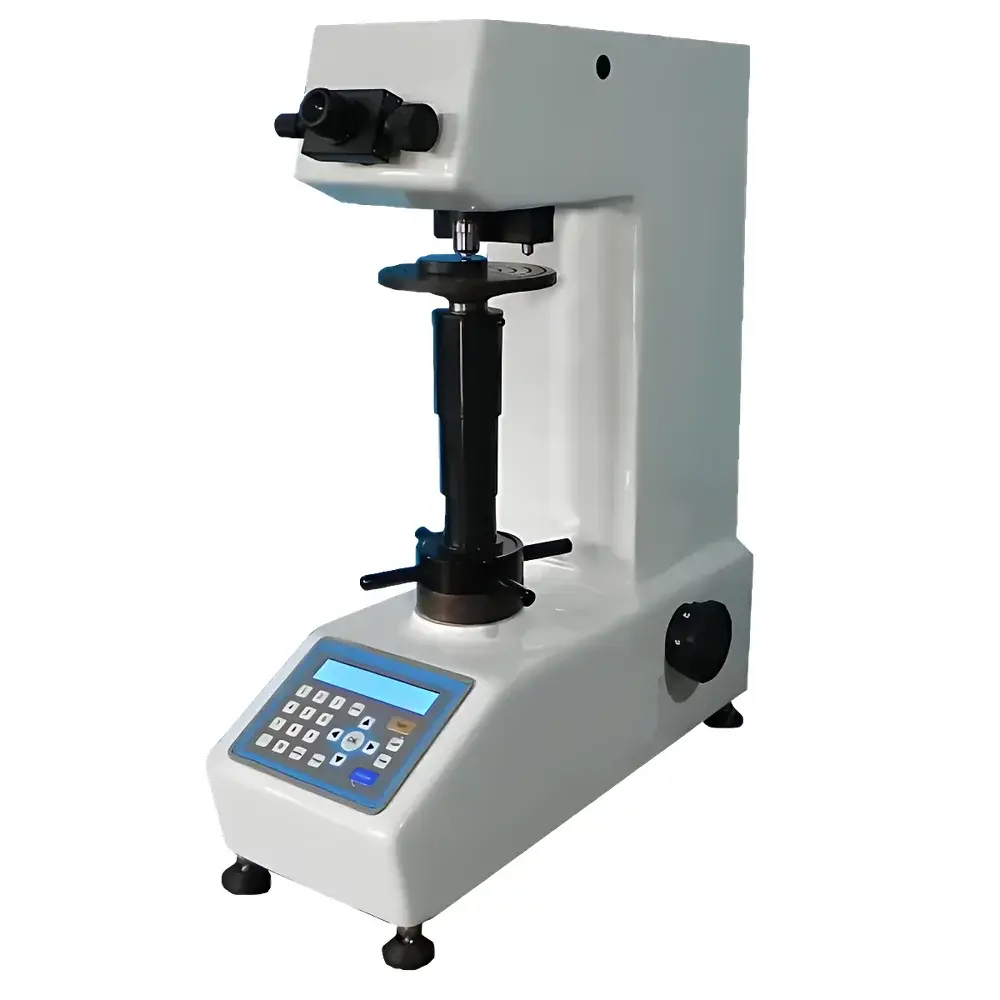
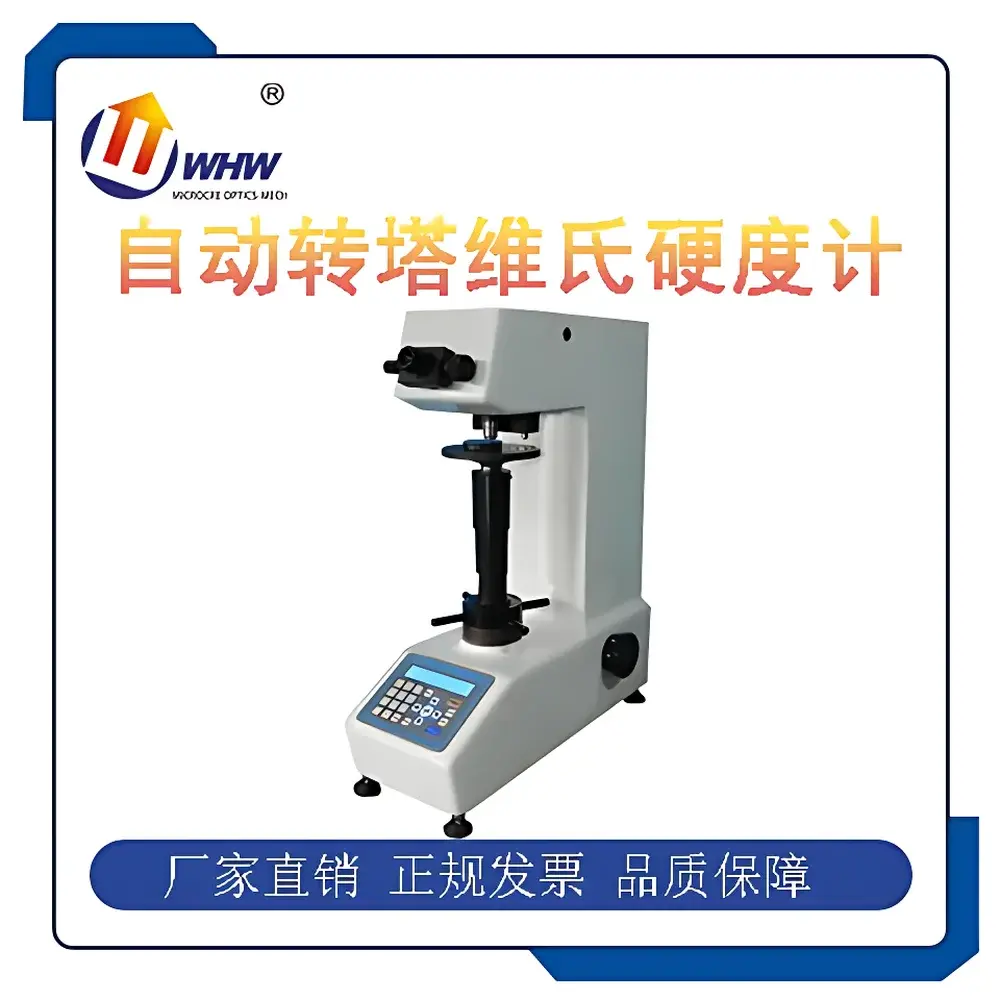
YANRUN HV-5Z/10Z/30Z/50Z Automated Vickers Hardness Tester
| Brand | YANRUN |
|---|---|
| Origin | Shanghai, China |
| Manufacturer Type | Direct Manufacturer |
| Region of Origin | Domestic (China) |
| Model | HV-5Z / HV-10Z / HV-30Z / HV-50Z |
| Hardness Tester Type | Vickers Hardness Tester |
| Measuring Range | 0.001–6000 HV |
| Test Forces (kgf) | HV-5Z: 0.2, 0.3, 0.5, 1, 3, 5 |
| HV-10Z | 0.3, 0.5, 1, 3, 5, 10 |
| HV-30Z | 1, 3, 5, 10, 20, 30 |
| HV-50Z | 1, 5, 10, 20, 30, 50 |
| Turret Control | Motorized Auto-Turret |
| Load Application | Fully Automatic Loading/Unloading/Holding |
| Hold Time | 0–99 s (1-s increments) |
| Optical System | Dual-Magnification Objective Lenses (10× observation / 20× measurement), 10× Eyepiece |
| Total Magnification | 100× (observation), 200× (measurement) |
| Minimum Detection Unit | 0.25 µm |
| Measurement Method | Manual indentation diagonal entry via calibrated eyepiece, auto-calculated HV value |
| Display | LCD with dual-scale readout (HV + selectable converted scales) |
| Compliance | GB/T 4340.2, JJG 151 |
| Max Specimen Height | 220 mm |
| Distance from Indenter to Column | 130 mm |
| Dimensions (H×W×D) | 680 × 216 × 565 mm |
| Power Supply | AC 220 V / 50 Hz |
Overview
The YANRUN HV-5Z/10Z/30Z/50Z series represents a fully integrated, opto-mechanical Vickers hardness testing platform engineered for precision metrology in metallurgical laboratories, quality control departments, and materials R&D facilities. Based on the Vickers indentation principle—where a diamond pyramid indenter (136° apex angle) is applied under controlled static load to produce a geometrically reproducible square impression—the system delivers traceable hardness values in the Vickers scale (HV), with optional conversion to Knoop (HK), Rockwell (HRA, HRB, HRC, etc.), Brinell (HBW), and superficial Rockwell (HR15N–HR45T) scales per ASTM E92, ISO 6507-1, and GB/T 4340.2. Designed for high repeatability and operator independence, the instrument features motorized turret positioning, fully automated force application and dwell control, and real-time digital readout of hardness values—eliminating manual interpolation from printed tables. Its optical path integrates dual-objective lenses (10× for observation, 20× for measurement) and a calibrated 10× eyepiece, enabling reliable detection of indentations as small as 0.25 µm in diagonal length—critical for evaluating thin films, case-hardened layers, brittle ceramics, and microstructural phases.
Key Features
- Fully automatic loading, holding, and unloading cycle with programmable dwell time (0–99 s, adjustable in 1-second increments)
- Motorized auto-turret with pre-aligned Vickers and Knoop indenters; seamless switching between test forces without manual recalibration
- Dual-scale LCD display showing primary Vickers hardness (HV) alongside real-time conversion to up to 14 alternate hardness scales (e.g., HRC, HBW, HK)
- Optical measurement system with 100× observation magnification and 200× measurement magnification; mechanical micrometer eyepiece with 0.25 µm resolution
- Intuitive soft-key interface for parameter input—including test method selection (Vickers/Knoop), load selection, dwell time, and illumination intensity adjustment
- Robust mechanical architecture with hardened column, precision-ground Z-axis guide, and vibration-damped base—ensuring stability during high-force testing (up to 50 kgf)
Sample Compatibility & Compliance
The HV-5Z/10Z/30Z/50Z accommodates a broad spectrum of specimen geometries and material classes: micro-sections, thin foils (<0.5 mm), surface-treated components (nitrided, carburized, PVD/CVD coatings), brittle inorganic solids (alumina, silicon carbide, sapphire, glass), and low-modulus alloys. Maximum specimen height is 220 mm, with a 130 mm clearance from indenter center to column—supporting standard flat, cylindrical, and irregularly shaped samples using included large, medium, and V-shaped anvil stages. The system complies with national and international metrological standards including GB/T 4340.2 (Chinese national standard for Vickers hardness testing), JJG 151 (Calibration Regulation for Hardness Testing Machines), and aligns with the technical requirements of ISO 6507-2 (Verification of hardness testers) and ASTM E10-22 (Standard Test Method for Brinell Hardness of Metallic Materials), ensuring audit readiness for GLP and ISO/IEC 17025-accredited laboratories.
Software & Data Management
While the base configuration operates via embedded firmware and LCD interface, optional integration with the HMAS (Hardness Measurement Analysis System) enables full digital workflow management. HMAS supports image capture of indentations via optional CCD camera, automated diagonal measurement using edge-detection algorithms, statistical reporting (mean, SD, CV%), pass/fail thresholding, and export to CSV or PDF formats. All test records—including operator ID, timestamp, load, dwell time, measured diagonals, calculated HV, and environmental metadata—are stored with tamper-evident audit trails. When configured with user authentication and electronic signatures, the system meets documentation integrity requirements under FDA 21 CFR Part 11 for regulated environments.
Applications
This hardness tester serves critical functions across industrial and academic domains: verification of heat treatment uniformity in aerospace turbine blades; quantification of case depth in gear teeth; evaluation of coating adhesion and cohesive strength in biomedical implants; hardness profiling across diffusion zones in dissimilar metal welds; and microhardness mapping of intermetallic phases in aluminum-lithium alloys. Its low-force capability (0.2 kgf minimum) makes it suitable for IC packaging substrates and MEMS device characterization, while the 50 kgf upper limit supports cast iron and tool steel validation per ISO 6507-1 Annex A. Routine use is documented in QC protocols for automotive powertrain components, electronics substrate suppliers, and third-party certification bodies.
FAQ
What standards does this instrument comply with?
It conforms to GB/T 4340.2 and JJG 151, and its mechanical and optical performance aligns with ISO 6507-2 and ASTM E92 for Vickers hardness verification.
Can the system perform Knoop hardness testing?
Yes—the same diamond pyramid indenter is used, and the instrument supports HK calculation when Knoop test parameters are selected via the control interface.
Is calibration traceability provided?
Each unit ships with certified reference hardness blocks (high and medium range), and calibration certificates are issued against national metrological standards; annual verification is recommended per ISO/IEC 17025 guidelines.
What optional accessories enhance microstructural analysis?
A CCD camera kit, digital cross-table (manual or motorized), thin-film clamping fixtures, and the HMAS software package enable image-based measurement, spatial mapping, and statistical process control.
Does the instrument support network connectivity or data export?
Standalone units output results via LCD and manual recording; HMAS-equipped systems support USB storage, LAN export, and direct integration into LIMS or MES platforms via configurable API endpoints.



