
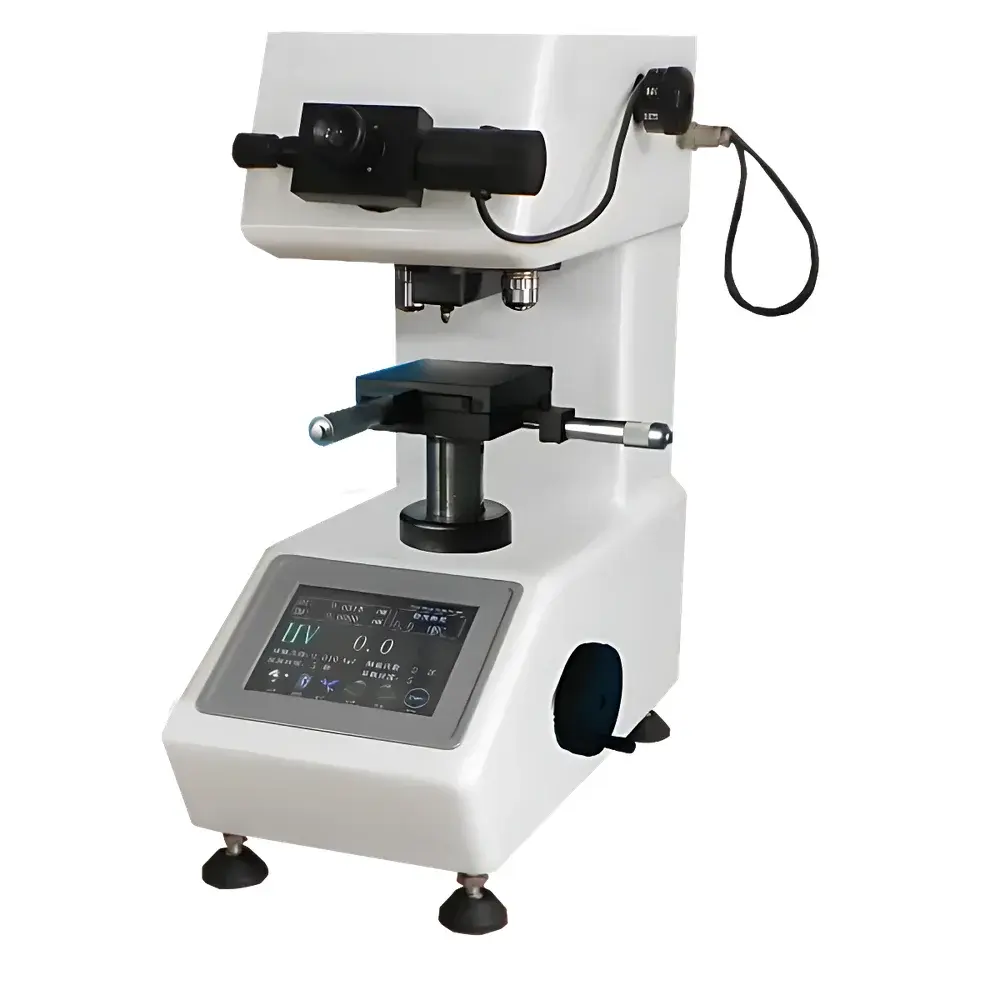
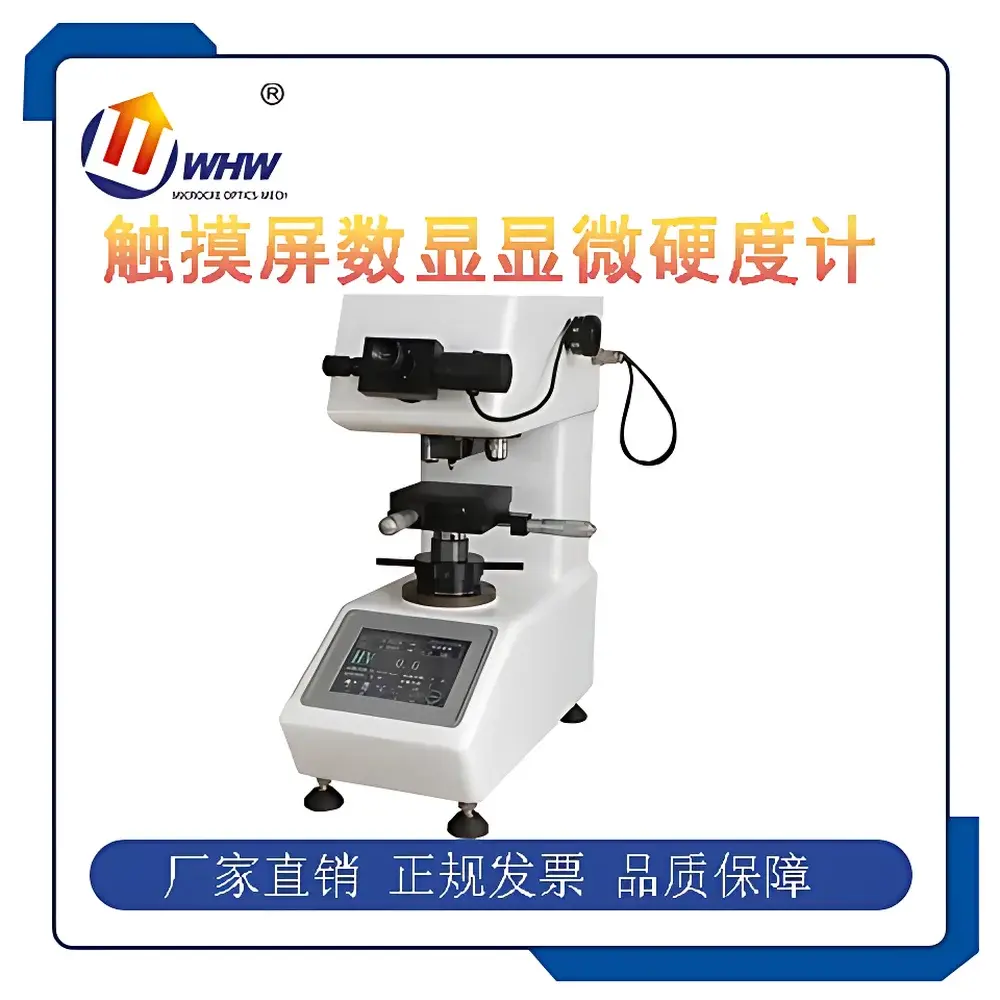
YANRUN HVS-1000MZ Touchscreen Digital Microhardness Tester
| Brand | YANRUN |
|---|---|
| Origin | Shanghai, China |
| Manufacturer Type | Direct Manufacturer |
| Instrument Type | Microhardness Tester |
| Model | HVS-1000MZ |
| Measurement Range | 0.001–6000 HV |
| Total Test Forces | 10, 25, 50, 100, 200, 300, 500, 1000 gf |
| Standards Compliance | GB/T 4340 |
| Automation | Motorized Turret, Fully Automatic Loading/Unloading/Holding |
| Optical Magnification | 100× and 400× (dual-magnification measurement system) |
| Minimum Detectable Indentation Resolution | ~0.013 µm at 400× |
| X-Y Stage Travel | 25 × 25 mm |
| Maximum Specimen Height | 65 mm |
| Data Storage | Up to 60 test records onboard |
| Integrated Thermal Printer | Yes |
| Power Supply | AC 220 V / 50 Hz |
Overview
The YANRUN HVS-1000MZ is a fully automated, touchscreen-enabled microhardness tester engineered for high-precision indentation hardness evaluation of metallic, ceramic, thin-film, and brittle materials at the microscale. It operates on the principle of Vickers and Knoop indentation testing—applying a precisely controlled diamond pyramid indenter under defined loads, followed by optical measurement of the resulting impression diagonal(s) to calculate hardness values in HV (Vickers) or HK (Knoop) units. Designed for laboratory environments requiring traceable, repeatable, and standards-compliant mechanical property characterization, the HVS-1000MZ integrates a rigid aluminum alloy monolithic frame, coaxial optical-path architecture, and motorized turret positioning to eliminate parallax and ensure alignment integrity between objective lens, indenter, and illumination path. Its dual-magnification optical system (100× and 400×) enables both rapid survey scanning and sub-micron-scale indent analysis—critical for evaluating case-hardened layers, diffusion zones, intermetallic phases, and ultra-thin coatings where spatial resolution and load sensitivity are paramount.
Key Features
- 5.6-inch full-color capacitive touchscreen interface with intuitive, gesture-responsive navigation—designed for ergonomic operation without external keyboard or mouse
- Motorized auto-turret with synchronized indenter/objective switching and real-time positional feedback
- Dual-magnification measurement capability: simultaneous support for 100× (10× objective + 10× eyepiece) and 400× (40× objective + 10× eyepiece), extendable to 200×, 500×, or 1000× via optional objective configurations
- High-resolution optical train featuring integrated indenter–turret–objective–illumination alignment, achieving >98% light throughput efficiency and diffraction-limited image fidelity
- Digital encoder-based XY stage with 0.01 mm mechanical resolution and 25 × 25 mm travel range, enabling precise multi-point grid mapping and cross-sectional hardness profiling
- Eight-step programmable test force selection (0.098–9.807 N / 10–1000 gf), implemented via external rotary selector with automatic mechanical engagement and load verification
- Full automation cycle: load application → dwell time (0–60 s, adjustable in 1 s increments) → unloading → indentation imaging → diagonal measurement → hardness calculation → data logging
- Onboard thermal printer for immediate hardcopy output of test reports including date/time stamp, load, dwell time, diagonals, HV/HK value, and conversion equivalents
Sample Compatibility & Compliance
The HVS-1000MZ accommodates specimens up to 65 mm in height and 110 mm from column centerline to indenter axis—suitable for bulk metallographic mounts, coated wafers, sintered ceramics, and miniaturized components. Its low-force capability (down to 10 gf) supports evaluation of thin films (<1 µm), nitrided surfaces, electroplated layers, and brittle materials such as silicon carbide or borosilicate glass without cracking or pile-up artifacts. The instrument complies with GB/T 4340.1–2012 (equivalent to ISO 6507-1:2018 and ASTM E384–22) for Vickers microhardness testing, and supports Knoop testing per GB/T 18449.1–2012 (ISO 4545-1:2017). All hardness conversions (e.g., HV ↔ HRC, HBW, HRN, HRT) reference ASTM E140–22 and ISO 18265:2013 databases. For regulated environments, raw measurement data—including load, dwell time, diagonal lengths, operator ID, and timestamp—is stored with audit-trail integrity; when paired with optional HMAS software, it supports GLP/GMP-aligned workflows including electronic signatures and 21 CFR Part 11–compliant data archiving.
Software & Data Management
While the HVS-1000MZ functions autonomously via its embedded OS, integration with YANRUN’s HMAS (Hardness Measurement Analysis System) unlocks advanced metrology capabilities. HMAS provides real-time video capture, automated indentation detection using edge-enhanced thresholding algorithms, statistical process control (SPC) charting, depth-profile generation, and customizable report templates exportable to PDF, CSV, or Excel. All measurements include metadata tagging (specimen ID, heat treatment condition, location coordinates), supporting ISO/IEC 17025 traceability requirements. Onboard storage retains up to 60 test records with full parameter sets; USB export enables offline review and third-party statistical analysis. No cloud connectivity or remote access is implemented—ensuring full data sovereignty for sensitive R&D or production QA applications.
Applications
- Quality assurance of surface-hardened components (carburized gears, nitrided tooling steels)
- Thin-film adhesion and cohesion assessment in PVD/CVD-coated aerospace alloys
- Microstructural phase hardness mapping in duplex stainless steels and nickel-based superalloys
- Failure analysis of brittle fracture zones in semiconductor packaging substrates
- Calibration validation of reference hardness blocks per ISO 6507-3
- Evaluation of heat-affected zones (HAZ) in laser-welded micro-joints
- Research-grade indentation creep and strain-rate sensitivity studies (with extended dwell protocols)
FAQ
Does the HVS-1000MZ support Knoop hardness testing?
Yes—it accepts standard Knoop diamond indenters (136° long diagonal, 172.5° short diagonal) and calculates HK values automatically using the same optical measurement engine.
Can the instrument be calibrated to national metrology standards?
Yes—calibration is performed using certified reference hardness blocks traceable to NIM (China National Institute of Metrology) or NIST SRMs; certificate documentation is provided upon request.
Is the XY stage programmable for automated grid testing?
The manual stage supports stepwise positioning via encoder readout; for full automation, the optional digital XY stage with RS-232/USB interface and HMAS integration enables script-driven multi-location testing.
What maintenance is required for long-term accuracy?
Annual verification of load cell linearity, indenter geometry (via SEM), and optical magnification calibration is recommended; all adjustments are accessible via service mode and documented in the technical manual.
Is technical support available outside mainland China?
Yes—YANRUN provides remote diagnostics, English-language documentation, and application engineering consultation for international distributors and end users.



