
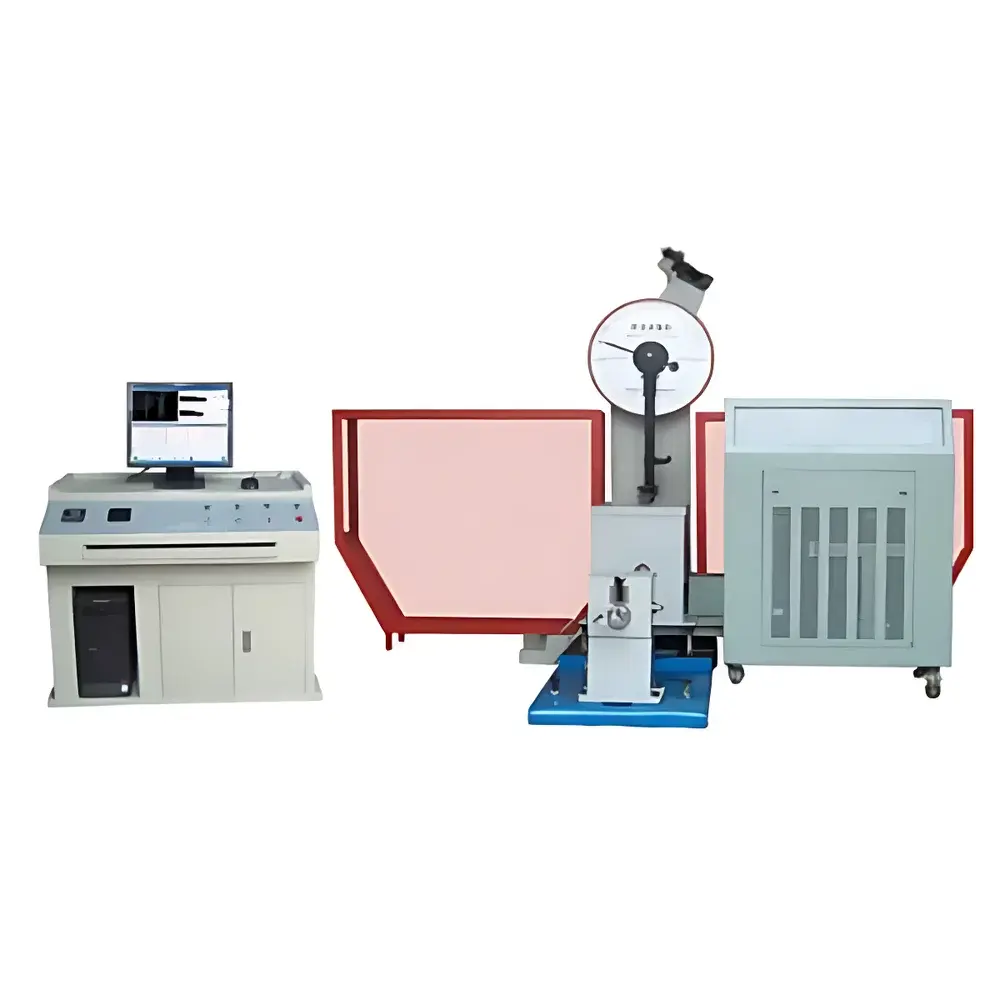
YANRUN JBDW-500Y Fully Automated Low-Temperature Charpy Impact Testing Machine with Microcomputer Control and Digital Display
| Brand | YANRUN |
|---|---|
| Model | JBDW-500Y |
| Type | Pendulum Impact Tester |
| Impact Energy | 250 J, 500 J |
| Impact Velocity | 5.4 m/s |
| Pendulum Arm Length | 800 mm |
| Specimen Span | 40 mm |
| Notch Radius (Anvil) | R1–R1.5 mm |
| Impact Blade Radius | R2–R2.5 mm |
| Blade Thickness | 16 mm |
| Cooling Method | Compressor-Based Refrigeration |
| Temperature Range | 0 °C to –60 °C |
| Temperature Stability | ±1.5 °C fluctuation, ≤2 °C gradient |
| Specimen Dimensions | 10 mm × 10 mm × 55 mm |
| Machine Dimensions (L×W×H) | 1500 mm × 850 mm × 1340 mm |
| Net Weight | 850 kg |
| Power Supply | 3-phase AC 380 V ±10%, 50 Hz, 5 A |
Overview
The YANRUN JBDW-500Y is a fully automated, microprocessor-controlled Charpy impact testing machine engineered for high-reproducibility mechanical property evaluation of metallic and polymeric materials at subambient temperatures. It operates on the principle of pendulum impact energy absorption—measuring the energy required to fracture standardized notched specimens under defined kinetic conditions. Designed in accordance with ISO 148-1, ASTM E23, and GB/T 229, the system integrates compressor-based cryogenic cooling, precision electromechanical actuation, and real-time digital data acquisition to deliver traceable, GLP-compliant impact toughness results across a controlled temperature range from 0 °C down to –60 °C. Its robust cast-iron frame, dual-energy pendulum configuration (250 J and 500 J), and rigid 800 mm pendulum axis distance ensure minimal energy loss and high measurement fidelity per ISO/IEC 17025 validation requirements.
Key Features
- Fully automated specimen handling: Integrated motorized specimen feeder accommodates up to 20 pre-chilled specimens, enabling unattended sequential testing with programmable soak time per specimen.
- Dual-range calibrated pendulums: Independently certified 250 J and 500 J hammers—each with traceable NIST-traceable calibration certificates—allow optimal resolution across low- and high-toughness material classes.
- Compressor-driven low-temperature chamber: Maintains stable thermal gradients (≤2 °C) and tight fluctuation control (±1.5 °C) over the full –60 °C to 0 °C operating range, verified by integrated Pt100 sensors and PID-regulated refrigerant flow.
- Automatic pendulum positioning & release: Electromechanical lifting, locking, and trigger mechanisms eliminate manual intervention, reducing operator variability and enhancing repeatability (CV < 2.5% per ASTM E23 Annex A1).
- Optical position sensing: High-resolution光电 encoder and infrared proximity sensor confirm pendulum zero-angle reference and impact event timing with microsecond-level synchronization.
- Integrated safety architecture: Interlocked transparent polycarbonate guard, emergency stop circuitry, and automatic pendulum arrest post-impact comply with EN ISO 13857 and OSHA 1910.212 standards.
Sample Compatibility & Compliance
The JBDW-500Y accepts standard Charpy V-notch (CVN) and U-notch specimens measuring 10 mm × 10 mm × 55 mm, conforming to ISO 148-1:2016 and ASTM E23-22 dimensional tolerances. Anvil radius (R1–R1.5 mm) and striker blade radius (R2–R2.5 mm) are machined to within ±0.05 mm of nominal specification and verified via optical profilometry. The system supports both single-specimen and batch-mode testing with automated alignment using a dedicated specimen centering gauge. All mechanical components—including the pendulum shaft, bearings, and impact anvil—are manufactured from hardened tool steel and subject to annual metrological verification. Full compliance documentation—including factory calibration reports, CE Declaration of Conformity (2006/42/EC Machinery Directive), and RoHS 2011/65/EU certification—is provided with each unit.
Software & Data Management
The proprietary YANRUN TestMaster™ software (v4.2) runs on the included Windows-based industrial PC and provides full test lifecycle management: method setup (temperature ramp rate, soak duration, impact sequence), real-time energy calculation, waveform visualization (impact force vs. time), and automated report generation in PDF/XLSX formats. Audit trail functionality logs all user actions, parameter changes, and calibration events with timestamps and operator IDs—meeting FDA 21 CFR Part 11 electronic record requirements when configured with Windows Active Directory authentication. Raw data export supports third-party statistical analysis (e.g., Weibull modulus estimation per ASTM E1922) and integration into LIMS environments via OPC UA or CSV batch export. Software updates and remote diagnostics are supported via encrypted TLS 1.2 connection.
Applications
This instrument is routinely deployed in metallurgical laboratories, pressure vessel manufacturing QA/QC departments, nuclear component qualification facilities, and academic materials science programs. Typical use cases include: determination of ductile-to-brittle transition temperature (DBTT) curves for pipeline steels; verification of temper embrittlement resistance in Cr-Mo alloys; low-temperature toughness screening of aerospace aluminum alloys (e.g., 7075-T651); and comparative impact assessment of weld metal versus base metal in offshore structural joints. Its ability to execute standardized tests under rigorously controlled thermal conditions makes it suitable for regulatory submissions to ASME BPVC Section IX, API RP 579, and EN 10045-1.
FAQ
What standards does the JBDW-500Y comply with?
ISO 148-1, ASTM E23, GB/T 229, EN 10045-1, and DIN 50115.
Can the system perform instrumented impact testing?
No—it is a conventional pendulum impact tester measuring total absorbed energy only; instrumented variants (e.g., with load cell and displacement transducer) are available as custom configurations.
Is external cooling water required for the compressor?
No—the integrated air-cooled condenser eliminates dependency on chilled water circuits or external cooling towers.
How is temperature uniformity validated inside the specimen chamber?
Using a 5-point NIST-traceable thermocouple array during factory acceptance testing (FAT), with spatial deviation documented in the calibration certificate.
What maintenance intervals are recommended?
Biannual verification of pendulum calibration, annual compressor oil and refrigerant charge check, and quarterly inspection of specimen gripper alignment and safety interlocks.



