
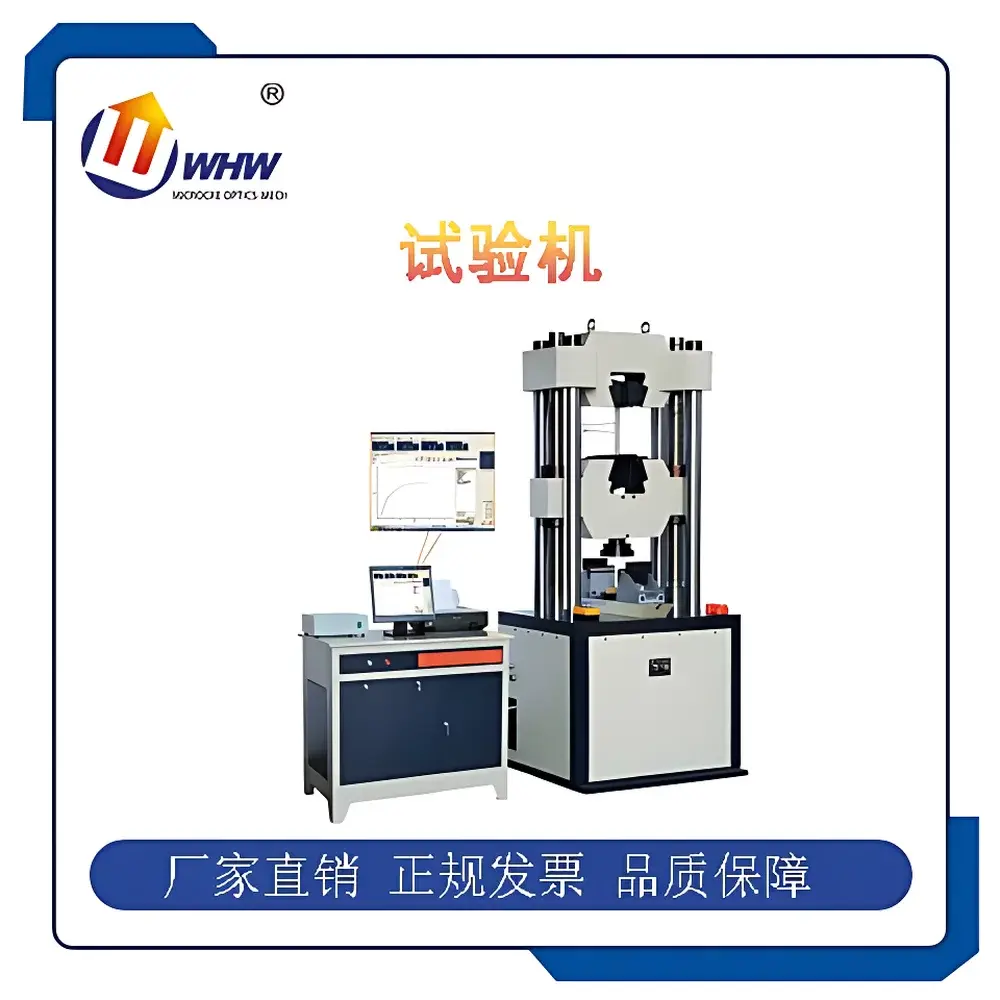
YANRUN MC009 Series Microcomputer-Controlled Electro-Hydraulic Servo Universal Testing Machine WAW-1000G
| Brand | YANRUN |
|---|---|
| Origin | Shanghai, China |
| Manufacturer Type | Direct Manufacturer |
| Country of Origin | China |
| Model | MC009-WAW-1000G |
| Instrument Type | Electro-Hydraulic Servo Testing Machine |
| Load Capacity Range | 20–1000 kN |
| Load Accuracy | ±1% or ±0.5% FS |
| Test Force Resolution | 0.002 kN |
| Displacement Resolution | 0.01 mm |
| Deformation Measurement Accuracy | 0.005 mm |
| Control Modes | Constant Load / Constant Displacement / Constant Strain (0.4–100% FS) |
| Control Accuracy | ±1.0% (for setpoints <10% FS), ±0.5% (≥10% FS) |
| Strain Rate Control Accuracy | ±2.0% (<0.05% FS), ±0.5% (≥0.05% FS) |
| Tensile Space | 850 mm |
| Compression Space | 750 mm |
| Piston Stroke | 250 mm |
| Round Specimen Grip Range | Φ13–Φ60 mm |
| Flat Specimen Grip Thickness | 0–40 mm |
| Bending Span | 450 mm |
| Bending Roller Diameter | Φ30 mm |
| Max Bending Depth | 150 mm |
| Max Piston Speed | 50 mm/min |
| Clamping Method | Integrated Hydraulic Clamping |
| Host Dimensions (W×D×H) | 1250×780×2650 mm |
| Oil Source Dimensions (W×D×H) | 1150×700×950 mm |
| Weight | 4550 kg |
Overview
The YANRUN MC009 Series Microcomputer-Controlled Electro-Hydraulic Servo Universal Testing Machine WAW-1000G is a high-capacity, precision-engineered mechanical testing system designed for static tensile, compression, bending, and shear testing of metallic and non-metallic materials. It operates on the principle of closed-loop electro-hydraulic servo control, where real-time feedback from load cells, extensometers, and displacement transducers enables dynamic regulation of hydraulic actuation via proportional servo valves. The machine conforms to international mechanical testing standards including ASTM E4, ASTM E8/E8M, ISO 6892-1, ISO 7500-1, and GB/T 228.1—2021, supporting Class 0.5 or Class 1 accuracy per ISO 7500-1:2018. Its lower-mounted cylinder architecture ensures gravitational stability during high-load compression tests, while the upper tensile zone provides unobstructed specimen access and optical compatibility for digital image correlation (DIC) systems. The geometric alignment of the loading train — with coaxial piston rod, crosshead, and grip centers — minimizes parasitic bending moments, enhancing measurement fidelity across the full 20–1000 kN operating range.
Key Features
- Lower-cylinder, single-column frame design with optimized load path geometry and enhanced structural rigidity for long-term repeatability under cyclic and static loads.
- Integrated hydraulic clamping system with pressure-regulated jaw actuation, enabling uniform gripping force across round (Φ13–Φ60 mm) and flat (up to 40 mm thick) specimens without manual torque adjustment.
- High-resolution data acquisition: 24-bit A/D conversion with 1/500,000 internal resolution, enabling seamless full-range measurement without range switching or signal attenuation.
- Multi-mode closed-loop control: Simultaneous or independent regulation of test force (±0.5% FS accuracy ≥10% FS), displacement (0.01 mm resolution), and strain (0.005 mm accuracy) at user-defined rates.
- Dual protection architecture: Hardware-based overload cutoff (triggered at >103% FS) and software-enforced stroke limit detection prevent mechanical overtravel and protect both equipment and operator.
- Modular oil source unit with high-efficiency variable-speed motor, multi-stage filtration (including high-pressure particulate filters), and pressure-compensated servo valve manifold for stable flow delivery under varying ambient temperatures.
Sample Compatibility & Compliance
The WAW-1000G accommodates standard and custom geometries per ASTM E8, ISO 6892-1, and EN 10002-1, including round bars, flat sheets, welded joints, castings, and composite laminates. Its 850 mm tensile height and 750 mm compression clearance support extended gauge length testing and large-section structural components. Bending fixtures comply with ASTM E290 and ISO 7438, featuring adjustable roller spacing (450 mm span), hardened Φ30 mm rollers, and 150 mm maximum deflection capability. All mechanical interfaces meet ISO 26203-1 requirements for grip alignment verification. The system supports GLP-compliant audit trails when integrated with validated software; hardware-level traceability is maintained through NIST-traceable load cell calibration certificates (included at shipment) and annual recalibration intervals aligned with ISO/IEC 17025 laboratory accreditation protocols.
Software & Data Management
The embedded Windows-based control and analysis platform supports real-time plotting, multi-channel synchronized acquisition (force, displacement, strain, temperature), and automated report generation in PDF/XLS formats compliant with ISO 14253-1 and ASTM E1300. Raw data is stored in binary .tdms format with embedded metadata (operator ID, calibration date, environmental conditions), ensuring integrity for FDA 21 CFR Part 11 compliance when configured with electronic signatures and role-based access control. Export modules include ASCII, CSV, and universal HDF5 for third-party post-processing in MATLAB, Python (NumPy/Pandas), or MTS TestSuite. Software validation documentation (IQ/OQ protocols) is available upon request for regulated environments requiring GMP or aerospace qualification (e.g., AS9100 Rev D).
Applications
- Mechanical property certification of structural steels, aluminum alloys, titanium grades, and high-strength composites for aerospace OEMs and Tier-1 suppliers.
- Quality assurance testing of welded pipe joints, rebar couplers, and pre-stressed concrete anchors per ASTM A615/A615M and EN 10080.
- Research-grade characterization of polymer matrix composites under combined axial-torsional loading (when equipped with optional torsion module).
- Validation of additive manufacturing (AM) build parameters via tensile-to-failure mapping across build plates, supporting ASTM F3122 and ISO/ASTM 52904 workflows.
- Long-term creep and relaxation studies using sustained-load hold functionality with drift compensation algorithms.
FAQ
What standards does the WAW-1000G comply with for calibration and verification?
It meets ISO 7500-1:2018 (Class 0.5 or 1), ASTM E4, and GB/T 228.1—2021. Factory calibration includes NIST-traceable load cell certification and geometric alignment verification reports.
Can the system be integrated into an existing LIMS or MES environment?
Yes — via OPC UA or TCP/IP API interface; custom drivers are available for Siemens SIMATIC IT, LabVantage, and Thermo Fisher SampleManager.
Is remote diagnostics and firmware update supported?
Standard Ethernet connectivity enables secure remote maintenance through TLS-encrypted VNC sessions; firmware updates require authenticated USB key authorization.
What is the recommended maintenance schedule for hydraulic components?
Oil replacement every 2,000 operational hours or biannually (whichever occurs first); filter elements replaced quarterly; servo valve inspection annually by certified YANRUN service engineers.
Does the system support high-speed dynamic testing?
No — it is optimized for quasi-static testing (0.00025–50 mm/min crosshead speed). For dynamic or fatigue applications, consider the YANRUN DF series electrodynamic systems.



