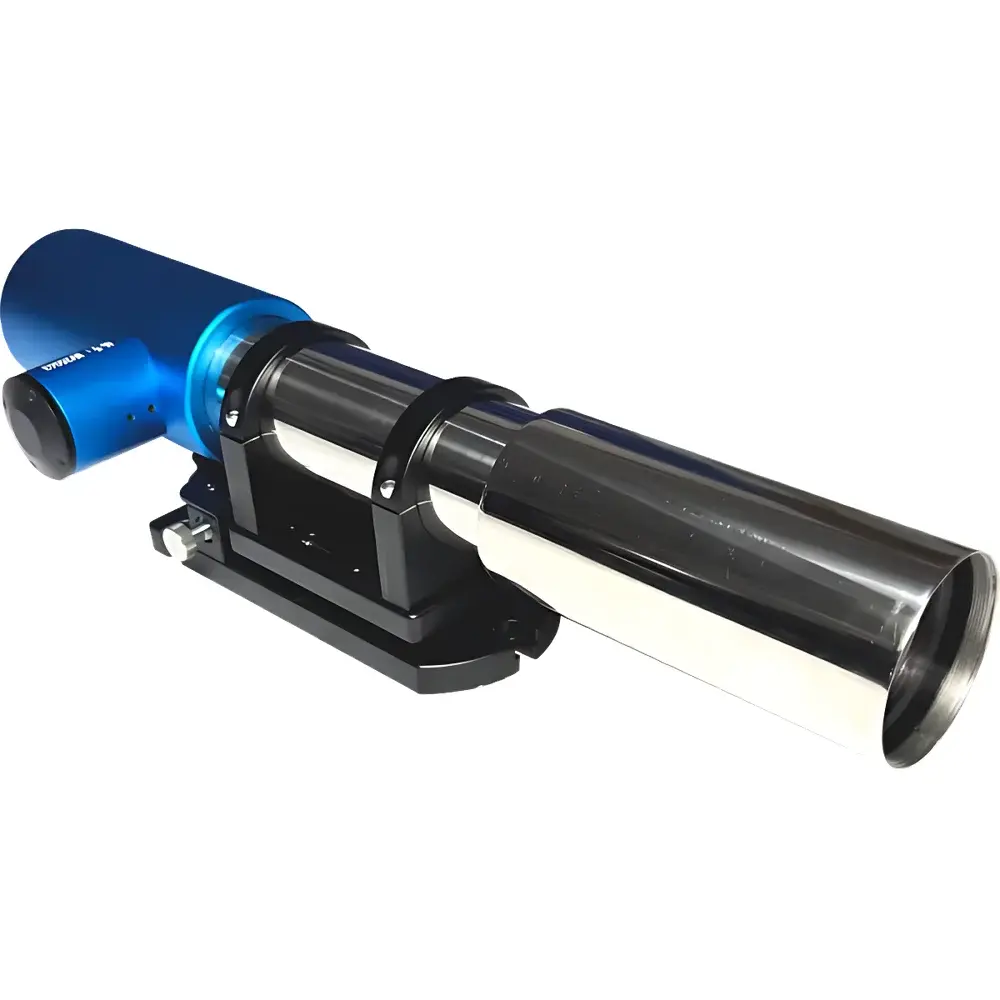
YANRUN MC030-LD350/60/0.5 Auto-Collimator
| Brand | YANRUN |
|---|---|
| Origin | Shanghai, China |
| Manufacturer Type | Manufacturer |
| Model | LD350/60/0.5 |
| Focal Length | 350 mm |
| Aperture | 60 mm |
| Light Source | High-Stability LED |
| Measurement Range | 0–40 m |
| Angular Resolution | 0.1″ to 0.0001″ (adjustable, arc seconds) |
| Field of View (X/Y) | 1800″ × 1500″ (arc seconds) |
| Accuracy (Center) | ±0.5″ @ ±100″, ±1″ @ ±600″ |
| Frequency Response | ≤30 Hz |
| Interface | USB 2.0 |
| OS Compatibility | Windows 7 or later (64-bit) |
Overview
The YANRUN MC030-LD350/60/0.5 Auto-Collimator is a high-precision electro-optical angular measurement instrument engineered for traceable, non-contact evaluation of angular deviations in mechanical, optical, and aerospace systems. It operates on the fundamental principle of optical autocollimation: a collimated beam—generated by projecting a reticle located at the focal plane of a 350 mm focal length objective lens—is reflected by a planar mirror under test and reimaged onto a high-resolution photodetector array situated at the same focal plane. A mirror tilt α induces a linear displacement ΔS on the detector surface proportional to 2α, enabling sub-arcsecond angular quantification. This dual-axis (X/Y) configuration supports simultaneous orthogonal angular assessment without mechanical reorientation, making it suitable for dynamic alignment verification, stability monitoring, and long-term drift analysis in controlled laboratory and industrial environments.
Key Features
- Dual-axis real-time angular measurement with independent X- and Y-channel readouts, eliminating sequential axis scanning and reducing cumulative setup error.
- Integrated electronic eyepiece technology replaces manual visual alignment, removing observer-dependent parallax and subjective targeting uncertainty.
- High-stability semiconductor LED illumination system ensures consistent luminance over >50,000 hours, minimizing thermal drift and intensity fluctuation during extended calibration cycles.
- Adjustable angular resolution down to 0.0001 arc seconds (0.05 µrad), configurable via software to match application-specific sensitivity and noise tolerance requirements.
- Modular accessory architecture—including interchangeable retroreflectors, precision mounts, motorized stages, and beam splitters—enables adaptation to diverse metrology workflows such as rotary table calibration, multi-axis machine tool verification, and interferometric reference alignment.
- Native support for multilingual UI (English, Chinese, Russian, Korean) with full localization of menus, error prompts, and report metadata—critical for multinational manufacturing and academic collaborations.
- USB 2.0 interface compliant with standard HID and CDC protocols, ensuring plug-and-play compatibility with Windows 7+ (64-bit) without proprietary driver dependencies.
Sample Compatibility & Compliance
The MC030-LD350/60/0.5 accommodates reflective surfaces with minimum reflectivity ≥4% (e.g., bare aluminum, coated mirrors, polished steel, silicon wafers) across its 0–40 m working distance range. Its 60 mm aperture supports robust signal capture even under low-light or vibration-prone conditions. The instrument conforms to core dimensional metrology standards including ISO 230-1 (machine tool testing), ISO 10360-2 (coordinate measuring machine acceptance), and ASTM E2915 (optical alignment procedures). While not certified to GLP or FDA 21 CFR Part 11 out-of-the-box, audit-ready data logging—including timestamped raw sensor outputs, user ID tagging, and version-controlled firmware logs—can be implemented via third-party validation packages aligned with GMP-aligned quality systems.
Software & Data Management
Bundled YANRUN Collimation Suite v4.x provides comprehensive control, visualization, and reporting functionality. Real-time waveform plots display both X- and Y-axis angular deviations with configurable averaging windows (1–100 samples) and digital filtering (low-pass cutoff: 0.1–30 Hz). All measurements are stored in structured binary format with embedded metadata (instrument ID, operator, date/time, environmental notes). Export options include native .xlsx reports compliant with ISO/IEC 17025 documentation requirements, CSV for statistical process control (SPC) integration, and .png/.svg vector graphics for technical documentation. Software supports batch processing of time-series datasets, statistical summary generation (mean, std dev, max/min, Cg/Cgk), and pass/fail threshold overlays per ANSI/ASME B89.1.12M guidelines.
Applications
- Precision installation and in-situ alignment of CNC machine tools, coordinate measuring machines (CMMs), and large-scale optical benches.
- Geometric error mapping—including straightness, flatness, perpendicularity, and parallelism—for ASME B5.54 and ISO 230-6 compliance verification.
- Dynamic stability assessment of air-bearing rotation stages used in semiconductor lithography and synchrotron beamline instrumentation.
- Aerospace component verification: wing spar angular tolerancing, gimbal mount repeatability, and inertial sensor platform leveling.
- Optical assembly metrology: laser cavity alignment, telescope collimation, and interferometer reference arm stabilization.
- Academic and national metrology lab use for teaching autocollimation fundamentals, calibrating angle artifacts, and validating angular encoders per ISO 10012.
FAQ
What is the maximum measurable angular range before image loss occurs?
The instrument maintains full field-of-view coverage up to ±600 arc seconds (±0.167°); beyond this, the reticle image moves outside the active sensor area, triggering automatic warning indicators in software.
Can the system measure angular motion at frequencies above 30 Hz?
The specified ≤30 Hz frequency response reflects the analog bandwidth of the photodetector electronics and USB polling latency; higher-frequency components require external high-speed DAQ synchronization using TTL trigger output.
Is NIST-traceable calibration documentation included?
A factory calibration certificate (ISO/IEC 17025 accredited by CNAS) is provided with each unit, listing as-delivered accuracy against primary angle standards; optional annual recalibration services are available through authorized YANRUN service centers.
Does the software support automated pass/fail reporting per GD&T specifications?
Yes—user-defined geometric tolerances (e.g., ISO 1101 orientation controls) can be imported as XML templates; the software auto-generates annotated reports with deviation color-coding, statistical summaries, and PDF export.
How is thermal drift compensated during extended measurements?
The optical bench features low-expansion aluminum alloy construction (CTE ≈ 23 × 10⁻⁶/K), and internal temperature sensors feed real-time compensation coefficients into the angular calculation algorithm, reducing thermal-induced bias to <0.02″/°C over 0–40°C ambient range.