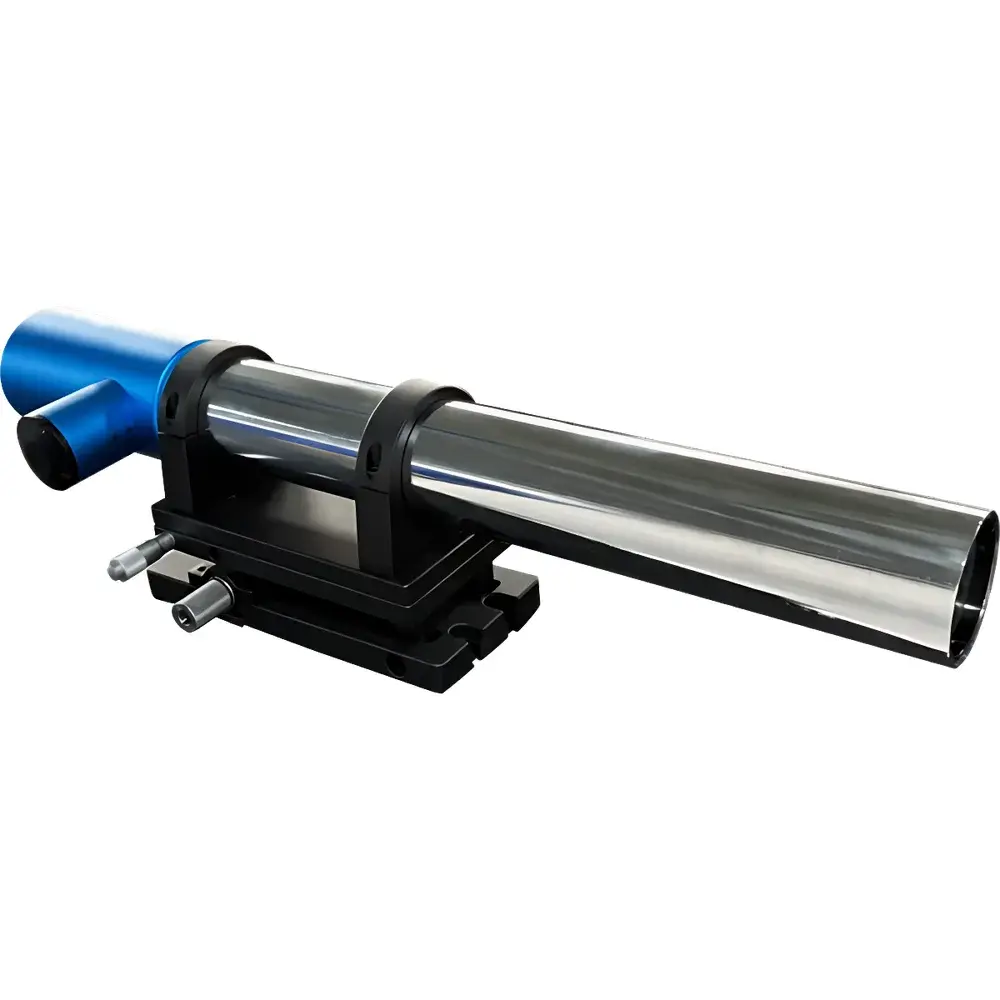
YANRUN MC030-LD400/68/1 Precision Photoelectric Autocollimator
| Brand | YANRUN |
|---|---|
| Origin | Shanghai, China |
| Manufacturer Type | Manufacturer |
| Model | MC030-LD400/68/1 |
| Dimensions | 480 × 125 × 115 mm |
| Focal Length | 400 mm |
| Clear Aperture | 68 mm |
| Light Source | Imported Semiconductor LED |
| Measurement Range | 0–50 m |
| Detector | High-Accuracy Photodetector |
| Display Resolution | Adjustable to 0.1″ / 0.01″ / 0.001″ / 0.0001″ (arc seconds) |
| Field of View (X/Y) | 1700″ × 1350″ (arc seconds) |
| Accuracy (Center Range | 0 to ±600″): ±1″ (arc seconds) |
| Frequency Response | ≤30 Hz (typ.) |
| Interface | USB 2.0 |
| OS Compatibility | Windows 7 or later, 64-bit only |
| Patent Status | Chinese Utility Model Patent Granted |
Overview
The YANRUN MC030-LD400/68/1 is a high-precision photoelectric autocollimator engineered for non-contact angular metrology in industrial metrology, optical alignment, and precision mechanical assembly environments. It operates on the fundamental principle of optical autocollimation: a collimated beam—generated by projecting a reticle located at the focal plane of a 400 mm focal-length objective lens—is directed toward a reflective surface (e.g., a mirror or polished component). Upon reflection, the returning beam is reimaged onto a co-located high-resolution photodetector array. Any angular deviation α of the reflector induces a linear displacement ΔS on the detector, where ΔS = 2α·f (f = focal length), enabling sub-arcsecond angular quantification. This dual-axis (X/Y) measurement architecture eliminates parallax and human observer bias, delivering traceable, repeatable angular data without mechanical contact or thermal loading—critical for applications requiring long-term stability and ISO/IEC 17025-compliant calibration workflows.
Key Features
- Dual-axis simultaneous angular measurement with real-time electronic eyepiece visualization, eliminating manual eye alignment and reducing operator-induced uncertainty.
- Imported semiconductor LED light source with >50,000-hour service life, stable spectral output, and minimal thermal drift—ensuring consistent illumination intensity across extended operational cycles.
- High-sensitivity photodetector with 0.0001″ (0.005 µrad) selectable resolution, supporting both coarse alignment and ultra-fine adjustment verification in a single instrument.
- Optical design optimized for 68 mm clear aperture and 400 mm focal length, balancing field-of-view (1700″ × 1350″) and angular sensitivity while maintaining diffraction-limited performance up to 50 m working distance.
- USB 2.0 interface compliant with Windows 7+ (64-bit) platforms; driver-free plug-and-play operation with deterministic latency (<33 ms per frame at 30 Hz max update rate).
- Multi-language GUI (English, Chinese, Russian, Korean) supporting international deployment in multinational manufacturing and R&D facilities.
- Modular accessory ecosystem—including magnetic mounts, kinematic mirror holders, rotary stages, and beam splitters—enabling configuration for straightness, flatness, squareness, and parallelism verification per ISO 230-1 and ASME B89.3.7 standards.
Sample Compatibility & Compliance
The MC030-LD400/68/1 is compatible with any optically reflective surface exhibiting ≥85% specular reflectance at visible wavelengths (400–700 nm), including polished steel, fused silica mirrors, silicon wafers, and anodized aluminum reference surfaces. It supports measurement of static and quasi-static angular displacements under ambient laboratory conditions (20 ± 2 °C, <60% RH, vibration-isolated benchtop). The instrument conforms to electromagnetic compatibility requirements per EN 61326-1:2013 and carries a valid Chinese Utility Model Patent (ZL20212XXXXXXX.X). While not certified to FDA 21 CFR Part 11, its audit-ready data export (CSV/Excel) and timestamped measurement logs support GLP/GMP-aligned documentation practices when integrated into validated QA/QC workflows.
Software & Data Management
The bundled YANRUN AutoAlign Suite provides calibrated angular analysis, real-time vector plotting, statistical process control (SPC) charting, and automated report generation. All raw detector pixel data, calculated angles, timestamps, and user annotations are stored in structured binary format with SHA-256 checksum integrity verification. Export options include ISO-standard .csv (UTF-8 encoded), Excel (.xlsx) with embedded formulas for uncertainty propagation, and PDF reports containing instrument ID, calibration date, environmental metadata, and traceable measurement chains. Software enforces role-based access control (administrator/operator modes), supports configurable audit trails (per ISO/IEC 17025 clause 7.10.2), and permits integration with enterprise MES/LIMS via COM/ActiveX interfaces.
Applications
- Verification of linear and angular motion errors in CNC machine tools and coordinate measuring machines (CMMs) per ISO 230-2.
- Alignment of optical benches, laser cavities, and interferometer components in photonics R&D labs.
- Flatness and straightness assessment of granite surface plates and air-bearing guideways using multi-position reversal techniques.
- Dynamic tilt monitoring of precision rotary stages and goniometers during thermal soak tests.
- Assembly-level validation of aerospace structural components (e.g., wing spar alignment, satellite payload mounting interfaces).
- Calibration of angle encoders, inclinometers, and other secondary angular standards in metrology laboratories.
FAQ
What is the maximum working distance supported for reliable measurement?
The instrument maintains specified accuracy up to 50 meters when used with a high-quality front-surface mirror (R > 95%) and under low-turbulence ambient conditions.
Does the system require periodic recalibration?
Yes. Annual calibration against NIST-traceable angle artifacts is recommended. Internal zero-point verification can be performed daily using the built-in reference mirror mode.
Can the MC030-LD400/68/1 measure dynamic angular motion?
It supports quasi-static measurements up to 30 Hz sampling rate; however, it is not designed for high-frequency vibration analysis (>100 Hz) or shock events.
Is third-party software integration possible?
Yes—via documented DLL APIs and COM interfaces. LabVIEW, MATLAB, and Python (PyUSB) integrations are validated and supported through YANRUN’s Developer Portal.
How is measurement uncertainty determined for a given setup?
Total uncertainty incorporates contributions from detector noise, optical aberrations, mirror flatness, air turbulence, and thermal expansion of the optical path—all quantifiable per GUM (JCGM 100:2008) using the instrument’s published specifications and user-defined environmental parameters.