
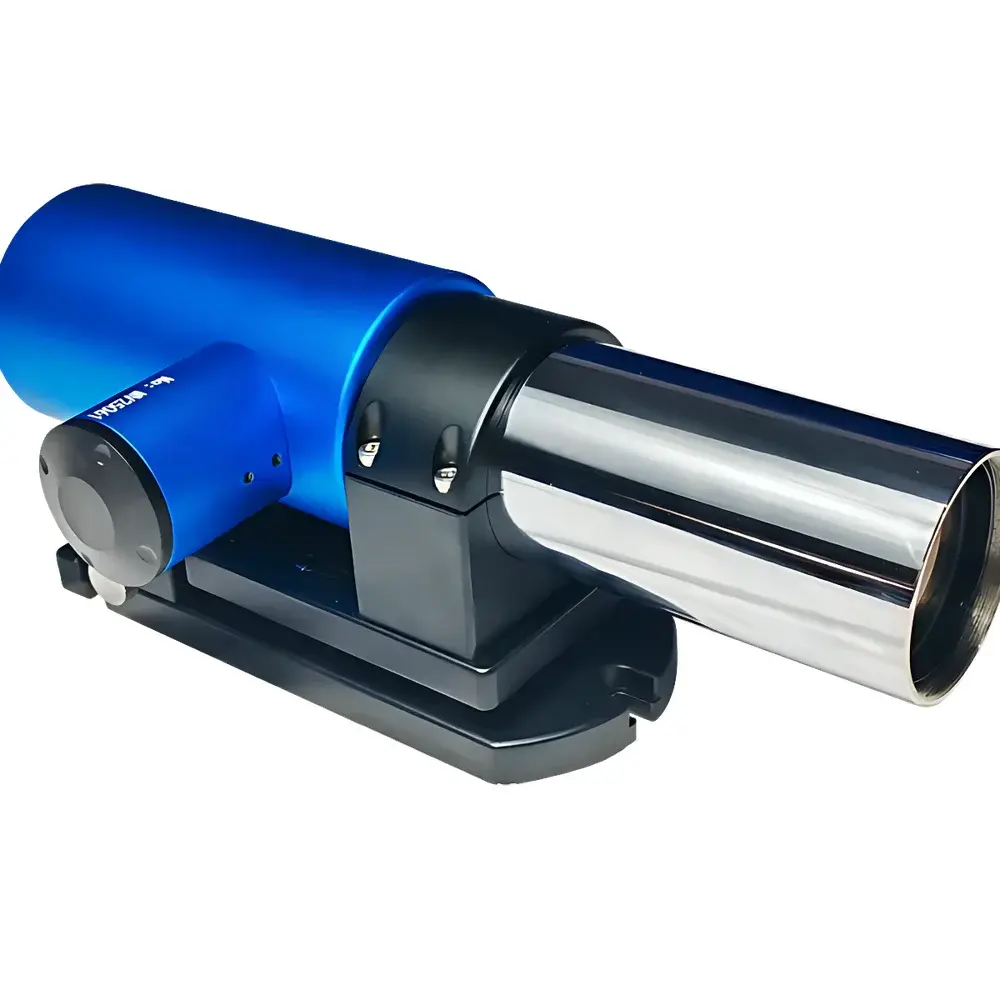
YANRUN MC030-ZJPX200-2350HZ Dual-Axis Electronic Autocollimator
| Brand | YANRUN |
|---|---|
| Origin | Shanghai, China |
| Manufacturer Type | Direct Manufacturer |
| Product Origin | Domestic (China) |
| Model | MC030-ZJPX200-2350HZ |
| Price Range | USD 7,000 – 28,000 |
Overview
The YANRUN MC030-ZJPX200-2350HZ is a high-precision dual-axis electronic autocollimator engineered for non-contact angular metrology in demanding industrial and metrological environments. Based on the fundamental principle of optical autocollimation—where a collimated beam is reflected back from a target mirror and imaged onto a high-resolution CMOS sensor—the instrument quantifies angular deviations by analyzing sub-pixel displacement of the returned beam centroid. Unlike traditional visual or mechanical autocollimators, this system integrates real-time digital image processing algorithms to deliver simultaneous, synchronous measurements along orthogonal X and Y axes with arcsecond-level resolution. Its design adheres to core optical metrology principles defined in ISO 10110-5 (surface form tolerances), ISO 21098 (autocollimator performance specifications), and supports traceable calibration protocols compliant with ISO/IEC 17025 requirements. The device is optimized for use in clean-room assembly lines, precision machine tool verification, optical alignment of interferometer components, and geometric error mapping of linear and rotary stages.
Key Features
- Dual-axis simultaneous measurement capability—real-time acquisition of angular deviation in both horizontal (X) and vertical (Y) planes without mechanical reorientation
- High-resolution CMOS imaging sensor with on-board centroid detection algorithm enabling stable sub-arcsecond repeatability
- Modular optical architecture supporting interchangeable objective lenses and extended working distances up to 20 m (dependent on aperture and mirror quality)
- Integrated thermal stabilization and vibration-damping housing to minimize drift under ambient temperature fluctuations (±0.5 °C/h)
- USB 3.0 interface with deterministic latency (<15 ms frame-to-host transfer) for synchronized data capture in automated test systems
- Compact, portable form factor (≤2.8 kg) with integrated battery option for field deployment in metrology labs and production floors
Sample Compatibility & Compliance
The MC030-ZJPX200-2350HZ requires a reflective surface—typically an optically flat mirror (λ/20 or better)—to serve as the angular reference target. It is compatible with standard kinematic mirror mounts (e.g., Thorlabs KM100, Newport UMB1) and accepts mirror sizes from Ø25 mm to Ø150 mm. Mirror surface quality, reflectivity (>95% at 633 nm), and mounting stability directly influence measurement uncertainty; therefore, users are advised to follow ISO 10110-7 guidelines for mirror specification and mounting. The instrument meets CE marking requirements for electromagnetic compatibility (EN 61326-1) and safety (EN 61010-1). Its firmware architecture supports audit-trail logging and user-access control, facilitating compliance with GLP and GMP documentation standards where angular verification is part of process validation (e.g., semiconductor lithography stage alignment or laser cavity setup).
Software & Data Management
The system ships with YANRUN Autocollimator Control Suite v4.x—a Windows-based application supporting both manual operation and programmable automation via TCP/IP and DLL APIs. The software provides real-time vector display of angular deviation, statistical process control (SPC) charts with Cp/Cpk calculation, and export of time-stamped CSV/ASCII datasets compatible with MATLAB, Python (NumPy/Pandas), and Metrology Data Exchange Format (MDEF). All measurement sessions include embedded metadata: operator ID, timestamp (UTC-synced), environmental conditions (optional external sensor input), and calibration certificate ID. For regulated environments, optional FDA 21 CFR Part 11-compliant configuration includes electronic signatures, role-based permissions, and immutable audit logs with SHA-256 hash integrity verification.
Applications
- Geometric error mapping of CNC machine tool axes (pitch, yaw, roll) per ISO 230-1 and VDI/VDE 2617 standards
- Alignment verification of multi-element optical systems—including telescope primary/secondary mirrors, laser resonators, and beam delivery optics
- In-process monitoring of precision bearing and spindle runout during assembly of ultra-precision spindles and coordinate measuring machine (CMM) guideways
- Calibration of angle encoders, inclinometers, and tilt sensors using reversal techniques per ISO 10012
- Thermal deformation analysis of large-scale structures (e.g., synchrotron beamline components) via long-term angular drift tracking
FAQ
What angular resolution is achievable with the MC030-ZJPX200-2350HZ?
The base model achieves ≤0.01 arcseconds (50 nrad) RMS repeatability under controlled lab conditions; higher-resolution variants (e.g., 0.001″ and 0.0001″) require custom calibration and environmental isolation.
Can this autocollimator be used with retroreflectors instead of flat mirrors?
No—it relies on specular reflection from a high-quality flat mirror; retroreflectors introduce systematic wavefront distortion incompatible with centroid-based angular reconstruction.
Is NIST-traceable calibration provided with the instrument?
Yes—each unit ships with a factory calibration certificate traceable to NIM (National Institute of Metrology, China), with optional NIST-traceable recalibration services available through authorized metrology partners.
Does the system support remote operation over Ethernet or industrial fieldbus?
Standard USB 3.0 is primary; optional Ethernet adapter module enables Modbus TCP and OPC UA integration for Industry 4.0 MES/SCADA environments.
How is thermal drift compensated during extended measurements?
Internal temperature sensors feed real-time compensation coefficients into the centroid algorithm; for sub-microarcsecond stability, active air temperature control within ±0.1 °C is recommended.



