
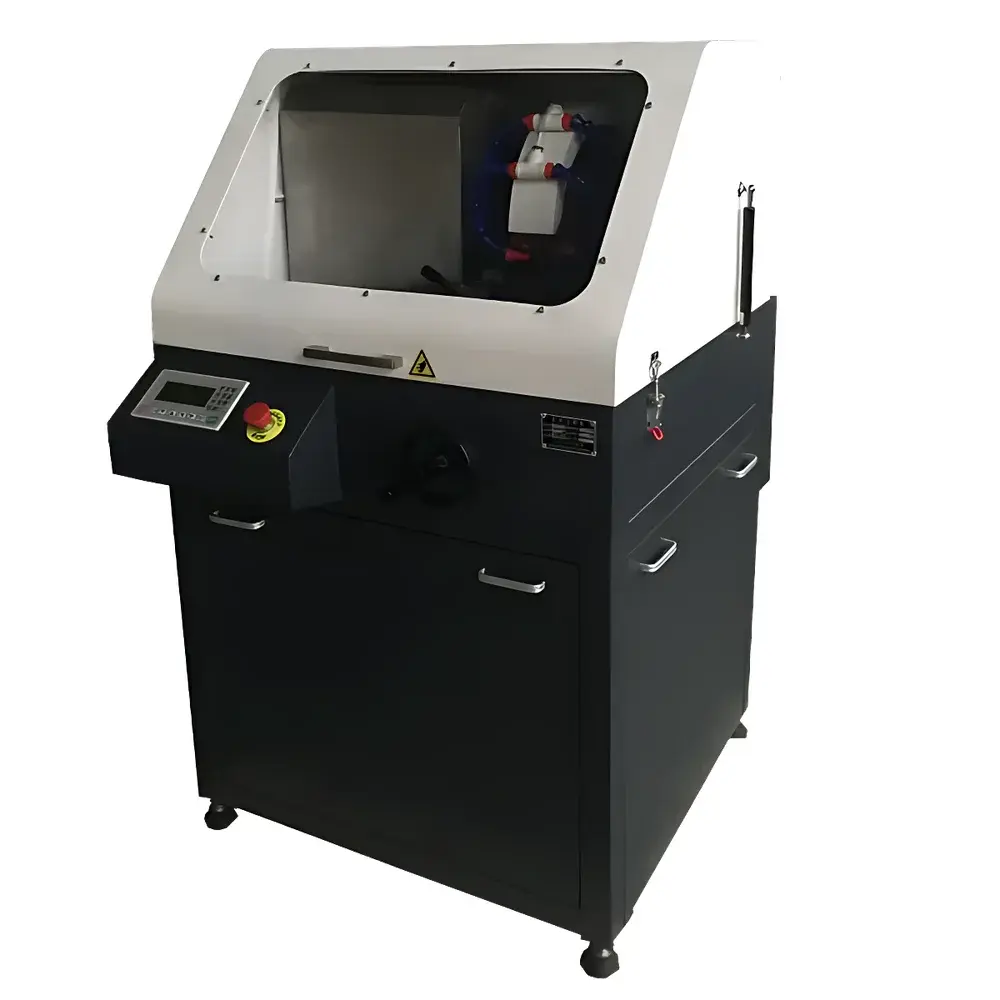
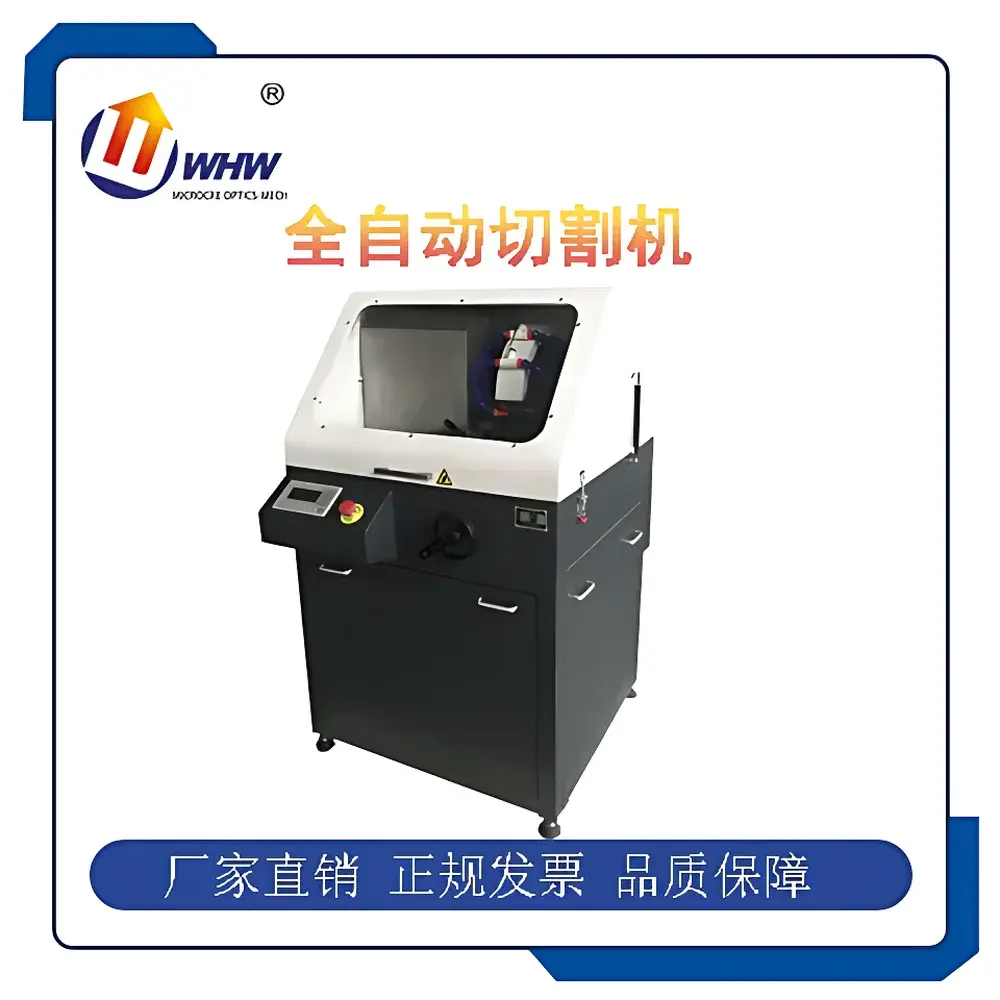
YANRUN QG-100Z Automatic Metallographic Sample Cutting Machine
| Brand | YANRUN |
|---|---|
| Origin | Shanghai, China |
| Manufacturer Type | Direct Manufacturer |
| Region of Origin | Domestic (China) |
| Model | QG-100Z |
| Instrument Type | Metallographic Cutting Machine |
| Spindle Speed | 2840 rpm |
| Max Cutting Diameter | 100 mm |
| Cutting Mode | Automatic/Manual |
| Cutting Table Dimensions | 300 × 280 mm |
| Cutting Feed Rate | 1–50 mm/min (infinitely variable) |
| Max Cutting Stroke | 280 mm (adjustable) |
| Feed Mechanism | Reciprocating (programmable) |
| Blade Specification | (300–350) × 2.0 × 32 mm |
| Cooling System | Automated 3-channel water cooling |
| Water Tank Capacity | 60 L |
| Motor Power | 4.0 kW |
| Configuration | Floor-standing integrated unit |
| Voltage Supply | 380 V AC |
| Weight | 300 kg |
Overview
The YANRUN QG-100Z Automatic Metallographic Sample Cutting Machine is an industrial-grade, floor-standing precision cutting system engineered for reproducible, thermally controlled sectioning of metallic and composite specimens prior to metallographic analysis. It operates on the principle of high-speed abrasive wheel cutting under programmable mechanical feed, where rotational energy from a 4.0 kW motor drives a diamond- or silicon-carbide-bonded blade at a fixed spindle speed of 2840 rpm. The machine’s design prioritizes specimen integrity—minimizing heat-affected zones (HAZ), microstructural distortion, and edge chipping—through synchronized coolant delivery, closed-loop stroke control, and real-time feed monitoring. Unlike general-purpose cut-off saws, the QG-100Z integrates metrological-grade motion control and environmental containment specifically to meet the stringent requirements of ASTM E3, ISO 14976, and GB/T 13298 for metallographic specimen preparation in QC laboratories, foundries, and R&D centers.
Key Features
- Large-capacity cutting chamber with 280 mm maximum vertical stroke—enabling full-sectioning of bulky castings, forgings, and welded joints up to Ø100 mm in diameter.
- Dual-mode operation: manual override for rapid positioning and fully automated cycle execution with pre-set feed rate (1–50 mm/min), stroke depth, and dwell time.
- Intuitive LCD control interface supporting parameter entry, cycle logging, and real-time digital display of remaining stroke distance—eliminating reliance on mechanical dials or external timers.
- Triple-channel automated water-cooling system delivering targeted coolant flow to both blade periphery and specimen interface, reducing thermal degradation and extending abrasive life.
- Interlocked safety enclosure with door-sensor activation—power disengages instantly upon lid opening, complying with IEC 60204-1 machinery safety standards.
- Self-return function: after cycle completion, the cutting head automatically retracts to its home position, ensuring consistent setup for sequential samples.
- Modular dual-vise clamping system with quick-release mechanism—accommodates irregular geometries and enables parallel alignment of multiple specimens without tooling adjustment.
Sample Compatibility & Compliance
The QG-100Z accommodates ferrous alloys (steels, cast irons), non-ferrous metals (aluminum, copper, titanium), sintered powders, and fiber-reinforced composites. Its 300–350 mm blade compatibility supports standard ISO 527-2 and ANSI B74.10 cutting wheels (2.0 mm thickness, 32 mm arbor). The machine conforms to GLP documentation requirements through built-in cycle traceability (date/time stamp, operator ID placeholder, parameter audit log), and its closed-loop cooling and containment design aligns with OSHA 1910.212 and EU Machinery Directive 2006/42/EC. Optional calibration certificates (traceable to NIST or CNAS-accredited labs) are available for GMP-regulated environments requiring documented equipment qualification (IQ/OQ).
Software & Data Management
While the QG-100Z operates via embedded firmware (no PC dependency), its control module stores up to 99 user-defined cutting protocols—including feed rate, stroke limit, coolant activation delay, and dwell duration—with password-protected editing. Cycle data (start/stop timestamps, total runtime, blade usage count) is retained in non-volatile memory for internal review. For integration into LIMS or MES platforms, RS-232 serial output provides ASCII-formatted event logs compatible with LabVIEW, Python-based parsing scripts, or custom SCADA gateways. All firmware updates are delivered via USB flash drive with SHA-256 checksum verification.
Applications
- Preparation of cross-sectional specimens for optical microscopy (OM), scanning electron microscopy (SEM), and electron backscatter diffraction (EBSD).
- Sectioning of weldment coupons for macro/micro examination per AWS D1.1, ASME Section IX, and EN ISO 17636.
- Routine QC sampling in heat treatment validation—e.g., case depth measurement on carburized gears or nitrided shafts.
- Failure analysis labs requiring artifact-free cuts from fracture surfaces, fatigue crack tips, or corrosion-damaged components.
- Academic metallurgy programs performing tensile bar sectioning, inclusion rating (ASTM E45), and phase transformation studies.
FAQ
What blade types are recommended for stainless steel cutting?
Diamond-impregnated resin-bonded blades (e.g., 350 × 2.0 × 32 mm, 120–150 mesh) are preferred for austenitic and duplex grades; silicon-carbide blades may be used for ferritic/martensitic steels with higher coolant flow rates.
Can the QG-100Z be integrated into an automated sample prep line?
Yes—its RS-232 port supports TTL-level handshaking for external PLC coordination; optional pneumatic vise actuation kits enable synchronization with robotic sample loaders.
Is the 60 L coolant tank sufficient for continuous operation?
Under typical 8-hour shifts with 3–5 min/cut cycles and standard 3-channel flow (2.5 L/min total), the reservoir supports ≥12 hours of uninterrupted use before refill; an auxiliary pump kit enables closed-loop recirculation with filtration.
Does the machine support ISO/IEC 17025-compliant calibration?
Yes—third-party calibration services include spindle runout verification (<5 µm TIR), stroke repeatability assessment (±0.1 mm over 200 mm), and feed rate accuracy validation (±1.5% of setpoint) with full uncertainty budget reporting.
What maintenance intervals are specified for the 4.0 kW motor and gearbox?
Lubrication of the feed screw and gear train is required every 500 operational hours; motor bearings are sealed-for-life but warrant vibration spectrum analysis annually in high-duty-cycle installations.



