
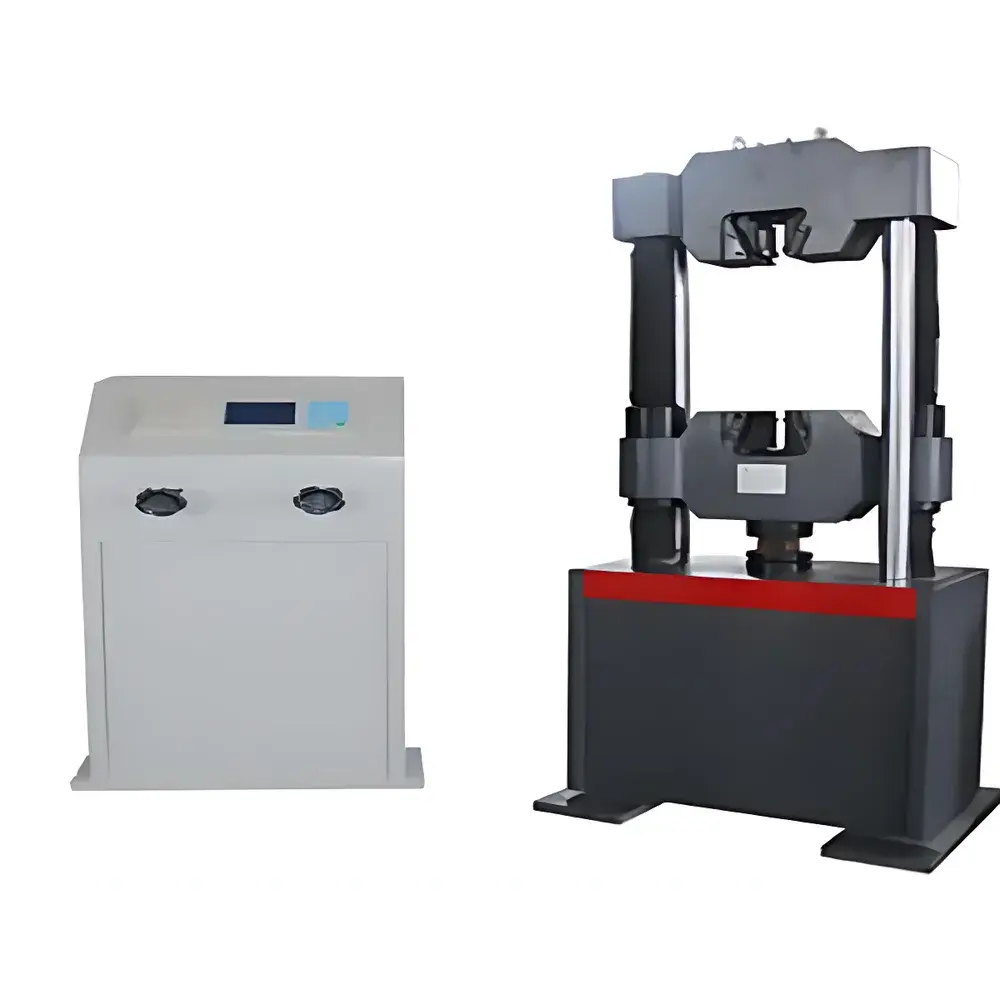
YANRUN WES-600B Electro-Hydraulic Servo Universal Testing Machine
| Brand | YANRUN |
|---|---|
| Origin | Shanghai, China |
| Manufacturer Type | Direct Manufacturer |
| Country of Origin | China |
| Model | WES-600B |
| Instrument Type | Electro-Hydraulic Servo Testing Machine |
| Max Test Load | 600 kN |
| Max Tensile Jaw Spacing | 600 mm |
| Flat Specimen Clamping Range | 0–15 mm |
| Round Specimen Clamping Range | Φ26–Φ40 mm |
| Compression Test Height | 550 mm |
| Piston Stroke | 150 mm |
| Load Indication Accuracy | ±1% of full scale |
| Bend Support Roller Spacing | 600 mm |
| Column Spacing | 450 mm |
| Motor Power | 3 kW |
| Dimensions (W×D×H) | 950 × 630 × 2265 mm |
| Weight | 2600 kg |
Overview
The YANRUN WES-600B Electro-Hydraulic Servo Universal Testing Machine is a high-capacity, precision-engineered mechanical testing system designed for static tensile, compression, bending, and shear evaluations of metallic, polymeric, composite, and ceramic materials. Built on a robust dual-column frame architecture with optimized load path geometry, the machine employs closed-loop electro-hydraulic servo control to deliver stable, repeatable force application across its full 600 kN capacity. Its measurement principle relies on high-stiffness load cells calibrated traceably to national standards, coupled with real-time displacement feedback from linear variable differential transformers (LVDTs) mounted directly on the moving crosshead. The system meets fundamental structural requirements outlined in ISO 7500-1 (Class 1 accuracy), ASTM E4 (verification of force-measuring instruments), and ASTM E8/E21 (tensile testing of metallic materials), supporting routine quality control and R&D validation workflows in manufacturing and academic laboratories.
Key Features
- Electro-hydraulic servo actuation with 3 kW high-efficiency motor and proportional pressure control valve for precise force ramping and dwell control
- Dual-column rigid frame with 450 mm column spacing and 2265 mm overall height, enabling large-scale specimen handling including full-length rebar and structural profiles
- Adjustable crosshead travel of 150 mm and maximum tensile jaw separation of 600 mm—accommodating standard and extended gage length specimens per ISO 6892-1 and ASTM A370
- Dedicated clamping systems: self-aligning wedge-type jaws for round specimens (Φ26–Φ40 mm) and flat specimens (0–15 mm thickness), each featuring hardened serrated inserts for high grip reliability
- Integrated compression assembly with spherical seat upper platen and lower fixed platen (150 mm diameter), compliant with ISO 3187 and ASTM C39/C109 test geometries
- Modular bending fixture set including adjustable support rollers (600 mm max span) and loading nose, suitable for three-point and four-point flexural tests per ISO 178 and ASTM D790
- Real-time digital display interface with LCD panel showing load, displacement, strain (when extensometer connected), and test rate—fully synchronized with host control software
Sample Compatibility & Compliance
The WES-600B accommodates a broad spectrum of standardized and custom specimen geometries. Round bar specimens from Φ26 mm to Φ40 mm and flat coupons up to 15 mm thick are secured using mechanically actuated, manually tightened jaw sets. For compression testing, cylindrical concrete or mortar specimens (up to 150 mm diameter × 300 mm height) and metal blocks are supported under controlled loading rates per ISO 13384-1. Bending fixtures accept beams up to 600 mm span with cross-sections conforming to ISO 178 (plastics) and ASTM D790 (reinforced polymers). All mechanical components—including load train elements, clamps, and platens—are manufactured to ISO 2768-mK general tolerances and undergo static load verification prior to shipment. The system’s ±1% load indication error complies with ISO 7500-1 Class 1 requirements for universal testing machines used in accredited laboratories.
Software & Data Management
The embedded control unit interfaces with optional PC-based testing software supporting Windows OS environments. The software provides configurable test templates aligned with ASTM E8, ISO 6892-1, ISO 15630-1, and GB/T 228.1 standards. It records raw load-displacement data at ≥100 Hz sampling rate, calculates engineering stress-strain curves, yield strength (Rp0.2), ultimate tensile strength (Rm), elongation (A50mm), and modulus of elasticity (E). Audit-trail functionality logs operator ID, timestamp, calibration events, and parameter modifications—supporting GLP and internal QA documentation needs. Export options include CSV, XLSX, and PDF report generation with embedded graphs, metadata headers, and digital signature fields. While not natively 21 CFR Part 11 compliant, the software architecture permits integration with third-party electronic lab notebook (ELN) systems via API or file-based synchronization.
Applications
- Mechanical property certification of structural steel grades (e.g., ASTM A615, GB/T 1499.2) in construction material QA labs
- Tensile evaluation of welded joints and heat-affected zones (HAZ) per AWS D1.1 and ISO 4136
- Compression testing of precast concrete elements and grout specimens in civil engineering R&D
- Bending performance assessment of fiber-reinforced polymer (FRP) laminates used in aerospace secondary structures
- Quality conformance testing of fasteners, anchor bolts, and threaded rods per ISO 898-1 and ASTM F606
- Educational demonstrations of stress–strain behavior, necking phenomena, and fracture mechanics fundamentals
FAQ
What standards does the WES-600B comply with for force calibration and verification?
It conforms to ISO 7500-1 (Class 1), ASTM E4, and GB/T 16825.1 for static calibration of force-proving instruments.
Is an extensometer supported for strain measurement?
Yes—the system includes analog and digital input channels compatible with clip-on and video extensometers meeting ISO 9513 Class 1 specifications.
Can the machine perform cyclic or fatigue testing?
No. The WES-600B is configured exclusively for static monotonic loading; it lacks the dynamic actuation hardware and controller firmware required for low-cycle or high-cycle fatigue protocols.
What maintenance intervals are recommended for hydraulic oil and filters?
Hydraulic oil should be replaced every 2,000 operating hours or biannually, whichever occurs first; suction and pressure filters require inspection every 500 hours and replacement as needed per OEM service manual.
Does the system support remote diagnostics or network connectivity?
Standard configuration includes USB and RS-232 ports; optional Ethernet module enables local network access for file transfer and basic remote status monitoring—but no cloud-based telemetry or OTA updates.



