
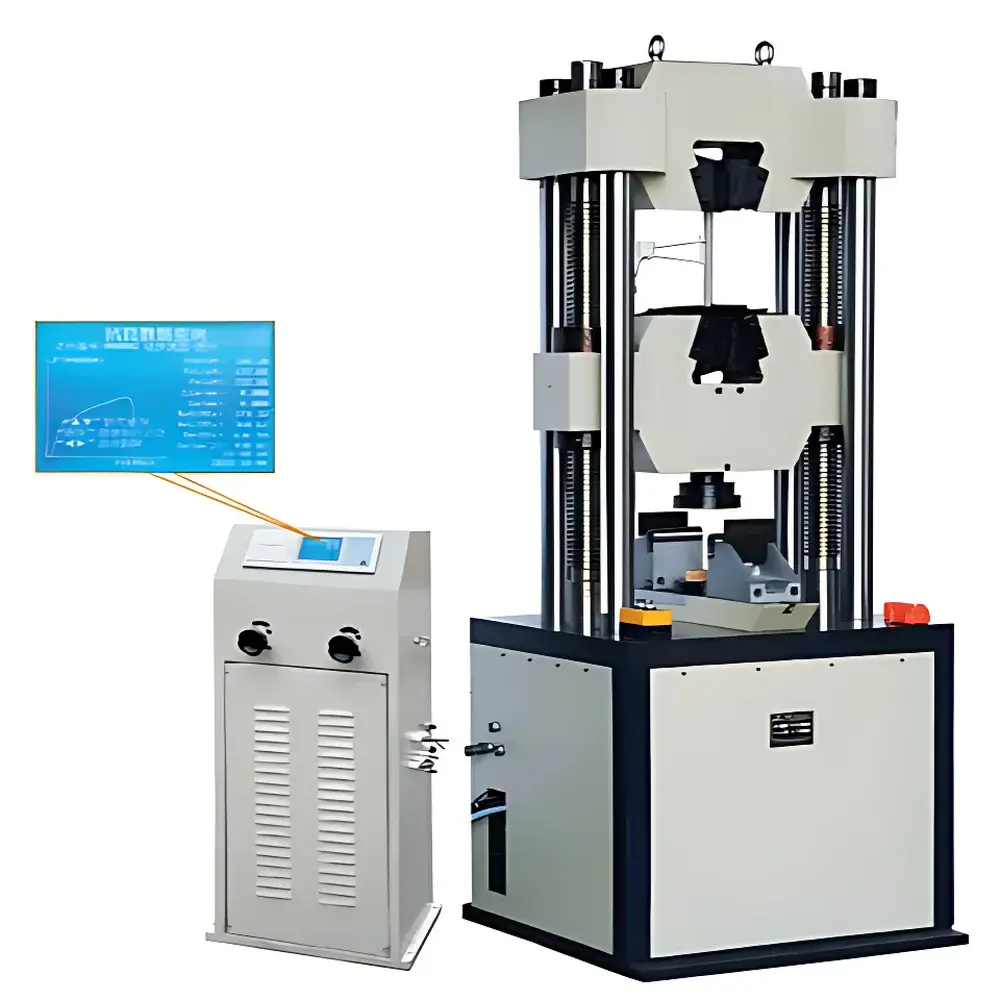
YANRUN WES600-1000D Digital Hydraulic Universal Testing Machine
| Brand | YANRUN |
|---|---|
| Origin | Shanghai, China |
| Manufacturer Type | Direct Manufacturer |
| Model | WES600-1000D |
| Instrument Type | Hydraulic Universal Testing Machine |
| Max Test Force | 600 kN / 1000 kN |
| Force Measurement Range | 4–100% FS |
| Force Indication Error | ≤ ±1% |
| Force Resolution | 0.01 kN |
| Tensile Space | 650 mm / 750 mm |
| Compression Space | 380 mm / 460 mm |
| Specimen Grip Type | Automatic Clamping |
| Round Specimen Diameter Range | Φ13–40 mm |
| Flat Specimen Thickness Range | 0–15 mm (15–30 mm optional) |
| Flat Specimen Max Width | 75 mm |
Overview
The YANRUN WES600-1000D Digital Hydraulic Universal Testing Machine is a dual-capacity, floor-mounted hydraulic testing system engineered for high-reliability mechanical property evaluation of metallic and non-metallic materials in industrial QA/QC, construction materials verification, and structural component validation. It operates on a proven hydro-mechanical principle: a high-stability servo-controlled hydraulic actuation system applies precisely regulated compressive or tensile loads to specimens via a lower-positioned piston cylinder, while load measurement is performed using a calibrated electronic load cell integrated into the load train. The machine supports standardized quasi-static testing per ASTM E4, ASTM E8/E8M (tension), ASTM E9 (compression), ISO 6892-1, ISO 37, and GB/T 228.1—enabling traceable determination of yield strength (Rp0.2), ultimate tensile strength (Rm), elongation at break (A%), modulus of elasticity, and compressive strength for concrete, cementitious composites, plastics, and welded assemblies.
Key Features
- Floor-mounted, low-profile architecture with bottom-mounted hydraulic cylinder—reducing overall height and improving spatial efficiency in constrained lab or field-deployed environments.
- Dual-capacity configuration (600 kN and 1000 kN models) accommodates broad material stiffness and strength ranges without mechanical range switching—ensuring seamless transition across ductile metals, high-strength alloys, and brittle civil engineering materials.
- Electronically calibrated load measurement system with 0.01 kN resolution and ≤ ±1% indication error across 4–100% of full scale—meeting Class 1 accuracy requirements per ISO 7500-1 and ASTM E4.
- Motor-driven crosshead adjustment via precision roller chain and ball screw transmission—enabling rapid, repeatable positioning of test zones for tensile (up to 750 mm), compression (up to 460 mm), and bending configurations.
- Integrated overload protection (trip threshold at +3% FS) and mechanical upper-limiter switch—automatically de-energizing the oil pump motor to prevent actuator overtravel or force transducer damage.
- Backlit LCD interface displaying real-time force–time curves, peak load capture, yield point detection for materials exhibiting distinct yielding behavior, and direct calculation of Rm, Rp0.2, and E-modulus upon input of specimen geometry.
Sample Compatibility & Compliance
The WES600-1000D accommodates standardized and custom geometries through interchangeable grip systems: automatic wedge-action clamps for round specimens (Φ13–40 mm), parallel flat grips (0–15 mm thickness, extendable to 30 mm), and 75 mm maximum jaw width for wide-section materials. With optional shear fixtures, it performs ASTM D732-compliant punch shear tests on metallic sheets and fasteners. Compression platens conform to ASTM C39/C39M for concrete cylinders and ISO 7435 for ceramic tiles. All control firmware and data handling comply with GLP documentation requirements; audit trails for test parameter entry, calibration events, and result export are retained locally. While not natively 21 CFR Part 11 compliant, the system supports external validation protocols for regulated environments when paired with secure network logging and user-access controls.
Software & Data Management
The embedded controller provides standalone operation without PC dependency—ideal for site-based construction labs or mobile testing units. Test parameters (specimen ID, cross-sectional area, gauge length) are entered via numeric keypad; results—including calculated mechanical properties, force–displacement plots, and statistical summaries—are viewable on-screen and exportable via RS232 to a connected thermal printer (optional). For advanced analysis, raw load–displacement data can be exported as CSV for post-processing in MATLAB, Excel, or third-party materials analysis platforms. Firmware supports multi-language UI (English default), password-protected calibration mode, and time/date-stamped test records aligned with ISO/IEC 17025 record retention expectations.
Applications
- Mechanical verification of reinforcing steel bars (rebar), structural bolts, and welded joints per ISO 15630-1 and ASTM A615/A615M.
- Compressive strength assessment of concrete cubes/cylinders (ASTM C39, EN 12390-3) and mortar prisms (ASTM C109).
- Tensile characterization of aluminum extrusions, stainless steel plates, and cold-formed steel sections used in building envelope systems.
- Quality conformance testing of anchor systems, cable assemblies, and chain links in civil infrastructure projects.
- Research-grade static loading of polymer composites, fiber-reinforced cement, and geosynthetic membranes under controlled displacement rates (0.005–100 mm/min equivalent).
FAQ
What standards does the WES600-1000D support for calibration and testing?
It conforms to ISO 7500-1 (static calibration), ASTM E4 (force verification), and ISO 376 (load cell calibration); test methods align with ASTM E8, ASTM E9, ISO 6892-1, and GB/T 228.1.
Is the system suitable for use in outdoor or temporary construction site laboratories?
Yes—the robust hydraulic architecture, floor-mounted stability, and standalone LCD interface make it well-suited for field deployment where environmental controls are limited.
Can the machine perform cyclic or fatigue testing?
No—it is designed exclusively for quasi-static monotonic loading; fatigue applications require electrodynamic or servo-hydraulic systems with closed-loop displacement/strain control.
How is force accuracy maintained over time?
The load cell is factory-calibrated with NIST-traceable reference standards; users may perform periodic verification using certified deadweight sets per ASTM E74 or ISO 376.
What safety certifications apply to the electrical and hydraulic subsystems?
The mainframe complies with CE machinery directive (2006/42/EC) and IEC 60204-1 for electrical safety; hydraulic components meet ISO 4413 pressure system integrity requirements.
Related Products



