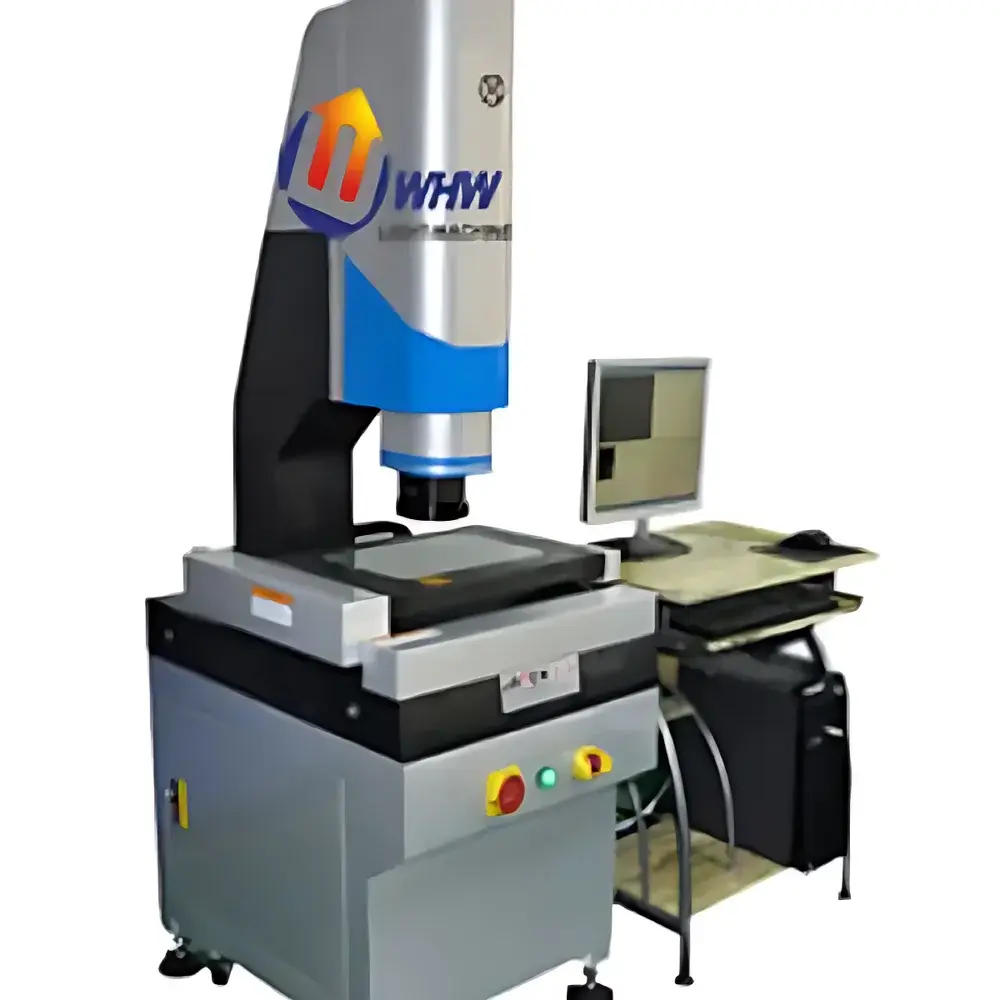
YANRUN YR-Q4030 CNC Intelligent Automatic Vision Measuring Machine
| Brand | YANRUN |
|---|---|
| Origin | Shanghai, China |
| Manufacturer Type | Direct Manufacturer |
| Model | YR-Q4030 |
| Operation Mode | Fully Automatic |
| X-Y-Z Travel Range | 400 × 300 × 200 mm |
| Overall Dimensions (W×D×H) | 1050 × 750 × 1735 mm |
| Measurement Accuracy | X/Y-axis ≤ (3 + L/200) µm |
| Encoders | High-precision optical linear encoders with 0.5 µm resolution |
| Camera | SONY progressive-scan color CCD sensor |
| Optical System | Motorized zoom lens (optional laser probe for height and transparency measurement) |
| Illumination | Programmable dual LED lighting — coaxial ring light (surface illumination) and contour backlight — intensity auto-adjusted per magnification |
| Software | Proprietary CNC vision metrology suite with geometric feature extraction, GD&T evaluation, and batch reporting |
| Power Supply | AC 220 V ±10%, 50 Hz |
| Environmental Requirements | 20 °C ±3 °C, 45–75% RH (non-condensing) |
Overview
The YANRUN YR-Q4030 CNC Intelligent Automatic Vision Measuring Machine is a high-precision coordinate metrology system engineered for non-contact, two- and three-dimensional geometric inspection of machined parts, sheet metal components, plastic injection molds, PCBs, and optoelectronic substrates. Built on a granite base and guided by precision linear motion stages, the system employs a motorized zoom optical path coupled with a high-resolution SONY progressive-scan CCD camera to capture sub-pixel edge data. Measurement principles follow ISO 10360-7 (coordinate measuring machines – part 7: characterization of image measurement systems) and align with ASTM E2918 for digital image-based dimensional verification. The machine operates under closed-loop CNC control, executing pre-programmed measurement routines with full repeatability and traceable calibration paths—making it suitable for in-process QC labs, contract manufacturing facilities, and R&D validation environments requiring ISO/IEC 17025-compliant data generation.
Key Features
- Fully automated CNC-driven measurement cycle—no manual joystick or step-by-step operator intervention required.
- Motorized telecentric zoom lens with continuous magnification range (typically 0.7x–4.5x), enabling seamless switching between macro and micro field-of-view without refocusing.
- Integrated dual-illumination architecture: independently controllable coaxial ring light for surface texture contrast and programmable profile backlight for silhouette edge detection—both intensity-modulated in real time based on current optical zoom factor.
- High-stability granite frame with vibration-damped isolation feet; thermal expansion compensated via real-time environmental monitoring (optional external temperature/humidity sensor integration).
- Z-axis vertical measurement capability enhanced by optional laser displacement sensor (not standard), enabling accurate thickness profiling of transparent materials such as optical glass, sapphire wafers, and polymer films.
- Compliance-ready architecture: audit trail logging, user role management, electronic signatures, and report export formats compatible with FDA 21 CFR Part 11 requirements when deployed with validated software configuration.
Sample Compatibility & Compliance
The YR-Q4030 accommodates parts up to 400 mm × 300 mm in footprint and 200 mm in height—ideal for medium-format mechanical assemblies, stamped connectors, and semiconductor packaging carriers. It supports measurement of metallic, ceramic, polymer, and translucent substrates—including polished glass, fused silica, and acrylic sheets—via combined edge detection and laser-assisted Z-height sampling. All measurement algorithms adhere to ISO 1101 (geometrical tolerancing), ISO 5459 (datum systems), and ASME Y14.5-2018 standards. Calibration certificates are issued per ISO/IEC 17025-accredited procedures when performed by authorized service centers. The system meets CE marking requirements for EMC Directive 2014/30/EU and Low Voltage Directive 2014/35/EU.
Software & Data Management
The proprietary vision metrology software provides a Windows-based GUI with scripting support (VBScript/Lua), offline programming mode, and hierarchical project templates. Core functionalities include automatic edge detection using sub-pixel Sobel gradient analysis, best-fit circle/line/plane fitting with least-squares optimization, true position (TP), concentricity, parallelism, perpendicularity, and profile of a surface evaluation. Reports are exportable in PDF, Excel (.xlsx), XML, and CSV formats—with configurable headers, logos, and revision stamps. Data integrity safeguards include encrypted local database storage, timestamped operator login logs, and version-controlled measurement programs. Optional network deployment enables centralized program distribution and remote diagnostics via secure HTTPS API endpoints.
Applications
- Dimensional verification of CNC-machined aerospace brackets and hydraulic manifolds.
- GD&T assessment of automotive transmission housings and brake caliper castings.
- Flatness and thickness uniformity analysis of display cover glass and touch panel laminates.
- PCB pad location accuracy, solder mask alignment, and fiducial mark repeatability testing.
- Tooling qualification for injection molding dies and progressive stamping tools.
- First-article inspection (FAI) documentation per AS9102 and PPAP Level 3 submission packages.
FAQ
Is the YR-Q4030 compliant with ISO/IEC 17025 for accredited calibration laboratories?
Yes—when operated with documented calibration artifacts, certified reference standards, and validated software configurations, the system supports measurement uncertainty budgets required for ISO/IEC 17025 accreditation.
Can the system measure features smaller than 10 µm?
Under optimal lighting and contrast conditions, edge detection resolution approaches 0.5 µm (based on encoder resolution and optical magnification), but practical measurement uncertainty for sub-10 µm features depends on surface finish, material reflectivity, and focus stability.
Does the software support multi-language UI and report localization?
The interface and report templates support UTF-8 encoding; localized language packs (English, German, Japanese, Korean) are available upon request and require separate licensing.
What maintenance intervals are recommended for long-term accuracy retention?
Annual full-system recalibration is advised; quarterly verification using certified gauge blocks and step gauges is recommended for production-critical applications.
Is remote software update and technical support available outside China?
Yes—YANRUN provides secure remote desktop assistance and firmware/software updates via TLS-encrypted channels, with English-speaking application engineers supporting EMEA and North American customers.