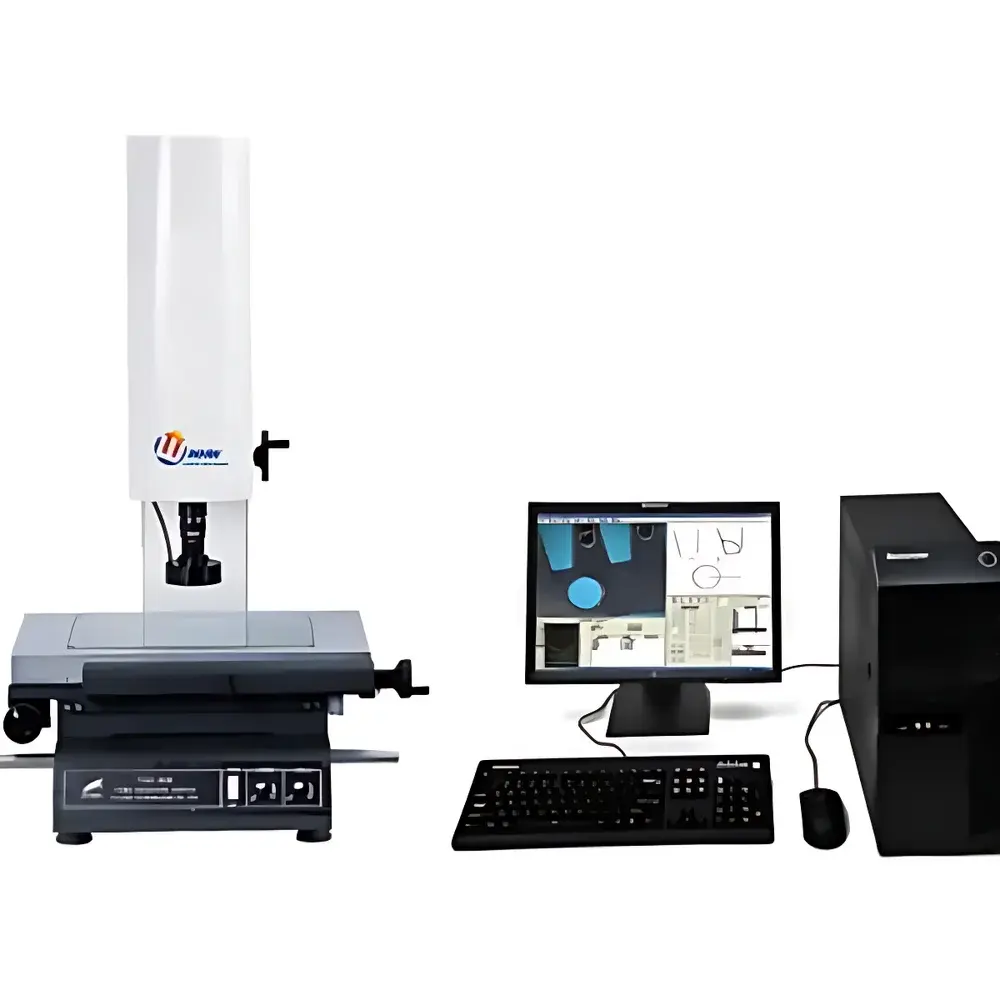
YANRUN YR-T3020 Economical Vision Measuring Machine
| Brand | YANRUN |
|---|---|
| Origin | Shanghai, China |
| Manufacturer Type | Direct Manufacturer |
| Region of Origin | Domestic (China) |
| Model | YR-T3020 |
| Price | USD 1 (Reference Only) |
| Table Material | Metal & Tempered Glass |
| Metal Stage Dimensions | 510 × 290 mm |
| Glass Stage Dimensions | 360 × 260 mm |
| X-Y Travel Range | 300 × 200 mm |
| Z-Axis Vertical Travel | 200 mm |
| Working Distance | 92 mm |
| Digital Readout Resolution (X/Y/Z) | 0.0005 mm |
| Positioning Accuracy (X/Y) | ≤ (3 + L/200) µm |
| Camera | 1/3" Color CCD |
| Zoom Objective Magnification | 0.7× to 4.5× |
| Total Video Magnification | 30× to 230× |
| Field of View (Object Side) | 7.0 mm to 1.1 mm |
| Illumination | Dual LED (Top Surface & Bottom Transmitted), Adjustable Brightness |
| Power Supply | AC 180–260 V, 50 Hz |
| Standard Software | Auto-edge detection, deburring, geometric feature measurement (points, lines, circles, circle-to-circle distance, part alignment), coordinate system registration |
Overview
The YANRUN YR-T3020 Economical Vision Measuring Machine is a benchtop coordinate measuring instrument engineered for high-reproducibility 2D geometric metrology in quality control laboratories, precision machining workshops, and R&D environments. It operates on the principle of non-contact optical imaging—capturing high-contrast silhouette or surface-reflected images via a calibrated telecentric optical path, then applying sub-pixel edge detection algorithms to extract dimensional data with traceable uncertainty. Designed for ISO 10360-compliant verification workflows, the YR-T3020 delivers certified measurement repeatability within its specified travel envelope (300 mm × 200 mm), supporting routine inspection of machined components, stamped parts, PCBs, connectors, and injection-molded plastic housings where tight tolerances (±3 µm base + L/200 systematic term) are required.
Key Features
- Robust dual-stage construction: Integrated 510 × 290 mm metal base plate with 360 × 260 mm optical-grade tempered glass insert for simultaneous transmitted and reflected illumination—optimized for both opaque and translucent samples.
- Precision mechanical motion system: Motorized or manual X-Y translation (300 × 200 mm range) with 0.5 µm digital encoder resolution; Z-axis lift mechanism (200 mm travel) enables focus adjustment and multi-layer feature analysis without sample repositioning.
- Modular optical subsystem: 1/3″ progressive-scan color CCD camera coupled with a 0.7×–4.5× continuous zoom telecentric objective, yielding a scalable total magnification range from 30× to 230× and object-side field-of-view from 7.0 mm down to 1.1 mm—enabling both macro overview and fine-feature interrogation.
- Dual LED illumination architecture: Independently controllable top-ring (surface) and bottom (transmitted) LED arrays with analog brightness regulation—critical for enhancing edge contrast across diverse material finishes (anodized aluminum, polished steel, matte plastics, solder masks).
- Integrated metrology software suite: Pre-installed vision measurement application supporting automatic edge detection, noise suppression (adaptive deburring), coordinate system alignment (best-fit, iterative, or manual), and GD&T-conformant reporting (per ASME Y14.5 and ISO 1101 standards).
Sample Compatibility & Compliance
The YR-T3020 accommodates flat, rigid parts up to 300 kg on its standard support table (1120 × 730 × 780 mm). Sample thickness is constrained only by the 200 mm Z-travel and 92 mm working distance—making it suitable for thin wafers, gaskets, and layered assemblies. All measurements adhere to ISO 15530-3 (calibration using reference artifacts) and support traceability to national metrology institutes via optional calibration certificates. The system meets CE electromagnetic compatibility (EMC) requirements and conforms to IEC 61000-6-2/6-3 standards. While not FDA 21 CFR Part 11–validated out-of-the-box, audit-ready software logs—including operator ID, timestamp, measurement parameters, and raw image capture—can be configured to satisfy GLP/GMP documentation needs in regulated manufacturing settings.
Software & Data Management
The embedded measurement software provides a Windows-based GUI with intuitive workflow navigation: image acquisition → lighting optimization → feature selection → algorithmic measurement → report generation. Measurement results are exportable in CSV, PDF, and DXF formats. Batch measurement mode allows programmed sequencing across multiple identical parts. All measurement sessions include full metadata logging—image files, scale calibration history, lighting configuration, and user-defined tolerances—to ensure full auditability. Optional SDK integration supports custom automation via TCP/IP or COM interface for integration into factory MES or SPC systems.
Applications
- Dimensional verification of CNC-machined features (hole diameters, slot widths, positional tolerances)
- PCB inspection: pad geometry, solder mask alignment, fiducial mark consistency
- Automotive stamping: flange width, bend angle, hole pattern deviation
- Medical device components: catheter hub symmetry, syringe barrel concentricity, microfluidic channel dimensions
- Plastic injection molding: gate vestige height, parting line mismatch, wall thickness uniformity (via focused depth-of-field technique)
FAQ
Is the YR-T3020 compliant with ISO/IEC 17025 laboratory accreditation requirements?
Yes—when operated with certified reference artifacts and documented calibration procedures, the YR-T3020 supports uncertainty budgeting per ISO/IEC 17025:2017 Clause 7.6. Full traceability documentation is available upon request.
Can the system measure features with surface texture or reflectivity variations?
Yes—the adjustable dual LED illumination, combined with real-time histogram-based threshold tuning in software, enables reliable edge detection on brushed metals, anodized surfaces, and matte-finish polymers.
Does the software support GD&T evaluation such as true position or profile of a surface?
Yes—the standard package includes basic GD&T tools (true position, circularity, parallelism); advanced profile and runout evaluation requires optional module licensing.
What is the recommended maintenance schedule?
Optical path cleaning every 3 months; annual mechanical recalibration (encoder zero-point and stage orthogonality verification) is advised for production-critical use.
Is remote technical support available for international users?
Yes—YANRUN provides English-language remote diagnostics and software assistance via TeamViewer or AnyDesk, with response time under 4 business hours during APAC/EU working windows.