
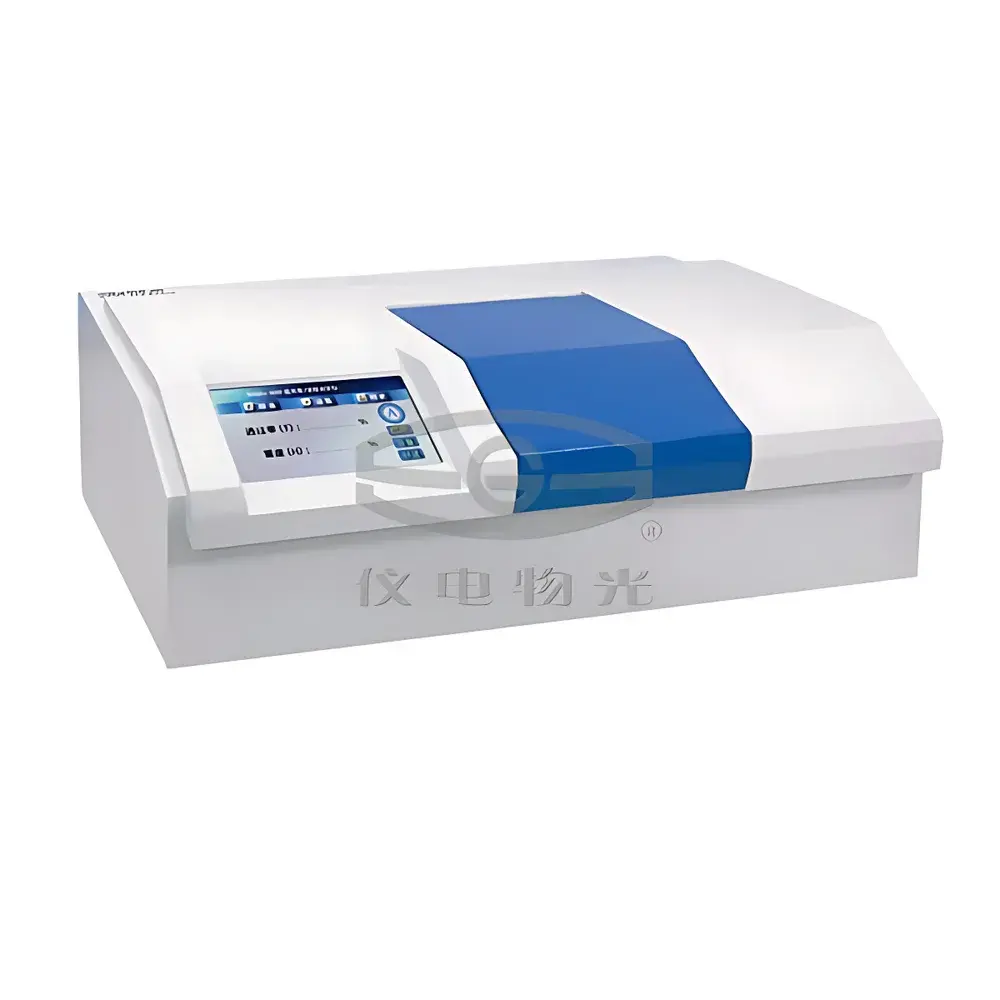
YDWG SGW®-800L Transmittance and Haze Meter
| Brand | YDWG |
|---|---|
| Origin | Shanghai, China |
| Model | SGW®-800L |
| Measurement Principle | CIE Standard Illuminant C (6774 K) LED Source |
| Transmittance Range | 0–100% |
| Haze Range | 0–30% |
| Transmittance Repeatability | ≤0.5% |
| Haze Repeatability | ≤0.2% |
| Transmittance Resolution | 0.01% |
| Haze Resolution | 0.01% |
| Transmittance Accuracy | ±1.5% |
| Haze Accuracy | ±0.5% |
| Sample Chamber | Closed-type, 50 mm × 50 mm max sample size |
| Display | 5-inch color LCD |
| Data Storage | 1000 sets |
| Interface | RS232 / USB / USB flash drive support |
| Power Supply | 220 V ±22 V, 50 Hz ±1 Hz, 30 W |
| Dimensions (W×D×H) | 470 mm × 270 mm × 170 mm |
| Net Weight | 5.7 kg |
| Compliance | GB/T 2410–2008, ASTM D1003–2007, JIS K7105–1981 |
Overview
The YDWG SGW®-800L Transmittance and Haze Meter is a precision optical instrument engineered for the quantitative evaluation of light transmission and scattering characteristics in flat, transparent, or semi-transparent materials. It operates on the principle of standardized CIE Illuminant C (6774 K), implemented via a stable, calibrated LED light source, ensuring spectral consistency aligned with international photometric conventions. The instrument measures two fundamental optical parameters: total transmittance—the ratio of transmitted radiant flux to incident flux—and haze—the percentage of transmitted light that deviates from the incident beam by more than 2.5°, as defined in ASTM D1003–2007. Designed for routine quality control and R&D validation in polymer, glass, and thin-film manufacturing environments, the SGW®-800L delivers traceable, reproducible results without requiring operator intervention during measurement—eliminating parallax error and ambient light interference through its fully enclosed sample chamber.
Key Features
- Integrated CIE-standard C-illuminant LED source with thermal stabilization for long-term photometric stability and minimal spectral drift.
- Closed-type sample chamber with precise 50 mm × 50 mm aperture geometry, minimizing stray light and enabling consistent collimation across all measurements.
- High-resolution 5-inch color LCD display with intuitive icon-based navigation and real-time parameter feedback—including transmittance (%T), haze (%H), and pass/fail status against user-defined thresholds.
- Dual-channel analog-to-digital conversion architecture ensures independent signal acquisition for direct and scattered light paths, supporting compliance with ISO/CIE geometric requirements for haze measurement.
- Onboard data management supports storage of up to 1000 measurement records with timestamp, sample ID, and operator tag—exportable via USB flash drive or RS232/USB serial interface for LIMS integration.
- Manual zero and calibration standardization workflow—fully compliant with GB/T 2410–2008 and ASTM D1003–2007 procedural requirements—ensures audit-ready documentation for GLP and internal QA protocols.
Sample Compatibility & Compliance
The SGW®-800L is optimized for rigid or flexible planar specimens with parallel surfaces and uniform thickness, including but not limited to polycarbonate sheets, acrylic panels, PET and PP films, tempered glass substrates, and coated optical filters. Its fixed 50 mm × 50 mm measurement area accommodates common QC sample cutouts used in injection molding and extrusion lines. All optical path geometry, detector angular acceptance, and illuminant spectral distribution conform to the geometric and photometric specifications outlined in ASTM D1003–2007 (Standard Test Method for Haze and Luminous Transmittance of Transparent Plastics), GB/T 2410–2008 (Test Method for Transmittance and Haze of Transparent Plastics), and JIS K7105–1981 (Testing Methods for Optical Properties of Plastics). Instrument verification is supported by NIST-traceable calibration standards (certified haze plates and neutral density filters), enabling full traceability under ISO/IEC 17025-accredited laboratory practices.
Software & Data Management
While the SGW®-800L operates as a standalone benchtop unit with embedded firmware, its RS232 and USB interfaces enable seamless bidirectional communication with external PCs running custom or third-party data acquisition software. Exported CSV files include column headers for date/time, sample ID, %T, %H, instrument serial number, and calibration status—facilitating automated report generation and statistical process control (SPC) charting. Audit trail functionality is maintained via onboard timestamping and non-volatile memory retention; no data overwrite occurs unless explicitly confirmed by the operator. For regulated environments, the instrument supports manual entry of analyst ID and batch number—sufficient for 21 CFR Part 11-compliant workflows when paired with validated PC-based software implementing electronic signatures and change control.
Applications
- Quality assurance of automotive glazing and interior trim components for haze-related visual defects.
- In-process monitoring of anti-fog film coatings on medical packaging films.
- Validation of UV-stabilized polycarbonate sheets for architectural glazing applications.
- Comparative analysis of surface etching or plasma treatment efficacy on PMMA substrates.
- Raw material qualification for optical-grade resins prior to extrusion or injection molding.
- Research into nanoparticle dispersion homogeneity in transparent nanocomposites via haze trend analysis.
FAQ
What standards does the SGW®-800L comply with for transmittance and haze measurement?
It meets the geometric, photometric, and procedural requirements of ASTM D1003–2007, GB/T 2410–2008, and JIS K7105–1981.
Can the instrument measure curved or non-planar samples?
No—it is designed exclusively for flat, parallel-surface specimens; curvature introduces beam divergence and violates the collimated geometry required by ASTM D1003.
Is automatic calibration available?
The SGW®-800L uses manual zero and standard calibration; this aligns with regulatory expectations for user-controlled verification in ISO 9001 and IATF 16949 environments.
How is measurement repeatability verified?
Repeatability is assessed per ASTM D1003 Annex A2 using certified reference standards; typical values are ≤0.2% for haze and ≤0.5% for transmittance across ten consecutive readings.
Does the instrument support GLP-compliant data archiving?
Yes—when connected to validated PC software with electronic signature, audit trail, and secure user access controls, it fulfills core GLP data integrity requirements.




