
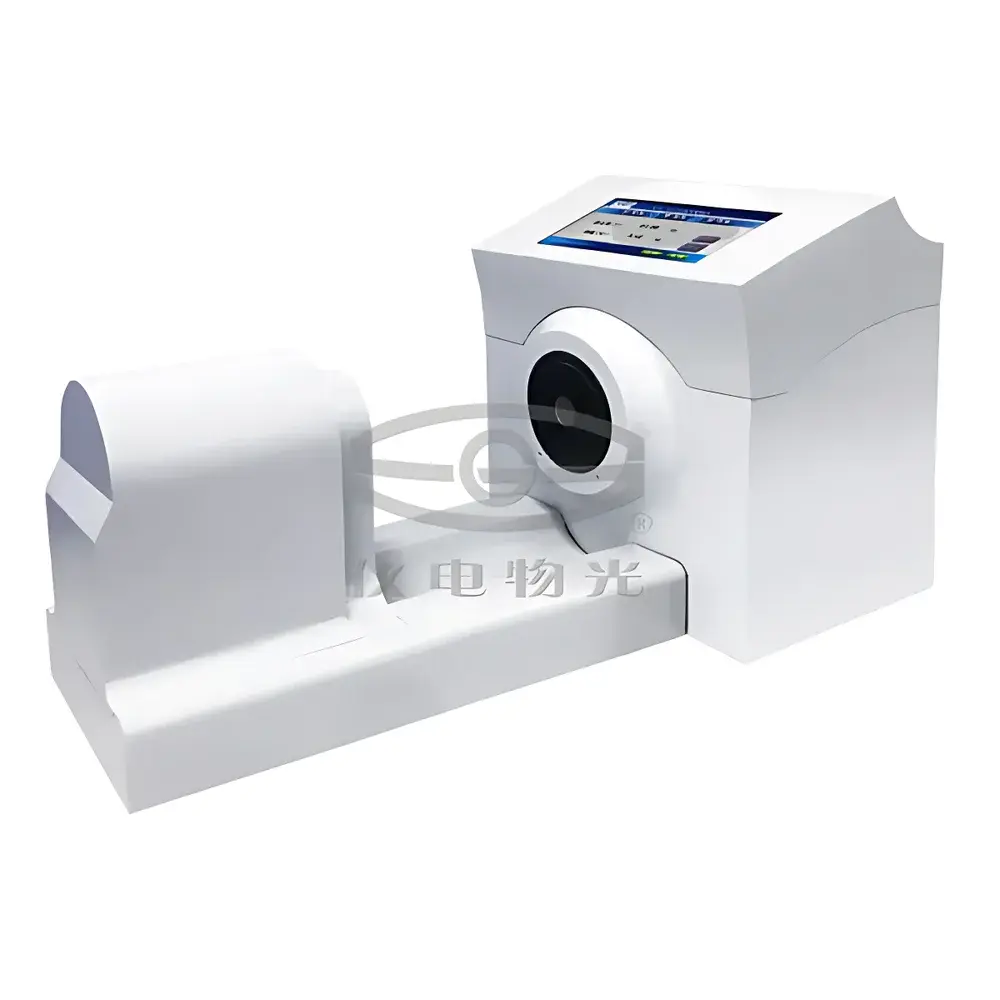
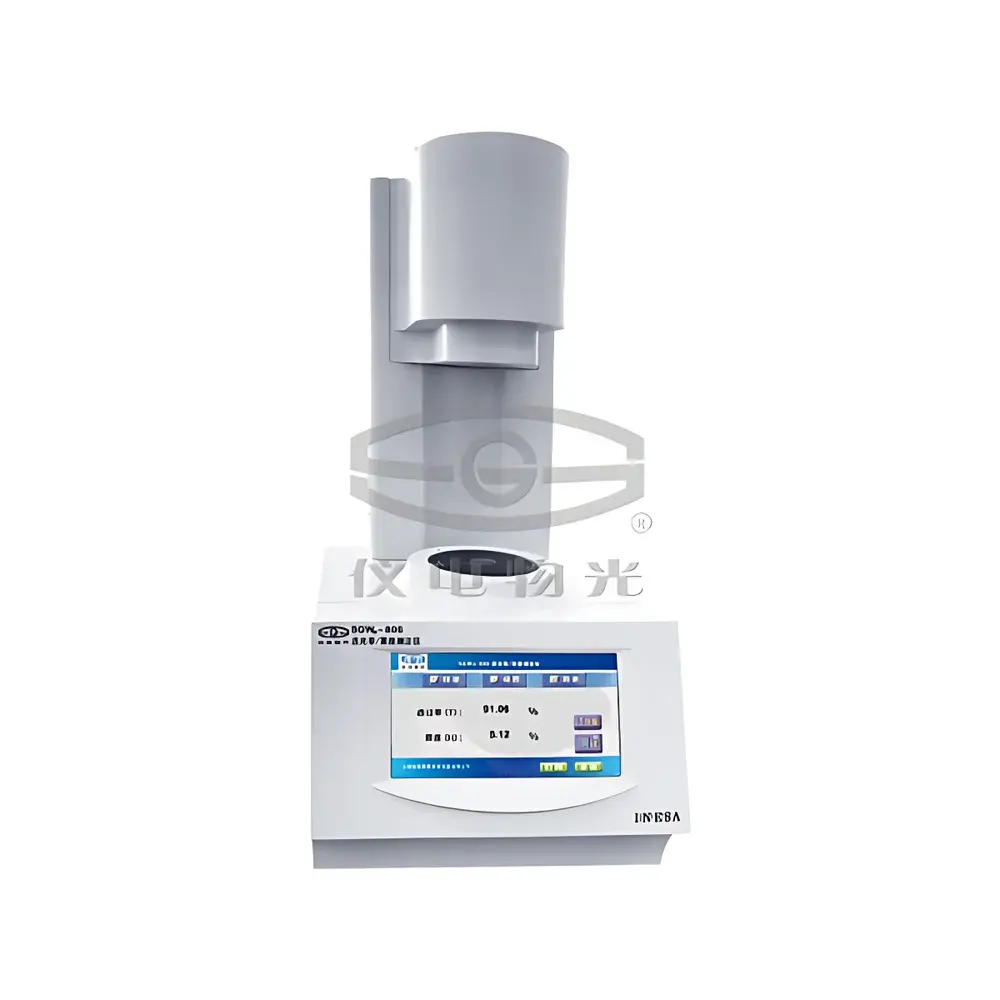
YDWG SGW®-806 Transmittance and Haze Meter (Dual-Position: Vertical & Horizontal Mounting)
| Brand | YDWG |
|---|---|
| Origin | Shanghai, China |
| Model | SGW®-806 |
| Type | Fully Automatic |
| Haze Range | 0–100% |
| Transmittance Range | 0–100% |
| Haze Repeatability | ≤0.1% |
| Transmittance Repeatability | ≤0.1% |
| Light Sources | CIE A (2856 K), C (6774 K), D65 (6500 K) |
| Minimum Display Resolution | 0.01% for both transmittance and haze |
| Sample Aperture | Ø25 mm (input), Ø21 mm (output) |
| Display | Large LCD touchscreen |
| Interface | USB port with U-disk data export |
| Power Supply | 220 V ±22 V, 50 Hz ±1 Hz |
| Dimensions | 700 × 270 × 300 mm |
| Net Weight | 7 kg |
Overview
The YDWG SGW®-806 Transmittance and Haze Meter is a fully automated optical measurement instrument engineered for precise quantification of luminous transmittance and haze in transparent and translucent planar materials. It operates on the principle of collimated beam transmission combined with hemispherical diffuse light collection via an integrating sphere photodetector system—fully compliant with ISO 13468-1, ISO 14782, ASTM D1003-22, and GB/T 2410-2008. Designed for laboratory and quality control environments, the SGW®-806 delivers traceable, reproducible measurements across diverse industrial substrates including polymethyl methacrylate (PMMA), polycarbonate (PC), polyethylene terephthalate (PET) films, automotive glazing, display cover glasses, packaging laminates, and architectural glass. Its dual-position mechanical configuration—supporting both vertical and horizontal sample loading—enables ergonomic operation and flexible integration into production line inspection stations or benchtop metrology workflows.
Key Features
- Triple-CIE-standard illumination: switchable LED-based A (2856 K), C (6774 K), and D65 (6500 K) light sources ensure spectral consistency across global regulatory testing protocols.
- High-resolution digital readout: transmittance and haze values displayed to 0.01% resolution on a large capacitive touchscreen interface—eliminating manual dials and minimizing operator-induced variability.
- Integrating sphere optics: 99% reflectivity BaSO₄-coated sphere with calibrated silicon photodiode detection ensures accurate separation of direct and diffusely scattered luminous flux per ASTM D1003 Annex A2.
- Dual-mount mechanical design: field-reconfigurable upright or horizontal orientation accommodates varied sample geometries and workflow constraints without recalibration.
- Microprocessor-controlled automation: embedded firmware executes standardized test sequences—including auto-zero, auto-calibration, and pass/fail threshold evaluation—per user-defined SOPs.
- Traceable data management: USB 2.0 interface supports direct export of CSV-formatted measurement logs to external storage media; no proprietary software required for basic data retrieval.
Sample Compatibility & Compliance
The SGW®-806 accepts flat, parallel-faced specimens up to 25 mm in diameter and 50 mm in thickness—including rigid sheets, flexible films, coated substrates, and laminated composites. It meets functional requirements specified in multiple international standards: ASTM D1003-22 (plastic transmittance/haze), ISO 13468-1 (plastics—determination of luminous transmittance), ISO 14782 (glass—haze measurement), GB/T 2410-2008 (Chinese national standard for plastics), HG/T 5065-2016 (clear topcoats for architectural coatings), and GB 14866-2006 (protective eyewear optical performance). All optical components are factory-aligned and certified against NIST-traceable neutral density reference standards; instrument verification reports include calibration uncertainty budgets conforming to ISO/IEC 17025 guidelines.
Software & Data Management
The SGW®-806 operates autonomously via its onboard embedded system—requiring no PC connection for routine measurement execution. Firmware supports configurable pass/fail limits, batch ID tagging, and timestamped result logging. Measurement records—including date/time stamp, light source selection, raw analog-to-digital converter (ADC) counts, and final calculated values—are stored internally and exportable via USB mass-storage mode. While no dedicated desktop application is bundled, exported CSV files are compatible with common statistical process control (SPC) platforms (e.g., Minitab, JMP) and LIMS environments. Audit trail functionality complies with GLP and GMP documentation expectations, and raw data integrity is preserved through write-protected internal memory architecture.
Applications
This instrument serves critical optical quality assurance functions across regulated manufacturing sectors. In automotive supply chains, it verifies haze compliance of laminated windshields and head-up display (HUD) combiners per SAE J2295. In consumer electronics, it validates transmittance uniformity of chemically strengthened cover glass used in smartphones and tablets. For medical device packaging, it confirms clarity specifications of thermoformed PET trays under USP . In architectural glazing R&D, it characterizes anti-reflective coating efficacy and particulate-induced scattering in insulated glass units (IGUs). Additional use cases include QC screening of optical adhesives, UV-curable resins, and polymer-based light-diffusing films employed in LED lighting modules.
FAQ
What standards does the SGW®-806 comply with for regulatory testing?
It conforms to ASTM D1003-22, ISO 13468-1, ISO 14782, GB/T 2410-2008, and several Chinese industry standards including HG/T 5065-2016 and GB 14866-2006.
Can the instrument measure curved or non-planar samples?
No—it is designed exclusively for flat, parallel-faced specimens; curvature introduces systematic error due to beam divergence and non-uniform path length.
Is third-party calibration certification available?
Yes—certified calibration services with ISO/IEC 17025-accredited documentation can be arranged through authorized YDWG service centers.
Does the SGW®-806 support FDA 21 CFR Part 11 compliance?
While the base firmware does not include electronic signature or role-based access control, audit-ready CSV logs and immutable timestamps meet foundational data integrity requirements for Part 11 alignment when deployed within validated IT infrastructure.
What maintenance is required for long-term accuracy?
Annual verification using NIST-traceable neutral density filters and sphere reflectance checks is recommended; optical surfaces should be cleaned only with lens-grade solvent and lint-free wipes to avoid coating damage.





