
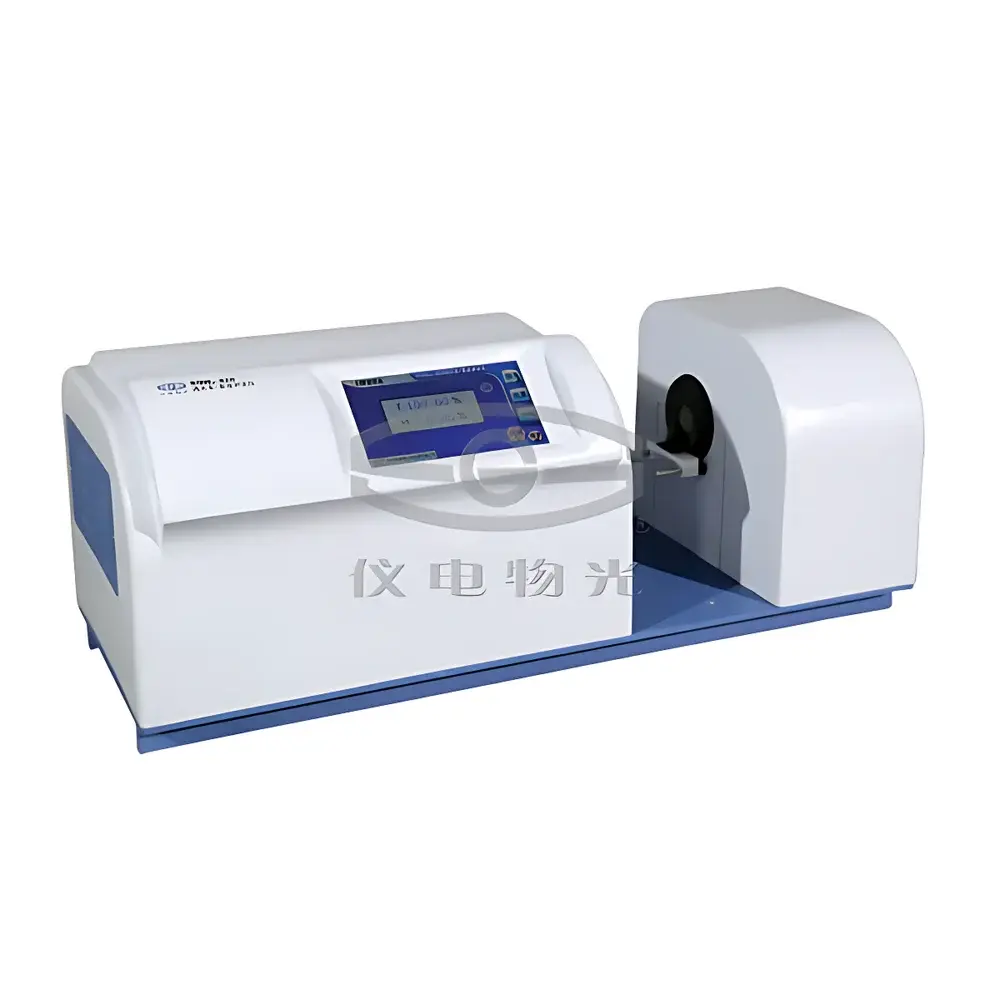
YDWG SGW®-810L Transmittance and Haze Meter
| Brand | YDWG |
|---|---|
| Origin | Shanghai, China |
| Model | SGW®-810L |
| Type | Automatic |
| Transmittance Range | 0–100.00% |
| Haze Range | 0–100.00% |
| Transmittance Repeatability | ≤0.5% |
| Haze Repeatability | ≤0.2% |
| Minimum Display Resolution | 0.01% (both) |
| Sample Port Diameter | Input Φ25 mm, Output Φ21 mm |
| Light Source | C-illumination LED (6774 K) |
| Compliance | GB/T 2410–2008, ASTM D1003–07, JIS K7105–1981, JJF 1303–2011 |
Overview
The YDWG SGW®-810L Transmittance and Haze Meter is a microprocessor-controlled optical measurement instrument engineered for precision quantification of light transmission and scattering characteristics in planar transparent and translucent materials. It operates on the principle of collimated illumination with hemispherical diffuse collection via an integrating sphere photometric detection system—fully compliant with the geometric and photometric requirements defined in ISO 13468-1, ASTM D1003–07, and GB/T 2410–2008. The instrument employs a stable C-illuminant LED source (correlated color temperature 6774 K), eliminating spectral drift and thermal instability associated with tungsten-halogen lamps. Its optical architecture ensures high reproducibility across batch testing of rigid sheets, flexible films, and liquid samples—critical for quality assurance in optical polymer manufacturing, display cover glass production, pharmaceutical packaging validation, and aerospace transparent composite evaluation.
Key Features
- Integrated dual-parameter measurement: simultaneous acquisition of total transmittance (%) and haze (%) per ASTM D1003 Section 7.2 and GB/T 2410 Clause 5.3.
- High-stability C-illuminant LED light source with calibrated spectral power distribution, certified traceable to NIM (National Institute of Metrology, China) reference standards.
- Optical path designed with parallel beam incidence and 180° integrating sphere detection (with BaSO₄-coated interior surface), minimizing angular dependency and edge-scatter artifacts.
- 7-inch full-color TFT-LCD touchscreen interface with embedded firmware supporting real-time statistical analysis (mean, SD, min/max) across up to 2000 stored measurements.
- Environmental immunity: built-in optical modulation eliminates ambient light interference—no darkroom required, enabling reliable large-sample measurement (e.g., automotive glazing panels up to 300 × 300 mm).
- Dual sample handling accessories included: magnetic film clamp (for thin polymer films ≥12 µm) and standardized liquid cell (10 mm pathlength, quartz windows) for solution-phase haze assessment.
- USB 2.0 host interface supports direct data export to PC in CSV format; firmware supports GLP-compliant audit trail logging (operator ID, timestamp, calibration status) when connected to validated laboratory information systems.
Sample Compatibility & Compliance
The SGW®-810L accommodates flat, parallel-faced specimens conforming to ASTM D1003 Annex A1 specifications: rigid plates (e.g., PMMA, PC, tempered glass), flexible films (PET, TPU, cellulose acetate), and homogeneous liquids (e.g., pharmaceutical suspensions, coating resins). Maximum specimen thickness: 40 mm. Minimum clear aperture: 25 mm diameter. All measurements adhere to the “total transmittance” and “haze” definitions per ISO 13468-1:2019 and USP particulate matter guidance for container-closure system clarity verification. Instrument calibration is verified using NIST-traceable neutral density filters (transmittance) and certified haze standards (e.g., NIST SRM 1979), with documentation satisfying FDA 21 CFR Part 11 electronic record requirements when paired with validated software.
Software & Data Management
Embedded firmware provides real-time calculation of haze per Equation 1 in ASTM D1003: H = (Td/Tt) × 100, where Td is diffused transmittance and Tt is total transmittance. Data storage includes operator name, date/time stamp, sample ID, and raw analog-to-digital converter (ADC) values for full traceability. USB export generates time-stamped CSV files containing all metadata and statistical summaries. Optional PC software (YDWG LabLink v3.2) enables automated report generation compliant with ISO/IEC 17025 clause 7.8.3, including uncertainty budgeting per GUM (JCGM 100:2008) for transmittance/haze combined standard uncertainty.
Applications
- Quality control of optical-grade polymers: monitoring batch-to-batch consistency in anti-reflective coated PET films used in OLED encapsulation.
- Regulatory testing of medical device packaging: verifying haze limits (<2.5%) for Tyvek®-laminated pouches per ISO 11607-1:2019.
- R&D of smart windows: quantifying dynamic haze shift during electrochromic switching cycles (0–10 V DC).
- Automotive glazing validation: measuring transmittance uniformity across curved laminated windshields using custom fixture adapters.
- Pharmaceutical formulation development: assessing colloidal stability of nanoparticle suspensions via time-resolved haze kinetics at 25 °C ± 0.5 °C.
FAQ
What standards does the SGW®-810L comply with for regulatory submissions?
It meets the photometric and procedural requirements of ASTM D1003–07, GB/T 2410–2008, ISO 13468-1:2019, and JIS K7105–1981—enabling data acceptance in FDA IND filings and EU MDR technical documentation.
Can the instrument measure curved or non-planar samples?
No—it requires optically flat, parallel surfaces per ASTM D1003 Section 6.1; curvature introduces systematic scatter error exceeding ±1.2% haze uncertainty.
Is firmware upgrade supported remotely?
Yes—via USB flash drive using signed .bin files distributed through YDWG’s authorized service portal; each update includes version-locked calibration certificate revalidation.
How often must the integrating sphere be cleaned or recoated?
BaSO₄ coating integrity is verified annually via reflectance mapping (using NIST SRM 2036); recoating is recommended after 5 years of continuous operation or if sphere reflectance falls below 95% at 550 nm.
Does the instrument support IQ/OQ/PQ protocol execution?
Yes—YDWG provides vendor-qualified qualification packages (including test scripts, acceptance criteria, and raw data templates) aligned with ISO/IEC 17025 and GMP Annex 15 requirements.





