
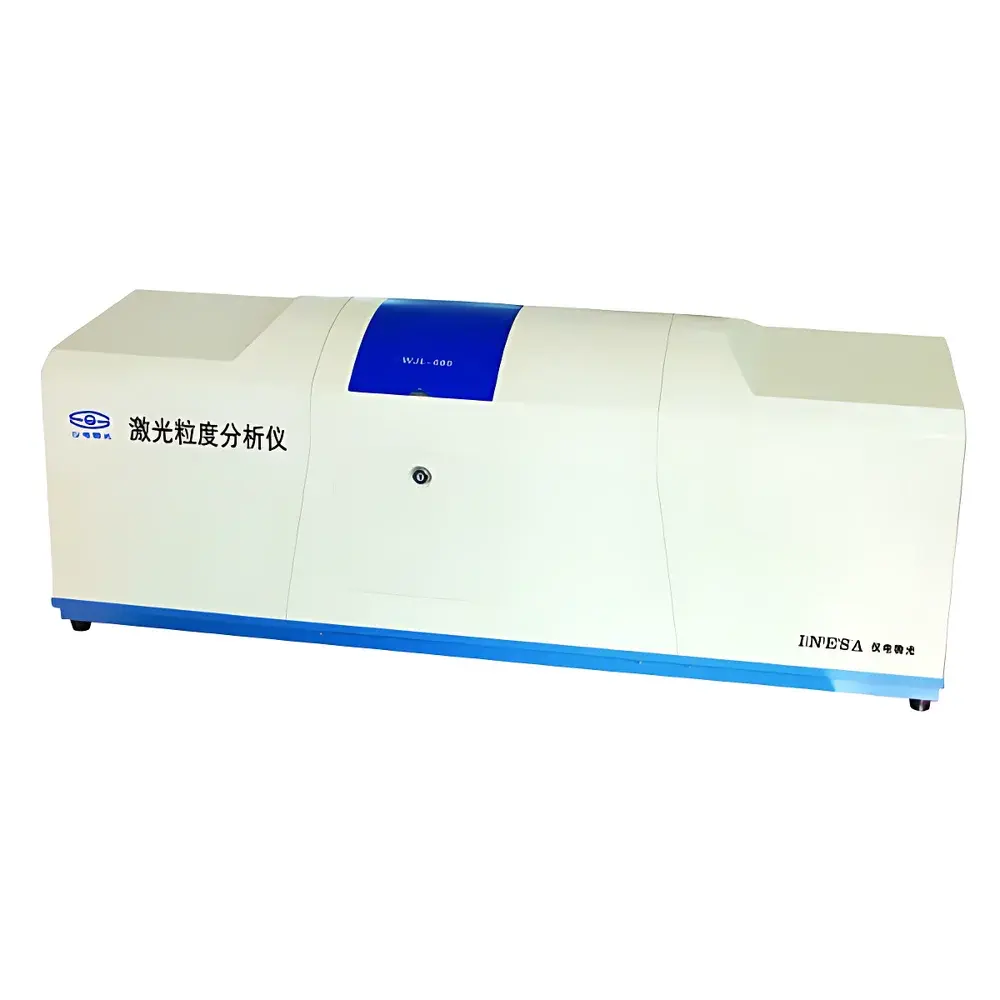
YDWG WJL-602/606/608 Wet Dispersion Laser Particle Size Analyzer
| Brand | YDWG |
|---|---|
| Origin | Shanghai, China |
| Model | WJL-602 / WJL-606 / WJL-608 |
| Measurement Range | 0.02–2000 µm (WJL-608) |
| Light Source | He-Ne laser, λ = 632.8 nm, lifetime >25,000 h |
| Dispersion Method | Wet dispersion with integrated ultrasonic system |
| Repeatability | ≤ ±0.5% (D50 of NIST-traceable standard particles) |
| Accuracy | ≤ ±0.5% (D50 of NIST-traceable standard particles) |
| Detection Angle | Up to 135° |
| Optical Design | Full-range convergent beam Fourier configuration with non-uniform 3D cross-fan detector array |
| Sample Flow Path | Fully sealed, corrosion-resistant wet module |
| Compliance | ISO 13320:2020 (Particle size analysis — Laser diffraction methods) |
Overview
The YDWG WJL-602/606/608 Wet Dispersion Laser Particle Size Analyzer is a laboratory-grade instrument engineered for high-precision particle size distribution (PSD) measurement of suspensions, emulsions, and colloidal dispersions. It operates on the principle of Mie scattering theory—fully implemented across the entire measurement range—and accounts for the complex optical properties (refractive index, absorption coefficient) of both particles and dispersant to deliver physically rigorous size inversion. Unlike simplified Fraunhofer approximations, the Mie-based algorithm ensures metrological validity for submicron and highly anisotropic particles—including metal oxides, pharmaceutical actives, ceramic precursors, and polymeric nanoparticles—where optical contrast and shape effects significantly influence scattering patterns. The system employs a stabilized helium-neon (He-Ne) laser (632.8 nm), selected for its narrow linewidth, low noise, and exceptional long-term power stability (>25,000 h operational lifetime). Its convergent-beam Fourier optical architecture eliminates redundant lens groups, enabling wide dynamic range (0.02–2000 µm) without mechanical reconfiguration while preserving angular resolution at both near- and far-field detection zones.
Key Features
- Full-range Mie scattering inversion engine with user-definable optical parameters (particle & medium refractive indices, imaginary component)
- Non-uniform 3D cross-fan photodetector array covering up to 135° scattering angle—optimized for signal capture across broad size distributions
- Integrated ultrasonic dispersion unit (40 kHz, adjustable amplitude and duration) with temperature-controlled sample circulation (±0.5 °C stability)
- Auto-alignment optical system ensuring consistent beam positioning and minimizing operator-induced measurement drift
- Corrosion-resistant wet dispersion module with PTFE-coated flow cell and quick-release fittings compatible with aqueous and organic media
- Modular design supporting future upgrades: optional zeta potential add-on, multi-angle backscatter extension, or GMP-compliant audit trail firmware
Sample Compatibility & Compliance
The WJL series accommodates a wide spectrum of industrial and research samples: inorganic pigments, cement clinker slurries, drug nanosuspensions, battery cathode slurries, soil colloids, and food-grade emulsions. All models comply with ISO 13320:2020 for laser diffraction methodology—including validation protocols for instrument performance verification using NIST-traceable reference materials (e.g., SRM 1963, SRM 2800). The optical path and fluidic design meet GLP requirements for traceability; raw scattering data, instrument settings, and environmental logs (temperature, pump speed, sonication energy) are time-stamped and retained with each measurement. While not pre-certified for FDA 21 CFR Part 11, the PADMAS software architecture supports configurable electronic signatures, role-based access control, and immutable audit trails when deployed on validated IT infrastructure.
Software & Data Management
The proprietary Particle Diameter Measure & Analysis System (PADMAS) provides comprehensive post-acquisition processing: differential and cumulative volume-based distributions; Rosin-Rammler (R-R), log-normal, and user-defined classification schemes; statistical comparison across batches; and export to CSV, PDF, PNG, and native Excel formats. Key metrics—including D10, D50, D90, span, specific surface area (volume- and mass-weighted), and four customizable percentile points—are computed in real time. Data files embed full metadata (instrument ID, operator, calibration timestamp, dispersion parameters), enabling retrospective QA review. Batch reporting templates conform to internal SOPs or external regulatory submission standards (e.g., ICH Q5A, USP ). Raw intensity vs. angle matrices are preserved for third-party reanalysis or method transfer validation.
Applications
This analyzer serves critical quality control and R&D functions across regulated and industrial sectors: monitoring granulation endpoints in oral solid dose manufacturing; characterizing primary particle size in lithium iron phosphate (LFP) cathode slurries; quantifying agglomeration state of silica nanoparticles in CMP formulations; verifying micronization efficiency of inhalable corticosteroids; and assessing sedimentation stability of pesticide suspensions. In academic labs, it supports fundamental studies on Ostwald ripening kinetics, polymer latex coagulation thresholds, and clay colloid transport in porous media. Its robustness in handling high-viscosity (up to 1000 mPa·s) and high-solid-content (>40 wt%) dispersions makes it suitable for process analytical technology (PAT) integration in continuous wet milling lines.
FAQ
Does the WJL series support dry powder measurement?
No—this model is configured exclusively for wet dispersion. Dry powder analysis requires the complementary WJL-D series with aerodynamic dispersion modules.
Can the system be validated for GMP environments?
Yes—when installed on validated hardware and operated under documented SOPs, the WJL platform supports IQ/OQ/PQ protocols. Audit trail and electronic signature capabilities require PADMAS v4.2+ and Windows Server domain authentication.
What refractive index values are recommended for common materials?
Default libraries include >120 entries (e.g., TiO₂: 2.55 + 0.1i; lactose monohydrate: 1.52 + 0.001i; water: 1.33 + 0i). Users may input custom values derived from literature or ellipsometry.
Is external PC specification mandatory?
Yes—minimum i3 CPU, 8 GB RAM, and SSD storage are required for real-time Mie inversion and batch report generation. USB 3.0 and Gigabit Ethernet ports are necessary for stable data streaming.
How often does the optical alignment require verification?
Automated daily self-check is performed at startup. Full optical alignment verification using reference scatterers is recommended every 6 months or after instrument relocation.
Related Products



