
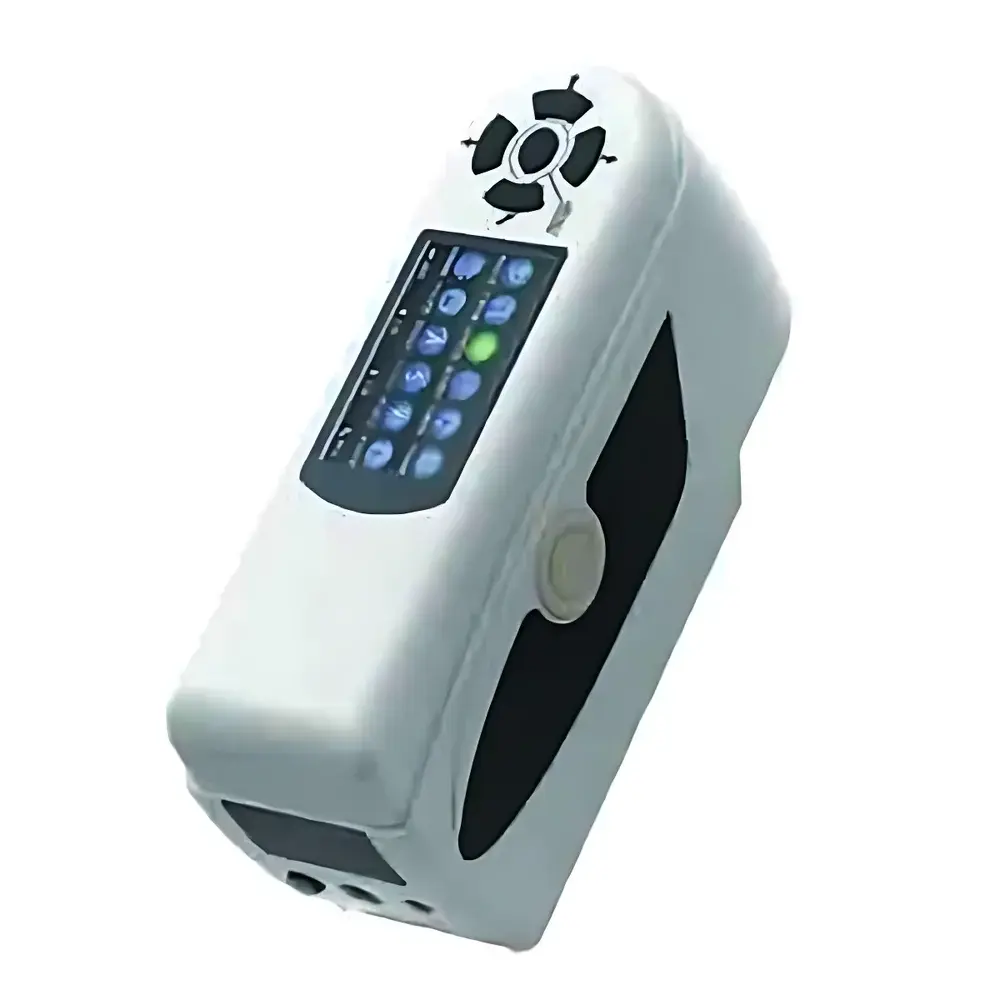
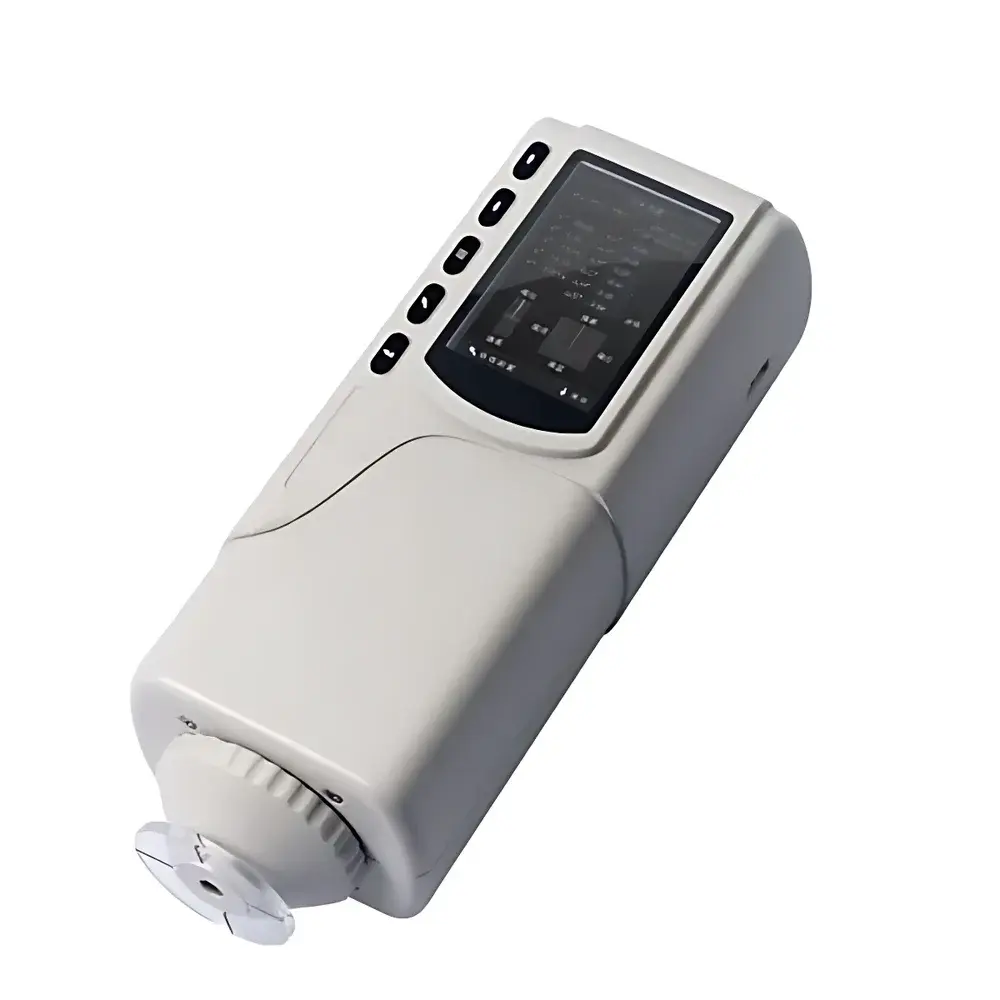
YDWG WSC-1B / WSC-2B / WSC-3B Portable Precision Color Difference Meter
| Brand | YDWG |
|---|---|
| Origin | Shanghai, China |
| Model | WSC-1B / WSC-2B / WSC-3B |
| Optical Geometry | 8°/d (diffuse illumination, 8° viewing) |
| Illuminant Options | D65, D50, A |
| Observer Angle | 10° standard observer |
| Spectral Response | Silicon photodiode array |
| Repeatability | ≤0.07 ΔE*ab (WSC-1B), ≤0.06 ΔE*ab (WSC-2B & WSC-3B), measured on white calibration tile (n=30) |
| Inter-instrument Agreement | ≤0.80 ΔE*ab (WSC-1B), ≤0.50 ΔE*ab (WSC-2B), ≤0.40 ΔE*ab (WSC-3B) |
| Measurement Aperture | Φ4 mm (WSC-1B), Φ8 mm (WSC-2B), dual Φ8 mm / Φ4 mm (WSC-3B) |
| Display | 2.8″ TFT true-color LCD |
| Color Spaces | CIE L*a*b*, L*C*h*, XYZ, RGB, L*u*v*, YI (Yellowness Index), WI (Whiteness Index), Color Fastness |
| Color Difference Formulas | ΔE*ab, ΔE*C*h*, ΔE*94, ΔE*CMC, ΔE*00, ΔE*Hunter |
| Storage Capacity | 100 reference standards + 20,000 sample measurements |
| Power | Rechargeable lithium-polymer battery (3.7 V, 3200 mAh) |
| charging time | 8 h |
| Operating Environment | −10 °C to 40 °C, 0–85% RH (non-condensing) |
| Dimensions & Weight | 205 × 67 × 80 mm / 450 g (WSC-1B) |
| Compliance | GB/T 3977–2008, GB/T 5698–2001, GB/T 7921–2008, JJG 595–1989 |
Overview
The YDWG WSC-1B / WSC-2B / WSC-3B Portable Precision Color Difference Meter is a compact, field-deployable spectrophotometric instrument engineered for high-reproducibility color measurement and quantitative color difference analysis in industrial quality control, R&D laboratories, and production line environments. Based on the d/8° integrating sphere optical geometry with diffuse illumination and 8° normal viewing, the system conforms to CIE 15:2004 and ISO 7724-1 requirements for standardized colorimetric evaluation. Each model employs a stabilized LED light source with blue-chip excitation to emulate standardized illuminants—D65 (daylight), D50 (printing industry standard), and A (incandescent)—and integrates a silicon photodiode array detector for spectral response across the visible range (360–780 nm equivalent). The instrument operates under the CIE 10° standard observer function and supports multiple color spaces—including CIE L*a*b*, L*C*h*, XYZ, RGB, L*u*v*, and specialized indices such as Yellowness Index (YI) and Whiteness Index (WI)—enabling traceable, metrologically sound assessment of chromatic deviation in accordance with national and international standards including GB/T 3977–2008, GB/T 7921–2008, and JJG 595–1989.
Key Features
- Integrated dual-aperture design (Φ4 mm and Φ8 mm) on WSC-3B enables flexible sampling of flat, curved, or recessed surfaces without accessory swaps.
- Stabilized LED illumination with thermal management ensures consistent spectral output over >1.6 million measurements (≥5 years service life), eliminating lamp replacement and drift-related recalibration.
- Onboard white calibration tile with stored reference values allows rapid startup and zero-user-intervention measurement—no daily recalibration required under stable ambient conditions.
- High-capacity 3200 mAh lithium-polymer battery delivers up to 3000 measurements per full charge (8-hour recharge cycle), supporting extended field use without disposable battery dependency.
- 2.8″ TFT true-color LCD provides intuitive navigation in both English and Simplified Chinese, with real-time display of ΔE*ab, ΔE*C*h*, ΔE*94, and other industry-standard color difference metrics.
- Rugged handheld form factor (205 × 70 × 100 mm, 500 g max) features ergonomic grip, protective rubberized casing, and IP52-rated ingress protection against dust and incidental moisture.
Sample Compatibility & Compliance
The WSC series accommodates solid, opaque, and semi-opaque samples—including painted panels, plastic injection-molded parts, textiles, ceramics, and coated metals—via interchangeable apertures and optional accessories (e.g., powder test kits, extended-depth Φ8 mm probe, thermal printer). All models comply with Chinese national metrological verification regulations (JJG 595–1989) and colorimetry standards (GB/T 3977–2008, GB/T 7921–2008). While not certified to ISO/IEC 17025 for accredited calibration labs, the instruments meet repeatability and inter-instrument agreement thresholds suitable for in-house QC workflows aligned with ISO 9001 and IATF 16949 process control requirements. Traceability is maintained through factory-calibrated white reference tiles and documented uncertainty budgets provided in the calibration certificate.
Software & Data Management
The included CQCS3 PC software (Windows-compatible) provides bidirectional USB communication for remote instrument control, batch data export (CSV, XLSX), statistical process control (SPC) charting, tolerance band definition, and pass/fail reporting. Audit trails record operator ID, timestamp, measurement parameters, and calibration events—supporting GLP-aligned documentation practices. Raw spectral reflectance data (interpolated at 10 nm intervals) and metadata are preserved for retrospective analysis. Software supports multi-instrument fleet management, enabling centralized firmware updates and configuration synchronization across production sites. Exported datasets are compatible with third-party analytics platforms (e.g., Minitab, JMP) for advanced multivariate color stability modeling.
Applications
- Automotive OEMs and Tier-1 suppliers for paint finish consistency verification across body panels and interior trims.
- Plastics compounders validating color batch homogeneity before extrusion and molding.
- Textile mills performing shade matching and fastness grading per AATCC and ISO 105 standards.
- Printing and packaging facilities monitoring CMYK spot color fidelity on flexo- and gravure-printed substrates.
- Food and pharmaceutical manufacturers assessing color uniformity of coated tablets, capsules, and packaging films under GMP-relevant protocols.
- Academic materials science labs conducting accelerated aging studies where chromatic shift serves as a proxy for polymer degradation kinetics.
FAQ
What is the measurement principle used in the WSC series?
The instrument implements diffuse/8° (d/8°) geometry per CIE 15:2004, using an integrating sphere to collect total reflected light from a defined sample area, then converting spectral reflectance into CIE tristimulus values via matrix transformation.
Does the device support FDA 21 CFR Part 11 compliance?
The CQCS3 software includes user authentication, electronic signatures, and audit trail logging; however, full Part 11 validation requires site-specific implementation and IQ/OQ/PQ documentation by the end user.
Can the WSC-3B measure concave or textured surfaces?
Yes—the optional Φ8 mm extended-depth probe and conical tip aperture enable stable contact measurement on recessed or low-relief geometries without air-gap artifacts.
Is NIST-traceable calibration available?
Factory calibration uses NIST-traceable ceramic white standards; users may request a calibration certificate with uncertainty statement (k=2) at time of purchase.
How frequently must the instrument be recalibrated?
Daily verification against the onboard white tile is recommended; full recalibration is required only after physical impact, extreme temperature exposure, or when inter-instrument agreement exceeds published tolerances.





