
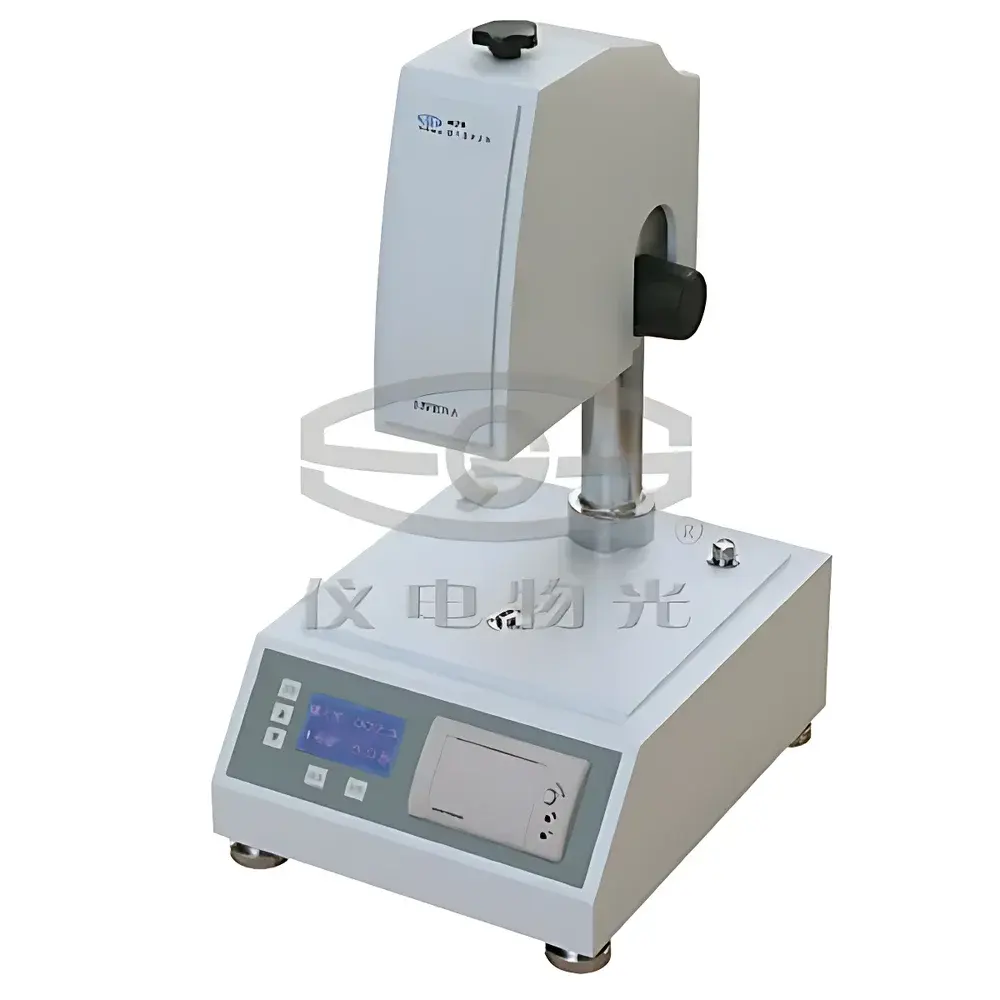
YDWG WZR-2 Penetrometer
| Brand | YDWG |
|---|---|
| Origin | Shanghai, China |
| Manufacturer Type | Authorized Distributor |
| Country of Origin | China |
| Model | WZR-2 |
| Pricing | Upon Request |
| Measurement Range | 0–50 mm (0–500 penetration units) |
| Minimum Resolution | 0.01 mm (0.1 penetration unit) |
| Displacement Sensor Resolution | 0.01 mm |
| Standard Cones | Cone I — total mass 150.0 g ± 0.1 g (cone body 131.78 g ± 0.07 g) |
| Timing Range | 1.0–9.9 s |
| Interface | RS-232 |
| Printer | Built-in RMD III 32PHR-410 thermal printer |
| Display | LCD |
| Power Supply | 220 V ± 22 V, 50 Hz ± 1 Hz, 30 W |
| Dimensions (W×D×H) | 340 × 280 × 600 mm |
| Net Weight | 16 kg |
Overview
The YDWG WZR-2 Penetrometer is a precision mechanical instrument engineered for the standardized determination of penetration depth in semi-solid materials—primarily lubricating greases, petroleum jellies, pharmaceutical ointments, and cosmetic bases. It operates on the fundamental principle of gravity-driven cone penetration: a standardized conical probe is released under controlled conditions onto the surface of a conditioned sample, and its vertical displacement into the material is measured after a defined dwell time (typically 5 seconds per ASTM D217 and GB/T 269–1991). Penetration depth is quantified in units of 0.1 mm (i.e., one penetration unit = 0.1 mm), with higher values indicating lower consistency or greater softness. The WZR-2 implements this classical empirical method with high repeatability and minimal operator dependency, making it suitable for routine QC laboratories, formulation development labs, and regulatory-compliant manufacturing environments where physical consistency testing is mandated.
Key Features
- Compliance with national and international standards including GB/T 269–1991, ASTM D217, ASTM D1321, and ISO 2137—ensuring traceable, auditable test results.
- Dual-standard cone configuration: interchangeable Cone I (150.0 g ± 0.1 g) and Cone II (37.5 g ± 0.1 g), enabling measurement across wide consistency ranges—from stiff industrial greases to low-viscosity topical gels.
- High-resolution linear displacement sensor with 0.01 mm resolution, calibrated to deliver consistent readings across the full 0–50 mm travel range (0–500 penetration units).
- Programmable timing module supporting dwell times from 1.0 to 9.9 seconds in 0.1 s increments—critical for method adaptation and comparative studies.
- Integrated thermal printer (RMD III 32PHR-410) for immediate hard-copy reporting, including date/time stamp, cone identity, dwell time, penetration value, and statistical summary (mean, SD, CV%) of replicate measurements.
- LCD interface with intuitive menu navigation, real-time display of penetration depth, elapsed time, and system status—designed for operation without PC dependency.
- Robust mechanical architecture with vibration-damped base and precision-guided release mechanism, minimizing parallax error and ensuring reproducible cone drop dynamics.
Sample Compatibility & Compliance
The WZR-2 accommodates standard sample cups (e.g., 50 mm diameter × 35 mm height per ASTM D217) and supports conditioning protocols per USP , Ph. Eur. 2.9.35, and JP 17 for pharmaceutical semi-solids. Its design conforms to GLP documentation requirements: all test parameters (cone ID, dwell time, ambient temperature, operator ID) are logged and printable. While not inherently 21 CFR Part 11 compliant, the RS-232 interface enables integration with validated LIMS or ELN systems that enforce electronic signature, audit trail, and data integrity controls. Calibration verification follows documented procedures using certified reference blocks traceable to NIM (National Institute of Metrology, China) or equivalent national metrology institutes.
Software & Data Management
The WZR-2 features embedded firmware supporting automated data acquisition, arithmetic averaging of up to 3 repeat measurements, and real-time statistical evaluation (mean, standard deviation, coefficient of variation). Raw penetration values and metadata are exportable via RS-232 to Windows-based applications—including Excel, LabArchives, or custom QA databases—using ASCII text format with tab-delimited fields. No proprietary software is required; terminal emulation (e.g., Tera Term, PuTTY) suffices for direct serial logging. For regulated environments, users may implement third-party validation packages to establish IQ/OQ protocols covering sensor linearity, timing accuracy, and thermal stability over operating temperature range (15–30 °C).
Applications
- Quality control of NLGI-grade lubricating greases during batch release and shelf-life monitoring.
- Formulation optimization of hydrophilic/hydrophobic ointment bases in pharmaceutical development.
- Stability assessment of topical drug products under accelerated storage conditions (e.g., ICH Q5C).
- Differentiation of raw material lots based on rheological consistency prior to blending.
- Supporting regulatory submissions requiring physical characterization per FDA Guidance for Topical Dermatological Products (2022) and EMA CHMP Assessment Report templates.
- Teaching laboratories demonstrating empirical texture analysis principles in materials science and pharmaceutics curricula.
FAQ
Does the WZR-2 meet ASTM D217 requirements?
Yes—the instrument satisfies all mechanical and procedural specifications outlined in ASTM D217–22, including cone geometry, mass tolerances, release mechanism, and timing accuracy.
Can the WZR-2 be used for non-pharmaceutical samples such as food-grade gels or adhesives?
Yes, provided the sample exhibits sufficient structural integrity to support cone penetration without extrusion or wall effects; method validation per ISO 11357–4 is recommended for novel matrices.
Is calibration certificate included with shipment?
No—calibration verification must be performed by the end user or an accredited third-party service provider prior to first use and at defined intervals (e.g., quarterly or per SOP), using traceable reference standards.
What environmental conditions are required for reliable operation?
A temperature-controlled room (20–25 °C ± 2 °C), low-vibration benchtop, and humidity <65% RH non-condensing are recommended to minimize thermal drift and ensure sample thermal equilibrium.
How is cone alignment verified?
Alignment is confirmed visually using the built-in optical sighting aid and mechanically verified using a certified gauge block set; misalignment >0.1 mm requires adjustment per the service manual.






