
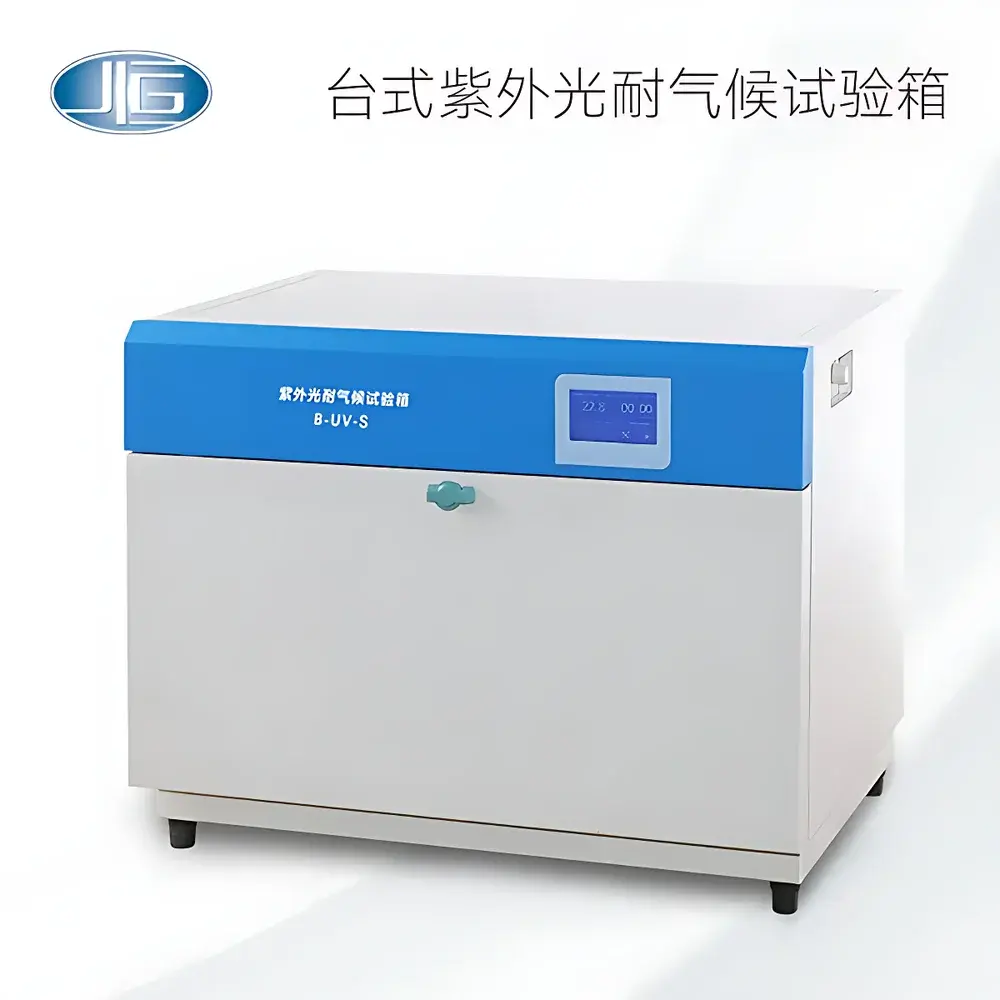
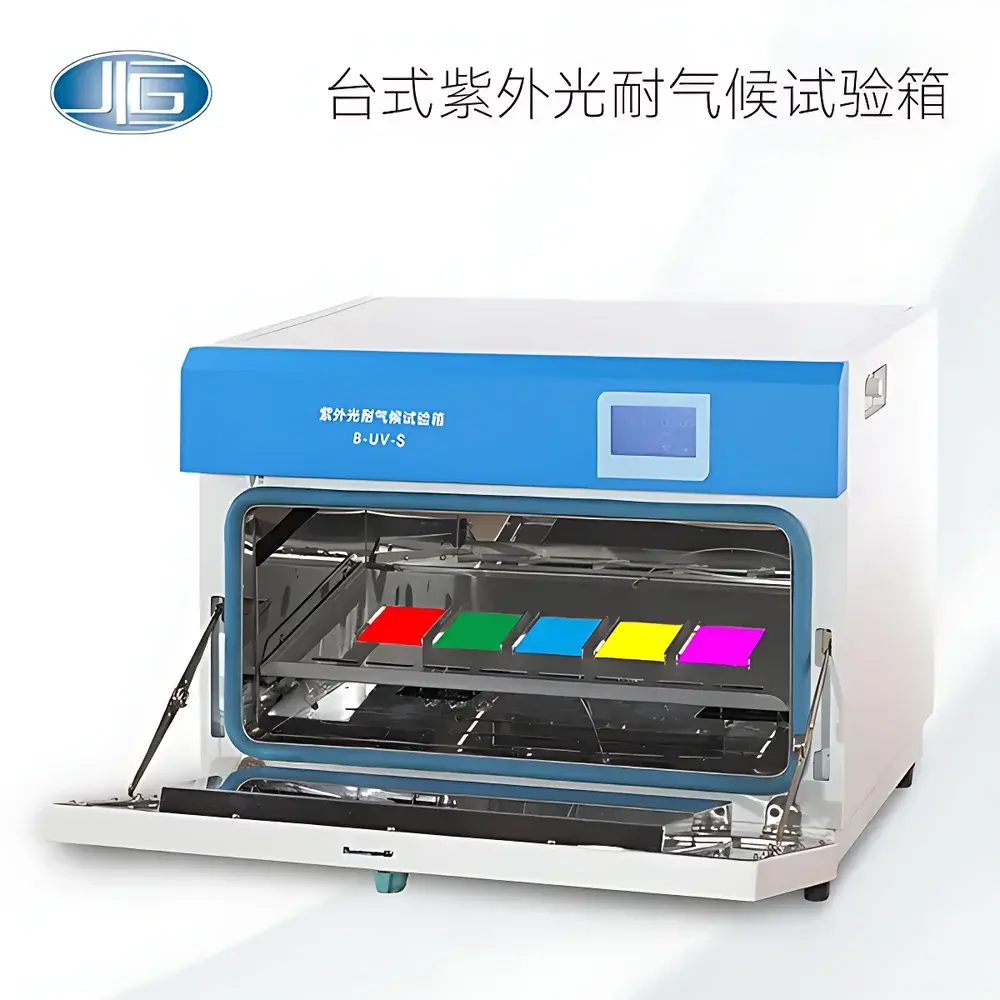
YIHENG B-UV-S Desktop UV Weathering Test Chamber
| Brand | YIHENG |
|---|---|
| Origin | Shanghai, China |
| Manufacturer Type | Direct Manufacturer |
| Country of Origin | China |
| Model | B-UV-S |
| UV Lamp Power | 20 W × 4 lamps |
| Irradiance (UVA) | 0.7 W/m² @ 340 nm |
| Black Panel Temperature Range | 45–80 °C |
| Sample Capacity | 18 standard specimen holders (70 × 150 mm each) |
| Chamber Interior Material | SUS304 stainless steel |
| Exterior Finish | Powder-coated cold-rolled steel |
| Control Interface | 4.3-inch capacitive touch screen with menu-driven UI |
| Optional Accessories | Handheld UV radiometer for manual irradiance calibration |
| Spray System | 3-nozzle uniform water spray assembly |
| Compliance Context | ICH Q1B (photostability testing), ISO 4892-3, ASTM G154, GB/T 14522 |
Overview
The YIHENG B-UV-S Desktop UV Weathering Test Chamber is an engineered solution for accelerated photochemical aging assessment under controlled ultraviolet (UV) irradiation and thermal stress. It operates on the principle of fluorescent UV lamp exposure—specifically UVA-340 lamps—which closely replicate the short-wavelength UV spectrum (295–365 nm) most responsible for polymer degradation in outdoor environments. Unlike xenon arc or carbon arc systems, this chamber leverages stabilized low-pressure mercury vapor lamps with phosphor coatings to deliver consistent spectral output centered at 340 nm, minimizing spectral drift over time. Designed for laboratory-scale comparative durability evaluation, the B-UV-S enables reproducible simulation of solar UV radiation effects—including photolysis, chain scission, and oxidation—without requiring full-spectrum sunlight replication. Its compact footprint and modular configuration make it suitable for QC labs, R&D facilities, and regulatory-compliant stability testing suites where space and budget constraints are critical.
Key Features
- Four independently mounted 20 W UVA-340 fluorescent lamps, delivering stable irradiance output with <5% spectral shift over 5,000 hours of operation—eliminating frequent recalibration needs.
- Black panel temperature control system with PID regulation, maintaining setpoint accuracy within ±1.5 °C across the operational range of 45–80 °C.
- Integrated 3-nozzle spray manifold enabling uniform deionized water application during dark cycles, simulating dew condensation and rain-induced thermal shock.
- 4.3-inch industrial-grade capacitive touchscreen interface supporting intuitive parameter entry, real-time monitoring of irradiance (via optional radiometer input), black panel temperature, and cycle timing.
- Chamber interior constructed entirely from electropolished SUS304 stainless steel for corrosion resistance and ease of cleaning; exterior finished with epoxy-polyester powder coating for mechanical durability.
- Standardized sample mounting architecture accommodating up to 18 specimens (70 × 150 mm each) on removable aluminum racks—compatible with irregular geometries via custom fixture adaptation.
Sample Compatibility & Compliance
The B-UV-S supports non-metallic materials including thermoplastics, coatings, adhesives, elastomers, textiles, and pharmaceutical packaging films. Its irradiance profile and thermal management align with key international standards: ISO 4892-3 (plastics—methods of exposure to laboratory light sources), ASTM G154 (standard practice for operating fluorescent UV-condensation apparatus), and GB/T 14522 (Chinese national standard for mechanical properties of paint and varnish films after UV exposure). For pharmaceutical applications, the chamber satisfies ICH Q1B “Photostability Testing of New Drug Substances and Products” requirements when operated with calibrated UVA lamps and validated black panel temperature control—enabling exposure to ≥200 W·hr/m² UV energy (320–400 nm) and ≥1.2 × 10⁶ lux·hr visible light dose. Cosmetic formulation developers use it to benchmark UV-filter efficacy and quantify changes in SPF-related parameters under standardized irradiation protocols.
Software & Data Management
While the B-UV-S does not include embedded PC-based software, its touch interface logs all test parameters—including start/stop timestamps, setpoints, actual black panel temperatures, and cumulative lamp-on hours—to internal flash memory. Data export is supported via USB port for CSV-formatted reports compatible with LIMS integration. Optional external radiometer readings can be manually entered and archived per test run. The system supports audit trails for GLP/GMP environments through timestamped operator ID entry (via alphanumeric keypad) and password-protected parameter modification. All firmware updates are delivered via USB stick and retain historical calibration offsets and user-defined test profiles.
Applications
- Accelerated weathering screening of automotive interior trim, architectural sealants, and marine coatings for gloss loss, chalking, and microcracking.
- Comparative photostability profiling of generic vs. innovator drug products per ICH Q5C guidelines.
- Formulation optimization of sunscreens and UV-absorbing polymers by quantifying transmittance decay kinetics via periodic spectrophotometric analysis.
- Quality assurance of printed electronics substrates exposed to indoor lighting environments containing significant UVA components.
- Validation of accelerated aging protocols against natural exposure data for ASTM D4329 correlation studies.
FAQ
Does the B-UV-S meet FDA 21 CFR Part 11 requirements for electronic records?
No—the device lacks electronic signature capability and automated audit trail generation required for Part 11 compliance. However, its manual logging features support paper-based traceability when paired with SOP-controlled documentation practices.
Can the chamber operate with UVC or UVB lamps?
No—it is mechanically and electrically configured exclusively for UVA-340 fluorescent tubes. Substitution with other lamp types voids calibration validity and may damage ballast circuitry.
What is the recommended maintenance interval for lamp replacement?
Lamps should be replaced every 5,000 hours or after 12 months of continuous operation—whichever occurs first—to maintain irradiance consistency within specification limits.
Is humidity control available as a factory option?
No—relative humidity is not actively regulated. Condensation is generated solely via spray-and-dwell cycles; ambient lab RH influences baseline moisture content but is not monitored or adjusted.
How is irradiance calibrated without built-in sensors?
Calibration requires periodic verification using a NIST-traceable handheld UV radiometer (e.g., UV-A sensor with cosine correction); users adjust lamp voltage via front-panel menu to match target 0.7 W/m² @ 340 nm.



