
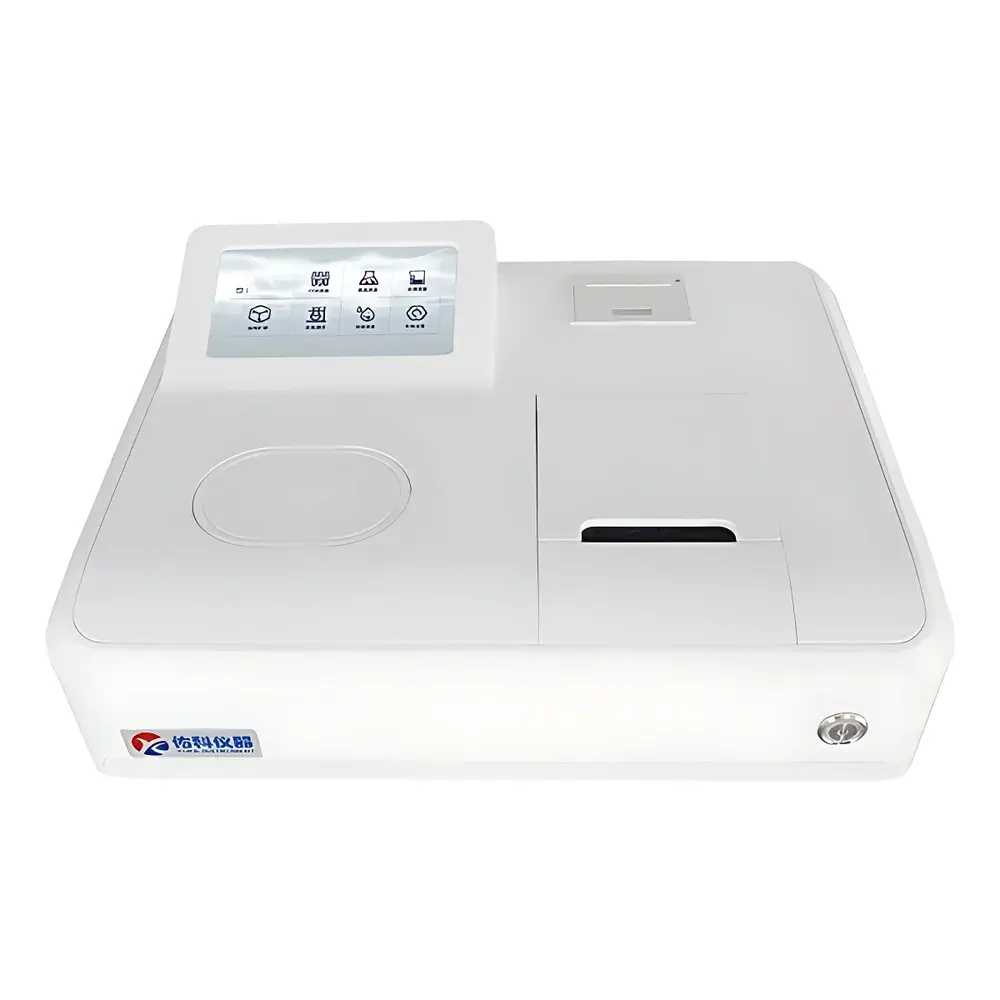
Yoke YKC-D1 Total Nitrogen Analyzer
| Brand | Yoke |
|---|---|
| Origin | Shanghai, China |
| Manufacturer Type | Direct Manufacturer |
| Product Origin | Domestic (China) |
| Model | YKC-D1 |
| Pricing | Available Upon Request |
| Measurement Method | Alkaline Potassium Persulfate Digestion + UV Spectrophotometry |
| Measurement Range | 0–80 mg/L |
| Accuracy | ≤8% RSD |
| Display | 5.6-inch Color Touchscreen GUI |
| Data Storage | ≥5,000 records (5 factory curves + 195 user-expandable calibration curves) |
| Light Source | Cold LED with Narrow-band Interference Filters (Lifespan: ≥100,000 hours) |
| Processor | ARM9 Core |
| Internal Memory | 512 MB |
| Connectivity | USB 2.0, RS-232 Serial Port |
| Printer | Integrated Thermal Printer |
| Custom Curve Support | Yes (Segmented K-coefficient adjustment) |
| Compatible Reagents | Lab-YY Pre-formulated Digestion & Detection Kits |
Overview
The Yoke YKC-D1 Total Nitrogen Analyzer is a benchtop laboratory instrument engineered for precise quantification of total nitrogen (TN) in aqueous environmental samples—including surface water, groundwater, wastewater, and treated effluents—according to the standardized alkaline potassium persulfate digestion coupled with ultraviolet spectrophotometric detection (Chinese National Standard HJ 636–2012, equivalent to ISO 11905-1:1997 and EPA Method 351.2 principles). This method ensures complete oxidation of organic nitrogen, ammonia, nitrite, and nitrate into nitrate ions under high-temperature alkaline conditions, followed by quantitative UV absorption measurement at 220 nm and 275 nm to correct for dissolved organic carbon interference. The YKC-D1 implements this regulatory-compliant workflow with hardware-level optimization: a thermally stabilized digestion module, precision optical path alignment, and dual-wavelength photometric detection architecture—delivering reproducible results across heterogeneous sample matrices without manual dilution or secondary filtration in most routine applications.
Key Features
- 5.6-inch capacitive color touchscreen with intuitive graphical user interface (GUI), supporting multi-language navigation and context-sensitive operation prompts
- Dual-wavelength UV photometer utilizing cold LED light source with narrow-band interference filters (FWHM < 5 nm), ensuring long-term photometric stability and minimizing spectral drift over extended operation cycles
- Integrated thermal printer enabling immediate hardcopy output of real-time measurements, calibration logs, and stored datasets—fully traceable per GLP documentation requirements
- Onboard data management system with 512 MB flash memory, supporting ≥5,000 measurement records; preloaded with 5 factory-calibrated curves and expandable library for up to 195 user-defined calibration functions
- ARM9-based embedded control architecture with deterministic real-time response, enabling seamless execution of multi-step digestion protocols, auto-zeroing, and background correction routines
- USB 2.0 host port for direct export of CSV-formatted datasets to external storage media; RS-232 serial interface compatible with LIMS integration via ASCII command protocol
- Support for segmented calibration coefficient (K) adjustment—allowing users to define non-linear response regions across the 0–80 mg/L dynamic range to accommodate matrix-specific deviations
- Optimized compatibility with Lab-YY certified pre-dosed reagent vials, reducing analyst exposure to hazardous chemicals and eliminating volumetric pipetting errors during digestion preparation
Sample Compatibility & Compliance
The YKC-D1 accepts liquid samples with turbidity ≤50 NTU and suspended solids content < 20 mg/L without mandatory pretreatment. For high-turbidity or particulate-rich samples (e.g., raw sewage, sediment pore water), optional centrifugation or membrane filtration (0.45 µm PVDF) is recommended prior to analysis. All measurement procedures align with HJ 636–2012, and the instrument’s calibration verification protocol satisfies internal quality control (IQC) requirements under ISO/IEC 17025:2017 Clause 7.7. Data audit trails—including operator ID, timestamp, curve selection, and raw absorbance values—are retained locally and exportable for regulatory review. While not FDA 21 CFR Part 11-certified out-of-the-box, the system supports manual electronic signature workflows when deployed within validated laboratory environments operating under GLP or ISO 14001 frameworks.
Software & Data Management
No proprietary PC software is required for basic operation—the YKC-D1 operates autonomously with full onboard firmware. However, optional Yoke DataLink utility (Windows-compatible) enables advanced functions: batch report generation (PDF/Excel), calibration curve validation statistics (R², LOD/LOQ estimation), trend analysis across time-series datasets, and automated QC flagging based on user-defined control limits. All exported files include embedded metadata (instrument ID, firmware version, digestion temperature profile, and reagent lot numbers when scanned via optional barcode reader add-on). Internal memory maintains write-cycle endurance exceeding 100,000 entries, with automatic overwrite protection for flagged QC failures or outlier events.
Applications
- Regulatory compliance monitoring for municipal wastewater treatment plants (WWTPs) reporting to local ecological bureaus
- Environmental impact assessment (EIA) field laboratories conducting TN profiling in rivers, lakes, and reservoirs
- Research institutions studying nitrogen cycling dynamics in agricultural runoff or wetland ecosystems
- Industrial effluent testing for food processing, pharmaceutical, and chemical manufacturing facilities
- Educational laboratories performing standard method validation exercises and method comparison studies
FAQ
Does the YKC-D1 require external digestion equipment?
No—the instrument integrates a programmable heating block (up to 125°C, ±0.5°C accuracy) and sealed digestion chamber, eliminating need for separate autoclaves or hot blocks.
Can the YKC-D1 measure nitrate or nitrite independently?
No—it is specifically designed for total nitrogen quantification. Separate instruments are required for speciated nitrogen analysis.
Is the calibration curve linear across the full 0–80 mg/L range?
Linearity is typically maintained up to 40 mg/L; above this concentration, segmented K-coefficient adjustment is recommended to compensate for Beer-Lambert law deviation.
What is the typical digestion cycle time per sample?
Standard protocol requires 30 minutes at 125°C, followed by 15 minutes cooling before photometric reading—total cycle: ~55 minutes.
How often must the optical system be recalibrated?
Factory calibration remains stable for ≥12 months under normal use; annual verification using NIST-traceable nitrate standards (e.g., SRM 2177) is advised.
Related Products







