York Instrument AccuStar Single-Axis Inclinometer
| Brand | York Instrument |
|---|---|
| Origin | USA |
| Manufacturer Type | Manufacturer |
| Origin Category | Imported |
| Model | AccuStar |
| Output Options | Analog (0–5 V, 0–10 V, ±5 V), Ratiometric, Digital (PWM), Serial (RS-232/RS-485) |
| Full Scale Range | ±60° |
| Linear Range | ±45° |
| Resolution | 0.001° |
| Accuracy (0–10°) | ±0.1° |
| Accuracy (10–45°) | ±1% of reading |
| Zero Repeatability | 0.05° |
| Cross-Axis Sensitivity | <1% (within ±45°) |
| Time Constant | 0.3 s |
| Frequency Response (−3 dB) | 0.5 Hz |
| RF Immunity | <±2° |
| Operating Temperature | −30°C to +65°C |
| Storage Temperature | −55°C to +65°C |
| Zero Tempco | 0.008°/°C |
| Scale Factor Tempco | 0.1%/°C |
| EMC Compliance | EN 55022 Class B, IEC 61000-4-2 Level 2 (ESD), IEC 61000-4-3 Level 3 (10 V/m), IEC 61000-4-4 Level 3 (2 kV), MIL-STD-461D CS114 |
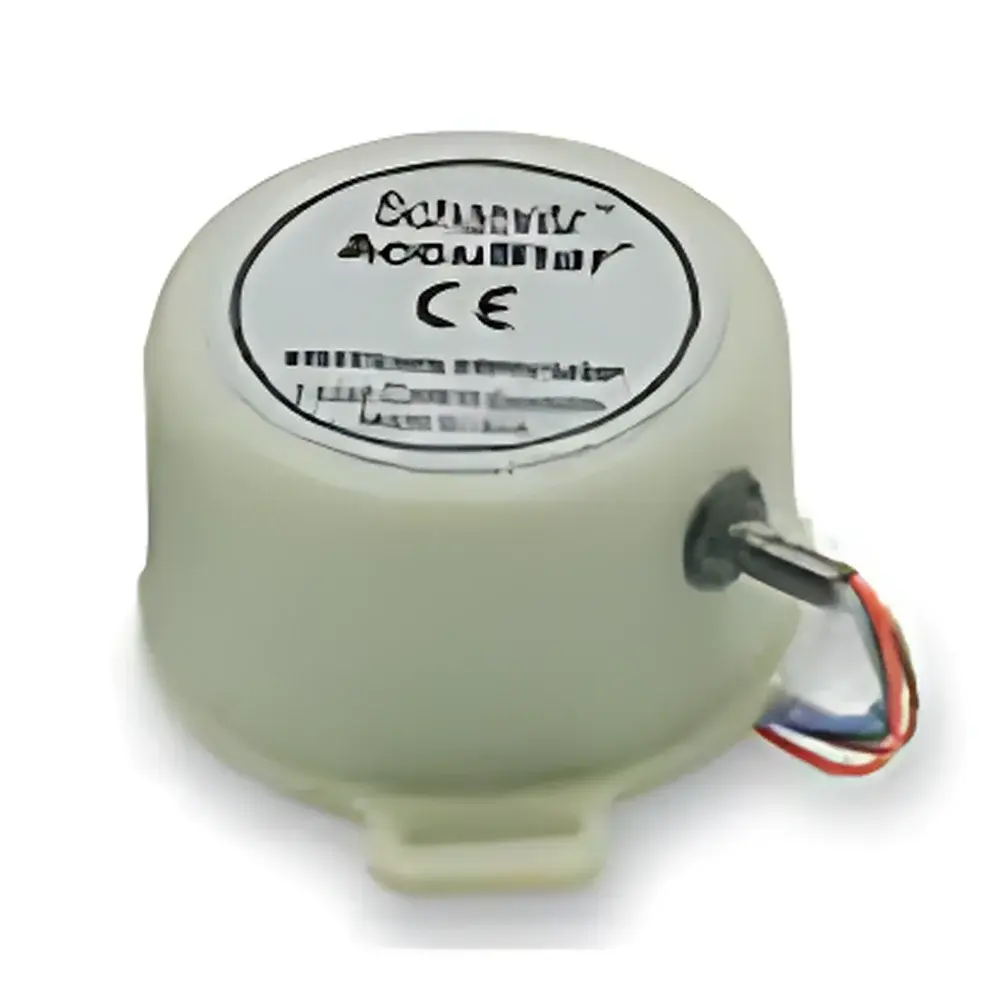
| Enclosure | Robust plastic housing, Ø2 in, Weight: 2 oz |
| Certifications | CE |
Overview
The York Instrument AccuStar Single-Axis Inclinometer is a high-stability, solid-state angular displacement sensor engineered for precision tilt measurement in demanding industrial and mobile environments. Unlike mechanical or MEMS-based inclinometers with moving parts or resonant structures, the AccuStar employs a patented capacitive sensing principle—featuring a monolithic, no-moving-parts transducer element. Angular rotation about its single measurement axis induces a linear change in differential capacitance, which is conditioned by low-power CMOS signal processing circuitry to produce a calibrated, direction-sensitive angular output. This architecture eliminates hysteresis, wear-related drift, and sensitivity to shock and vibration—making it particularly suitable for long-term deployment in construction equipment, antenna positioning systems, robotic joint feedback loops, and vehicle-mounted alignment platforms where reliability under thermal cycling and mechanical stress is non-negotiable.
Key Features
- Patented capacitive transduction technology with zero mechanical wear and no moving components
- High-resolution output: 0.001° resolution over ±60° full-scale range, with linear response up to ±45°
- Direction-aware output: analog, ratiometric, PWM, or serial (RS-232/RS-485) signals encode both magnitude and sign of tilt angle
- Compact form factor: 2-inch diameter, lightweight (56.7 g), IP65-rated robust plastic enclosure
- Low thermal drift: zero offset temperature coefficient of 0.008°/°C and scale factor tempco of 0.1%/°C
- Rugged EMC performance: compliant with EN 55022 Class B, IEC 61000-4 series, and MIL-STD-461D CS114 for operation in electrically noisy environments
- Fast dynamic response: 0.3 s time constant and −3 dB bandwidth of 0.5 Hz—optimized for quasi-static and slow-motion tilt monitoring
Sample Compatibility & Compliance
The AccuStar is designed for integration into OEM systems requiring traceable, repeatable angular metrology without recalibration over extended service life. Its solid-state construction ensures compatibility with ISO 9001-certified manufacturing workflows and supports GLP/GMP-aligned validation protocols where instrument stability and documented uncertainty budgets are required. The device carries CE marking per Directive 2014/30/EU (EMC) and 2014/35/EU (LVD), confirming conformity with essential health and safety requirements for electrical equipment operating within the European Economic Area. While not inherently FDA 21 CFR Part 11-compliant as a standalone sensor, its digital output variants support audit-trail-capable data acquisition systems when integrated into validated instrumentation platforms.
Software & Data Management
The AccuStar does not include embedded firmware or proprietary configuration software; instead, it delivers deterministic, protocol-transparent analog or serial outputs compatible with standard industrial DAQ systems (e.g., National Instruments, Keysight, Beckhoff), PLCs (Siemens S7, Allen-Bradley CompactLogix), and custom microcontroller-based interfaces. RS-232/RS-485 variants support ASCII command sets for real-time query of status, calibration ID, and temperature-compensated angle values. All output formats maintain inherent linearity and monotonicity across the full ±60° range—enabling direct use in closed-loop control algorithms without lookup-table interpolation. For system-level traceability, users may log timestamped angle readings alongside environmental telemetry (e.g., ambient temperature from onboard thermistor or external sensor) to support post-hoc uncertainty analysis per ISO/IEC 17025 guidelines.
Applications
- Wheel alignment systems: Real-time camber/caster feedback during dynamic calibration procedures
- Construction machinery: Platform leveling control for cranes, scissor lifts, and concrete pump booms
- Antenna and solar tracker positioning: Closed-loop tilt correction under wind-induced oscillation
- Mobile robotics: Joint angle feedback in legged or articulated manipulator systems
- Structural health monitoring: Long-term inclination trend analysis of bridges, towers, and retaining walls
- Transportation safety systems: Tilt-triggered alerts in railcar or heavy-vehicle roll-over prevention modules
FAQ
What is the difference between linear range and full-scale range?
The linear range (±45°) defines the angular span over which output error remains bounded by specified linearity limits (±0.1° at low angles, ±1% FS elsewhere). The full-scale range (±60°) indicates the maximum measurable angle before saturation; output remains monotonic but non-linear beyond ±45°.
Can the AccuStar be used in outdoor applications?
Yes—the housing meets IP65 ingress protection, and operational temperature spans −30°C to +65°C. However, prolonged UV exposure may affect long-term polymer integrity; optional conformal coating or mounting within shaded enclosures is recommended for multi-year field deployment.
Is factory calibration traceable to NIST standards?
Each unit undergoes end-of-line angular calibration using metrology-grade autocollimators traceable to NIST through accredited third-party laboratories. Calibration certificates—including uncertainty budgets per GUM (JCGM 100:2008)—are available upon request.
How is cross-axis sensitivity characterized?
Cross-axis error is defined as the angular output deviation induced by rotation about an axis orthogonal to the primary measurement axis. For the AccuStar, this is guaranteed to remain below 1% of reading for any orthogonal tilt ≤ ±45°, verified per ISO 22090-1:2017 test methodology.
Does the sensor require periodic recalibration?
No scheduled recalibration is mandated under normal operating conditions. The capacitive core exhibits negligible long-term drift (<0.01°/year typical). Recalibration is advised only after exposure to mechanical shock exceeding 500 g or thermal excursions beyond storage limits.