
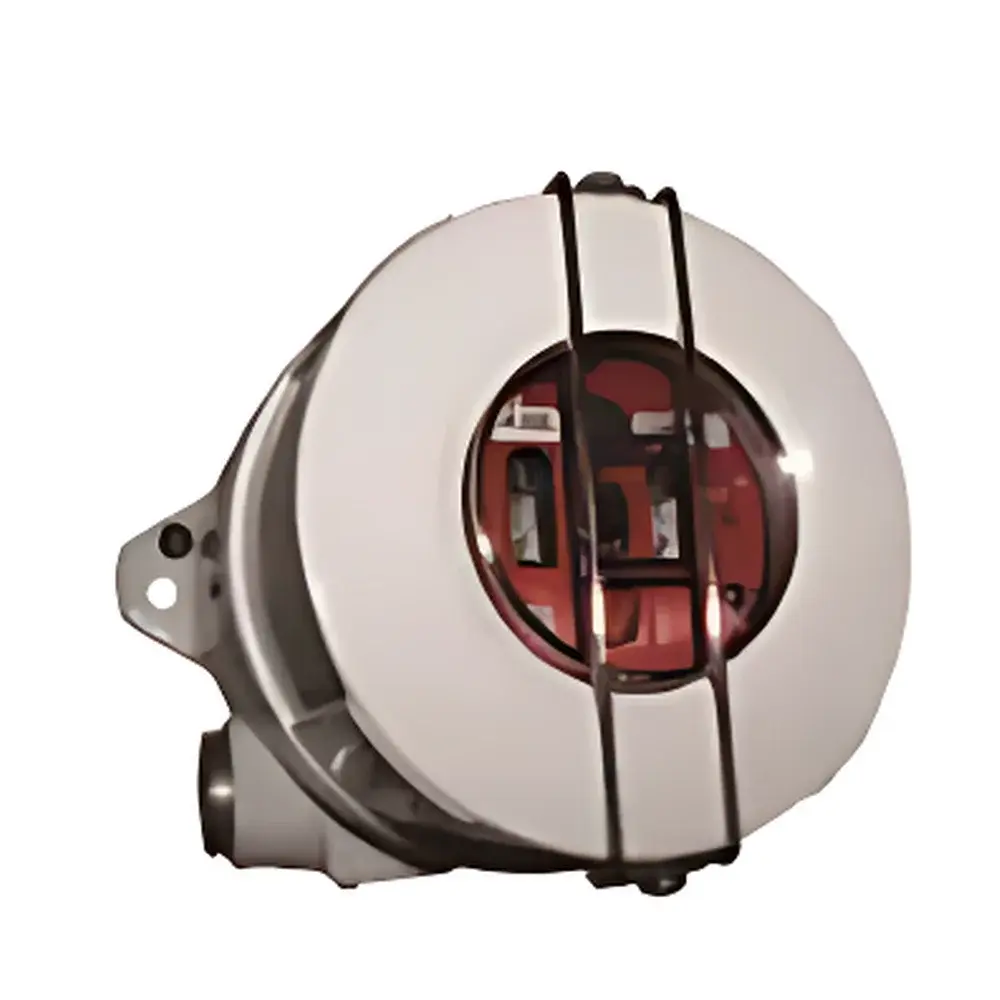
York Instruments SS4-A2 UV/IR Flame Detector
| Brand | York Instruments |
|---|---|
| Origin | USA |
| Manufacturer Type | Manufacturer |
| Product Category | Imported |
| Model | SS4-A2 |
| Pricing | Upon Request |
| Spectral Range | UV 185–260 nm, Visible 400–700 nm, IR 700–3500 nm |
| Detection Angle | 120° conical field of view |
| Sensitivity Options | 15 / 30 / 45 / 60 ft (1 ft² gasoline flame) |
| Response Time | 2–5 s at 60 ft |
| Operating Voltage | 24 VDC (20.5–34 VDC) |
| Relay Output | 1.0 A / 24 VAC |
| Operating Temperature | −40 °C to +85 °C |
| Humidity Range | 10–90% RH (non-condensing) |
| Hazardous Location Certification | Class I, Div 1 & 2, Groups B, C, D |
Overview
The York Instruments SS4-A2 UV/IR Flame Detector is a dual-spectrum, microprocessor-based fire detection system engineered for high-reliability early flame identification in industrial and hazardous environments. Unlike single-band detectors, the SS4-A2 simultaneously monitors ultraviolet (185–260 nm), visible (400–700 nm), and near-to-mid infrared (700–3500 nm) spectral bands—enabling robust discrimination between true hydrocarbon and non-hydrocarbon flames (e.g., hydrogen, ammonia, sulfur-containing fuels) and common false sources such as arc welding, lightning, sunlight, or hot metal surfaces. Its conical 120° field of view provides wide-area coverage without mechanical scanning, while its adaptive spectral correlation algorithm analyzes real-time intensity ratios across all three bands to suppress nuisance alarms with statistically validated confidence. Designed and manufactured in the United States, the SS4-A2 complies with rigorous functional safety requirements for continuous operation in demanding process facilities, refineries, offshore platforms, and chemical storage areas.
Key Features
- Dual-spectrum UV/IR + visible band detection ensures reliable flame signature recognition across diverse fuel types—including hydrocarbons, hydrogen, alcohols, and halogenated compounds.
- Configurable sensitivity settings (15 ft, 30 ft, 45 ft, or 60 ft detection range for a 1 ft² gasoline flame) allow optimization for specific hazard geometry and ambient conditions.
- Response time of 2–5 seconds at 60 ft meets NFPA 72 and IEC 61508 SIL 2 requirements for critical fire alarm applications.
- Explosion-proof housing certified to Class I, Div 1 & 2, Groups B, C, D; Class II, Div 1 & 2, Groups E, F, G; and Class III per UL 1613 and CSA C22.2 No. 142.
- Wide operating temperature range (−40 °C to +85 °C) and humidity tolerance (10–90% RH, non-condensing) support deployment in arctic climates and high-heat process zones.
- 24 VDC input (20.5–34 VDC) with fail-safe relay output (1.0 A / 24 VAC) enables seamless integration into existing fire alarm control panels (FACPs) and distributed control systems (DCS).
- Field-programmable via DIP switches or optional handheld configurator—no firmware upload required for basic parameter adjustment.
Sample Compatibility & Compliance
The SS4-A2 is validated for detection of open-flame combustion events from both carbon-based (e.g., methane, propane, diesel, gasoline) and non-carbon-based fuels (e.g., hydrogen, hydrazine, silane). Its spectral response profile has been verified against ASTM E1867 (Standard Test Methods for Fire Detector Response), UL 268 (Smoke Detectors), and UL 217 (Single and Multiple Station Smoke Alarms), with additional validation performed per EN 54-10:2017 for flame detectors. The unit supports traceability under ISO/IEC 17025-accredited calibration protocols and maintains full auditability for GLP/GMP-regulated sites requiring documented verification of detector performance history.
Software & Data Management
While the SS4-A2 operates as a standalone analog/digital alarm device without embedded network connectivity, it supports integration into enterprise-level fire safety management platforms via standard 4–20 mA or Modbus RTU interfaces (optional module). All configuration changes—including sensitivity level, alarm delay, and fault reporting mode—are logged internally with timestamp and operator ID when used with York’s optional diagnostic interface module. The device stores up to 1,024 event records (alarm, fault, self-test, configuration change) with cyclic overwrite, compliant with NFPA 72 Chapter 10 recordkeeping mandates and FDA 21 CFR Part 11 electronic record requirements when paired with validated data acquisition software.
Applications
- Oil & gas production platforms and flare stack monitoring
- Chemical processing units handling flammable solvents or reactive gases
- Aircraft hangars and fuel depot storage tanks
- Hydrogen refueling stations and electrolyzer enclosures
- Power generation turbine halls and boiler rooms
- Military ordnance handling facilities and propellant storage bunkers
- Pharmaceutical cleanroom solvent dispensing zones
FAQ
What flame types can the SS4-A2 reliably detect?
It detects hydrocarbon flames (e.g., natural gas, gasoline), hydrogen flames, alcohol fires, and other non-carbon-based combustibles—including those emitting weak or atypical UV/IR signatures—by analyzing multi-band spectral ratios rather than relying on absolute intensity thresholds.
Does the SS4-A2 require periodic recalibration?
No routine recalibration is required. The detector employs factory-trimmed, temperature-compensated UV and IR sensors with >10-year operational lifespan under normal conditions. Annual functional testing per NFPA 72 is recommended.
Can the SS4-A2 be installed outdoors?
Yes—its IP66-rated enclosure and −40 °C to +85 °C operating range make it suitable for unsheltered outdoor mounting, provided direct solar exposure on the optical window is minimized per manufacturer installation guidelines.
Is the SS4-A2 compatible with legacy fire alarm panels?
Yes—it provides isolated dry-contact relay outputs and optional 4–20 mA analog signal output, ensuring interoperability with conventional FACPs, PLCs, and SCADA systems without protocol translation.
How does the SS4-A2 differentiate sunlight from flame radiation?
By rejecting broadband UV signals lacking correlated IR emission—and by applying dynamic thresholding based on real-time visible-band background normalization—the detector achieves sunlight immunity even at high solar zenith angles and reflective surface conditions.




