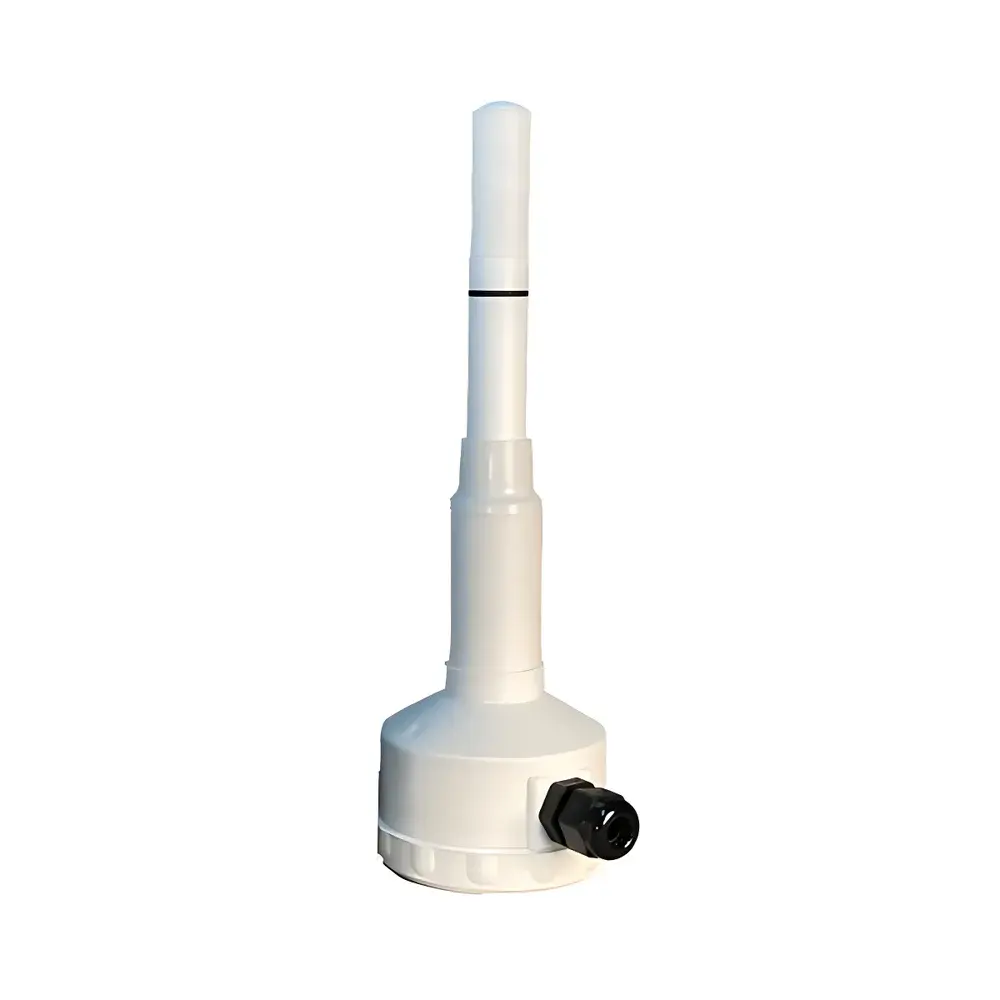
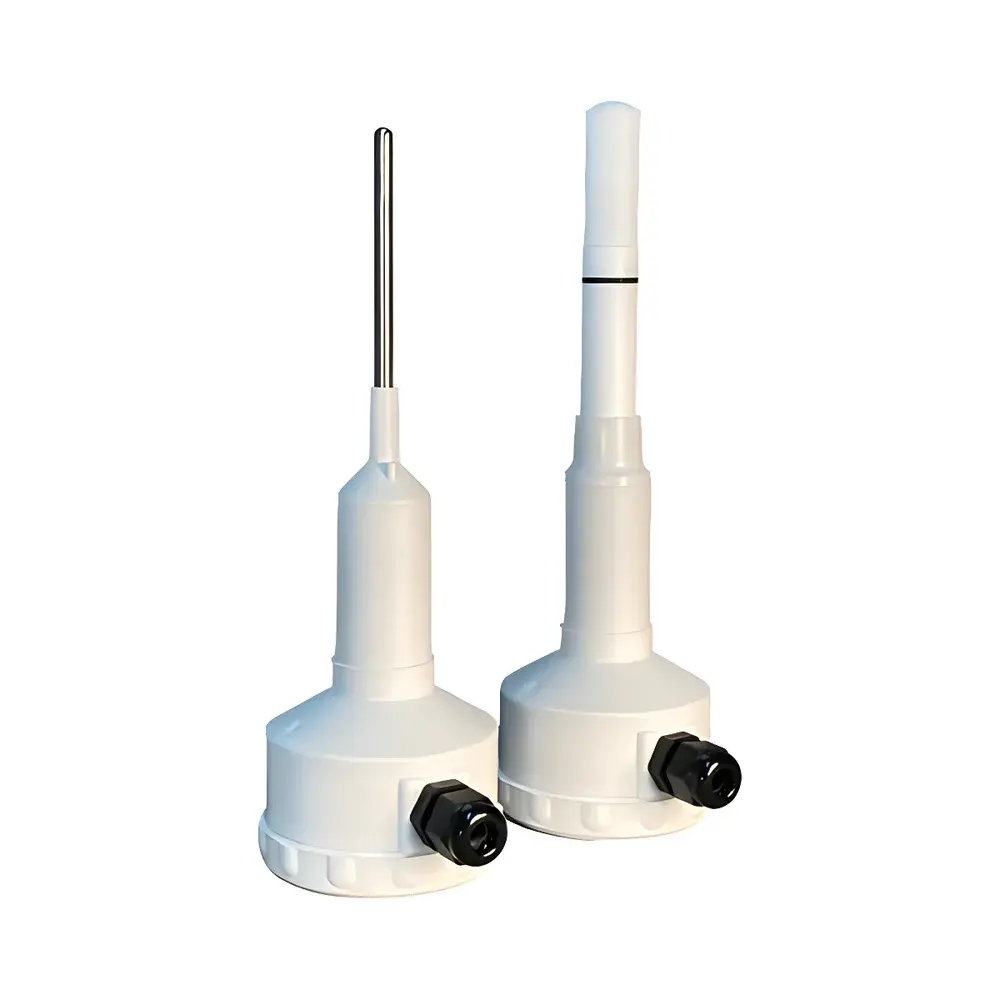
R.M. Young 41382LC2 Temperature and Humidity Sensor
| Brand | R.M. Young |
|---|---|
| Origin | USA |
| Model | 41382LC2 |
| Temperature Range | -50 to +50 °C |
| Temperature Accuracy | ±0.3 °C (@ 23 °C) |
| Temperature Resolution | 0.1 °C |
| Relative Humidity Range | 0–100 %RH |
| RH Accuracy | ±1 %RH (@ 20 °C) |
| RH Stability | <1 %RH/year |
| RH Response Time | 10 s (unshielded) |
| Temperature Response Time | 10 s (unshielded) |
| Output Signal | 4–20 mA (2-wire loop-powered) |
| Supply Voltage | 12–30 VDC |
| Max Current Draw | 46 mA |
| Sensor Type | Pt100 RTD (temperature), Rotronic Hygromer® (humidity) |
| Enclosure Dimensions | Ø64 mm × 176 mm |
| Weight | 200 g |
| Recommended Cable | 2-pair shielded, 22 AWG |
| Optional Radiation Shield | Model 43502 (aspirated) or Model 41003P (multi-plate) |
Overview
The R.M. Young 41382LC2 is a high-stability, industrial-grade temperature and humidity sensor engineered for continuous environmental monitoring in demanding outdoor and semi-outdoor applications. It integrates a precision Pt100 resistance temperature detector (RTD) and a calibrated Rotronic Hygromer® capacitive humidity sensing element within a single compact probe housing. The device operates on the principle of resistive thermal measurement and dielectric constant variation in a polymer-based humidity-sensitive layer—both traceably calibrated against NIST-traceable reference standards. Designed for long-term deployment in meteorological stations, HVAC validation networks, environmental research sites, and industrial process air monitoring, the 41382LC2 delivers metrologically sound data under wide ambient conditions—from polar field camps to arid desert installations. Its 4–20 mA two-wire analog output ensures compatibility with SCADA systems, PLCs, and data loggers compliant with IEC 61000-6-2/6-4 electromagnetic immunity standards.
Key Features
- Simultaneous, co-located measurement of air temperature and relative humidity using industry-validated sensor technologies (Pt100 RTD and Rotronic Hygromer®)
- Wide operational temperature range: −50 °C to +50 °C, with temperature accuracy of ±0.3 °C at 23 °C and humidity accuracy of ±1 %RH at 20 °C
- Proven long-term stability: humidity drift <1 %RH per year; temperature drift <0.02 °C/year (typical, when installed with appropriate radiation shielding)
- Fast thermal and hygric response: 10-second time constant (τ₆₃) for both parameters under unshielded conditions—optimized for dynamic ambient tracking
- Robust stainless-steel and anodized aluminum construction; IP65-rated enclosure suitable for permanent outdoor mounting
- Low-power, loop-powered 4–20 mA output eliminates need for local power supply at the sensor node—reducing installation complexity and grounding risks
- Compatible with standard 22 AWG shielded twisted-pair cabling; supports cable runs up to 1,000 meters (subject to loop resistance and voltage drop constraints)
Sample Compatibility & Compliance
The 41382LC2 is designed for direct measurement of ambient air—not for use in aggressive chemical vapors, condensing environments, or pressurized ducts without auxiliary conditioning. It meets the mechanical and environmental requirements specified in WMO No. 8 (Guide to Meteorological Instruments and Methods of Observation) for Class II climatological sensors. While not intrinsically safe-certified, it complies with UL 61010-1 and IEC 61326-1 for measurement equipment in industrial locations. When deployed with the optional Model 43502 aspirated radiation shield (fan-assisted ventilation) or Model 41003P multi-plate passive shield, the sensor achieves thermal equilibrium representative of true free-air conditions—critical for compliance with ISO 7726 (Ergonomics of the thermal environment) and ASTM D5465 (Standard Practice for Determining Air Temperature and Humidity in Outdoor Environments).
Software & Data Management
The 41382LC2 does not include embedded firmware or onboard data storage; it functions as a pure analog transducer. Its 4–20 mA output maps linearly across its full measurement span: 4 mA = −50 °C / 0 %RH, 20 mA = +50 °C / 100 %RH. Integration into supervisory systems requires external signal conditioning or acquisition hardware supporting HART-enabled or non-HART 4–20 mA interpretation. For traceable calibration documentation, R.M. Young provides NIST-traceable calibration certificates (optional at time of order), including individual sensor characterization data—supporting audit readiness for GLP, GMP, and ISO/IEC 17025-accredited laboratories. Raw output values are directly convertible to dew point, wet-bulb temperature, and vapor pressure using standard psychrometric algorithms (e.g., Magnus formula or ASHRAE Fundamentals Chapter 1).
Applications
- Meteorological surface observation networks (WMO-compliant weather stations)
- Environmental monitoring for EPA-regulated air quality assessment sites
- Validation and verification of HVAC performance in cleanrooms (ISO 14644-3) and pharmaceutical manufacturing suites
- Long-term climate research deployments—including Antarctic and Arctic field stations
- Industrial drying process control and ambient condition logging in food processing, wood kilns, and composite curing facilities
- Calibration reference nodes in distributed sensor arrays requiring spatially resolved microclimate profiling
FAQ
Is the 41382LC2 suitable for indoor use only?
It is engineered for outdoor exposure but performs equally well indoors. Its robust enclosure and wide temperature tolerance make it appropriate for unconditioned spaces such as warehouses, greenhouses, and utility tunnels.
Does the sensor require periodic recalibration?
While long-term stability is excellent (<1 %RH/year), annual recalibration against traceable references is recommended for applications requiring ISO/IEC 17025 compliance or regulatory reporting.
Can the output be converted to digital protocols like Modbus or SDI-12?
No—the 41382LC2 is analog-only. Digital conversion requires external signal conditioners (e.g., Campbell Scientific AM16/32B, Dataforth MAQ20-IOM, or Phoenix Contact VALVEMATIC modules).
What is the minimum supply voltage for reliable 4–20 mA operation?
12 VDC is the functional lower limit. At 12 VDC and maximum load (≤46 mA), the loop must maintain ≥3 V across the sensor terminals—verify total loop resistance accordingly.
Is condensation protection included?
No built-in heating or desiccant system is provided. In high-humidity or freezing-fog environments, use with an aspirated radiation shield (Model 43502) is strongly advised to minimize moisture accumulation and thermal lag.