
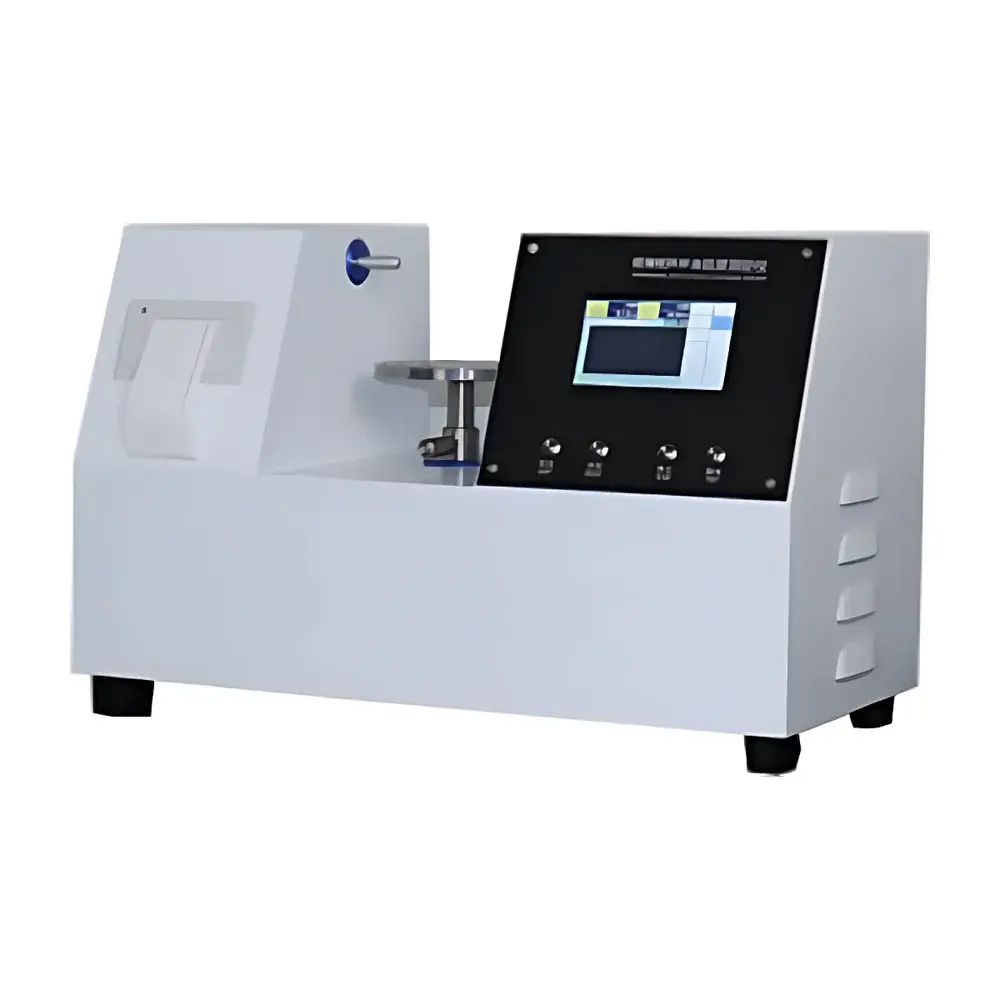
Yuelian PW-6618 Cup Body Stiffness Tester
| Brand | Yuelian |
|---|---|
| Origin | Guangdong, China |
| Manufacturer Type | Authorized Distributor |
| Country of Manufacture | China |
| Model | PW-6618 |
| Measurement Range | 0–10 N |
| Resolution | 0.01 N |
| Accuracy | ±1% FS |
| Repeatability | ≤1% FS |
| Cup Diameter Range | 30–150 mm |
| Cup Height Range | 15–120 mm |
| Test Speed | 50 ± 2.5 mm/min (adjustable from 1–200 mm/min) |
| Force Travel Distance | 9.5 ± 0.5 mm |
| Dimensions (L×W×H) | 380 × 260 × 290 mm |
| Net Weight | 18 kg |
Overview
The Yuelian PW-6618 Cup Body Stiffness Tester is an electromechanical testing instrument engineered for the precise quantification of axial rigidity in disposable paper cups and similar cylindrical rigid packaging containers. It operates on the principle of controlled angular deflection under axial compression—specifically, applying a calibrated linear force to the cup wall at a defined height and measuring the resulting resistance to buckling deformation. Designed in strict accordance with QB/T 2294–2006 “Paper Cups” (the People’s Republic of China Light Industry Standard), the tester replicates the standardized mechanical test protocol originally defined for manual cup stiffness evaluation but replaces operator-dependent actuation with closed-loop servo-controlled motion and digital load sensing. This ensures high reproducibility across operators, shifts, and laboratories—critical for quality assurance in high-volume paper cup manufacturing and third-party packaging certification labs.
Key Features
- Microprocessor-based control system with industrial-grade aluminum sandblasted front panel and capacitive touch LCD interface for intuitive navigation and real-time parameter monitoring
- Fully automated test sequence initiation: auto-detection of cup placement, automatic engagement of dual-sensor measurement heads, and programmable start/stop logic based on load threshold recognition
- Integrated motorized lift platform with precision lead-screw actuation enables repeatable vertical positioning of the cup relative to the loading head—eliminating manual height adjustment errors
- Dual-load-cell architecture provides redundancy and cross-verification of force readings, enhancing measurement integrity and minimizing drift-related uncertainty
- Real-time force–displacement curve visualization during test execution, with on-screen zoom, cursor-based data point interrogation, and export-ready plot generation
- Embedded thermal line printer supports immediate hardcopy output of test ID, date/time stamp, peak load (N), and pass/fail status per ASTM D642 or internal SOPs
- Adjustable crosshead speed (1–200 mm/min) accommodates both rapid screening and slow-rate creep compliance assessments per ISO 12048 or GB/T 4857.3
Sample Compatibility & Compliance
The PW-6618 accommodates standard single-wall and double-wall paper cups, coated or uncoated, within diameter (30–150 mm) and height (15–120 mm) envelopes typical of beverage, foodservice, and takeaway packaging. Its modular cup support tray accepts conical, straight-walled, and flared geometries without fixture changeover. The instrument meets functional equivalency requirements of QB/T 2294–2006 and aligns with measurement principles referenced in ISO 2436:2021 (Packaging — Compression testing of cylindrical containers) and ASTM D642 (Standard Test Method for Determining Compressive Resistance of Shipping Containers). While not certified to IEC 61000-6-2/6-4 or CE-marked for EU market placement, its electrical architecture complies with GB 4793.1–2007 (Safety requirements for electrical equipment for measurement, control, and laboratory use).
Software & Data Management
The embedded firmware supports user-defined test profiles—including preset cup size classes (e.g., “8 oz”, “16 oz”, “32 oz”), custom speed ramps, and pass/fail thresholds. All raw data—including timestamped force vs. displacement arrays, peak load, and deformation at 9.5 mm travel—are stored internally (≥1,000 tests) and exportable via USB 2.0 to CSV or XML format. Optional PC software (Yuelian TestSuite v3.x) enables GLP-compliant audit trails, multi-instrument fleet management, statistical process control (SPC) charting (X̄–R, Cpk), and FDA 21 CFR Part 11–compatible electronic signatures when paired with validated Windows OS environments.
Applications
- Quality control in paper cup converting facilities: monitoring batch-to-batch consistency of board basis weight, coating adhesion, and creasing integrity
- R&D validation of new fiber blends, bio-based barrier coatings, or recycled content formulations against stiffness retention targets
- Supplier qualification testing for cup suppliers serving QSR (Quick Service Restaurant) chains requiring documented mechanical performance history
- Regulatory submission support for packaging compliance dossiers submitted to CNCA (China National Certification and Accreditation Administration) or provincial market supervision bureaus
- Academic research on structure–property relationships in laminated paperboard under compressive loading conditions
FAQ
What standards does the PW-6618 directly implement?
It implements QB/T 2294–2006 as its primary reference standard; its force application geometry, travel distance (9.5 mm), and speed (50 mm/min nominal) are fully aligned with Clause 6.5.2 of that specification.
Can the instrument be integrated into a LIMS environment?
Yes—via optional RS-232 or USB CDC serial emulation mode, enabling direct communication with laboratory information management systems supporting ASTM E1384 or HL7 ADT messaging protocols.
Is calibration traceability provided with the unit?
Each unit ships with a factory calibration certificate traceable to NIM (National Institute of Metrology, China) through accredited secondary standards; annual recalibration using NIST-traceable deadweight kits is recommended.
Does the system support multi-point stiffness profiling along the cup height?
No—the PW-6618 performs single-height axial compression at the standardized 15 mm from the cup rim per QB/T 2294–2006; height-variable profiling requires custom fixtures not included in standard configuration.
What maintenance is required for long-term accuracy?
Bi-weekly cleaning of the linear guide rails and load cell contact surfaces with lint-free isopropyl alcohol; annual verification of encoder resolution and motor torque response by authorized service personnel.






