
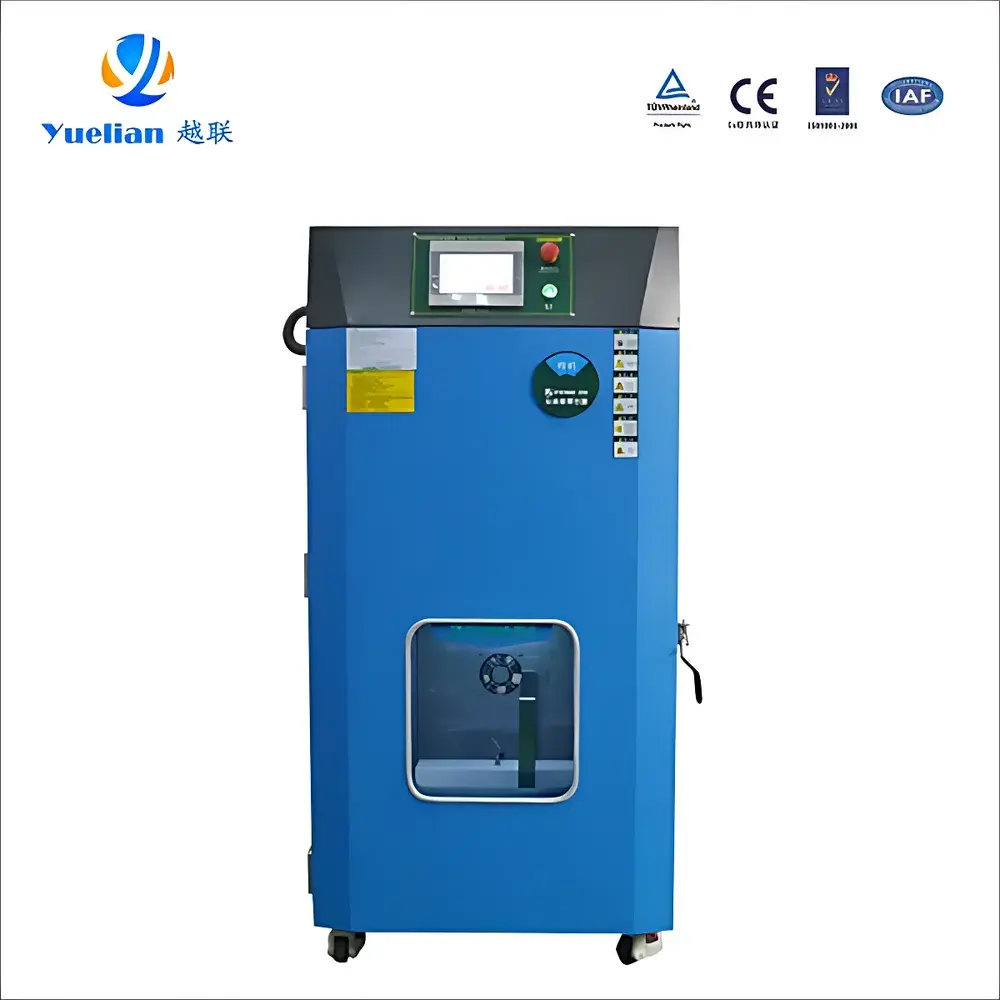
Yuelian YL-CJ-01 Battery Heavy Object Impact Tester
| Brand | Yuelian |
|---|---|
| Origin | Guangdong, China |
| Model | YL-CJ-01 |
| Sample Max Dimensions | W300 × D300 mm |
| Overall Dimensions | W880 × H1680 × D730 mm |
| Cabinet Material | Thick Cold-Rolled Steel (Gray + Blue Finish) / Interior: Stainless Steel |
| Viewing Window | 350 × 400 mm Double-Layer Tempered Explosion-Resistant Glass |
| Lighting | LED |
| Ventilation | Forced Exhaust System |
| Pressure Relief | Automatic Pressure Release Port |
| Control System | PLC with Touchscreen Interface |
| Drop Height Range | 0–910 mm (Adjustable, ±0.5 mm Accuracy, 0.1 mm Display Resolution) |
| Impact Mass | 9.1 kg or 10 kg (±0.1 kg Tolerance) |
| Impact Bar Diameter | 15.8 mm (±0.1 mm Tolerance) |
| Drive Mechanism | Electric Vertical Lifting |
| Test Surface | Hardened Steel Plate |
| Fixture Height Adjustment | 0–300 mm (Motorized, Movable) |
| Standard Accessories | Main Unit, Two Impact Weights, One General-Purpose Fixture |
| Optional | HD In-Cabinet Video Monitoring System |
| Operating Environment | 0–45 °C |
Overview
The Yuelian YL-CJ-01 Battery Heavy Object Impact Tester is a purpose-built safety evaluation instrument designed to assess the mechanical abuse resistance of lithium-ion and other rechargeable electrochemical cells under standardized impact conditions. It operates on the principle of controlled gravitational energy transfer: a calibrated mass is elevated to a defined height and released in free-fall onto a rigid metal bar positioned across the battery surface—thereby simulating mechanical intrusion events such as tool drop or structural deformation during transport or handling. The test method aligns with internationally referenced safety protocols including UN Manual of Tests and Criteria Part III, subsection 38.3.4 (Impact Test), IEC 62133-2:2017 Clause 8.3.2, and GB/T 31241–2014 Section 7.4. The device ensures repeatable, traceable, and auditable execution of impact trials—critical for quality control laboratories, battery cell manufacturers, and third-party certification bodies conducting compliance testing per UL 1642, UL 2054, and regulatory submission packages for CE, KC, or PSE marking.
Key Features
- PLC-based closed-loop control system with industrial-grade touchscreen HMI for intuitive parameter entry, real-time status monitoring, and event logging.
- Precision electric lifting mechanism enabling stepless height adjustment from 0 to 910 mm; height positioning accuracy maintained within ±0.5 mm, resolution 0.1 mm.
- Dual certified impact masses (9.1 kg ±0.1 kg and 10 kg ±0.1 kg) compliant with UN 38.3 and IEC 62133 requirements for cylindrical and prismatic cell categories.
- Calibrated impact bar (15.8 mm ±0.1 mm diameter, hardened stainless steel) mounted orthogonally to the longitudinal axis of cylindrical cells—ensuring consistent stress distribution per test standard geometry constraints.
- Robust monolithic cabinet structure fabricated from thick cold-rolled steel with dual-tone powder-coated finish (gray base + blue accent); interior lined with corrosion-resistant stainless steel.
- Explosion-rated observation window (350 × 400 mm) composed of laminated tempered glass meeting EN 12600 Class P2A impact resistance criteria—providing visual verification while containing potential venting events.
- Integrated forced-air exhaust ducting and automatic pressure relief port engineered to safely evacuate thermal runaway byproducts and mitigate internal overpressure during failure scenarios.
- Height-adaptive fixture stage (0–300 mm motorized vertical travel) accommodating variable battery thicknesses without manual reconfiguration—reducing setup time and operator variability.
Sample Compatibility & Compliance
The YL-CJ-01 supports full-spectrum battery form factors: cylindrical (e.g., 18650, 21700), prismatic, pouch, and coin-cell configurations. For cylindrical cells, orientation is strictly enforced—longitudinal axis parallel to impact surface, with the 15.8 mm bar perpendicular to that axis. Prismatic and pouch cells are tested exclusively on their largest face (width × depth). Coin cells undergo transverse bar placement across the center of the anode/cathode plane. All tests follow mandatory post-impact observation for 6 hours under ambient conditions (20–25 °C), with pass/fail criteria defined as absence of fire, explosion, or venting exceeding 100 °C surface temperature rise. The system is compatible with GLP-compliant documentation workflows and supports audit-ready data export for FDA 21 CFR Part 11–aligned environments when paired with validated software modules.
Software & Data Management
While the base configuration utilizes embedded PLC logic with non-volatile event memory (storing up to 1,000 test records with timestamp, height, mass, and operator ID), optional firmware upgrades enable Ethernet/IP connectivity for integration into centralized laboratory information management systems (LIMS). Data fields include pre-test sample ID, configured drop height, actual measured impact velocity (derived from height), bar contact confirmation signal, and manual pass/fail annotation. All logs are exportable in CSV format with ISO 8601 timestamps. When equipped with the optional HD video surveillance module, synchronized timestamped footage is stored on removable SD media—supporting root-cause analysis during non-conformance investigations and regulatory review.
Applications
- Pre-production design validation of cell mechanical robustness against point-load intrusion.
- Batch-level safety qualification testing prior to shipment to OEMs or pack integrators.
- Root-cause analysis support for field failure investigations involving physical damage pathways.
- Internal R&D studies correlating electrode stack architecture, separator tensile strength, and can weld integrity with impact-induced internal short-circuit thresholds.
- Supporting technical documentation for UN 38.3 test reports required for air/sea freight classification of lithium batteries.
- Training platform for safety engineers on standardized abuse test methodology and failure mode recognition.
FAQ
What standards does the YL-CJ-01 directly support?
It is engineered to execute test procedures specified in UN Manual of Tests and Criteria Part III Subsection 38.3.4, IEC 62133-2:2017 Clause 8.3.2, GB/T 31241–2014 Section 7.4, and UL 1642 Section 9.
Can the system accommodate oversized battery packs beyond 300 × 300 mm?
No—the maximum supported sample footprint is 300 mm (W) × 300 mm (D); larger assemblies require disassembly into individual cells or use of dedicated large-format impact systems.
Is calibration certification included with delivery?
Yes—a factory-issued calibration report traceable to CNAS-accredited national standards is provided, covering impact mass, bar diameter, and height measurement subsystems.
Does the unit meet electromagnetic compatibility (EMC) requirements for lab installation?
It complies with GB/T 18268.1–2010 (IEC 61326-1) for laboratory equipment, including emission limits (Class B) and immunity to electrostatic discharge, radiated RF fields, and electrical fast transients.
How is operator safety ensured during high-energy impact events?
Multiple redundant safeguards are implemented: interlocked door sensors halting operation upon access, real-time pressure monitoring triggering automatic venting, explosion-rated viewing window, and emergency stop circuit integrated into the main power supply.



