
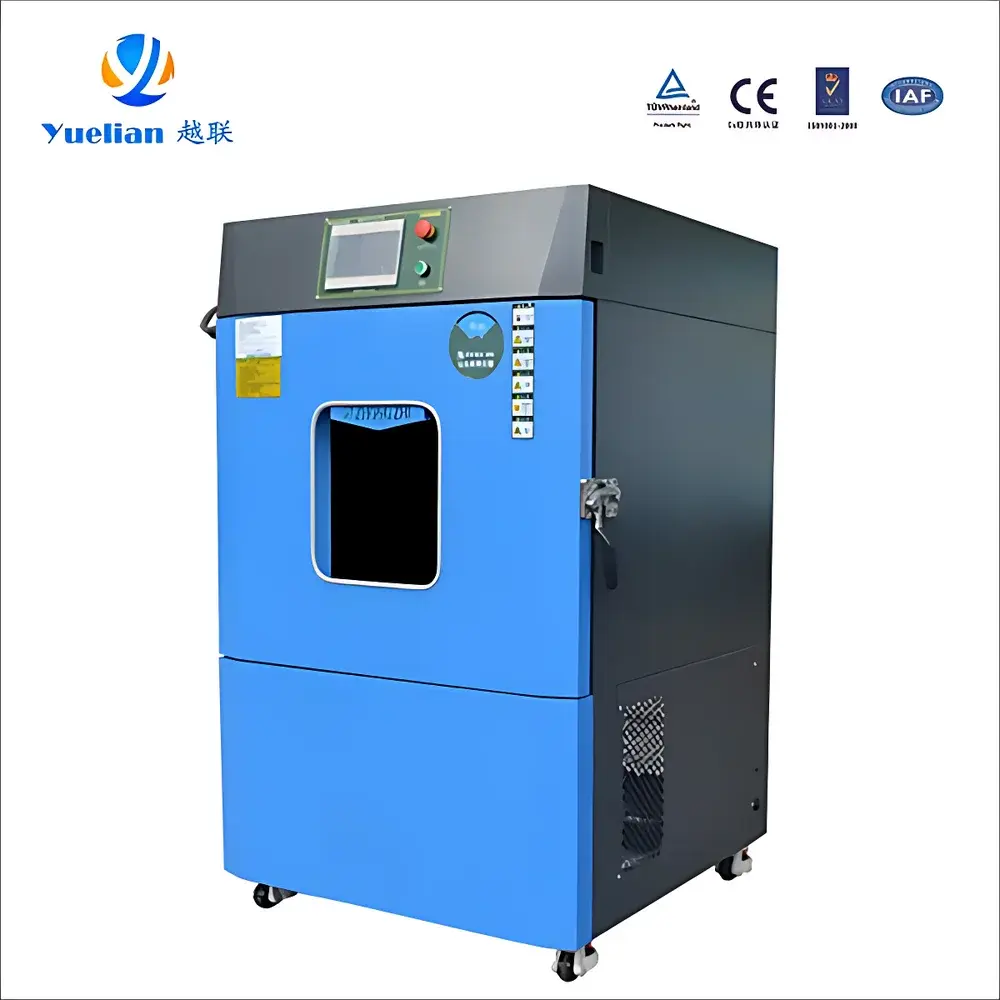
Yuelian YL-RL-02 Battery Thermal Abuse Test Chamber
| Brand | Yuelian |
|---|---|
| Origin | Guangdong, China |
| Manufacturer Type | Authorized Distributor |
| Country of Origin | China |
| Model | YL-RL-02 |
| Price | Upon Request |
| Internal Volume | 800 L |
| Internal Dimensions | W800 × H1000 × D1000 mm |
| External Dimensions | Approx. W1180 × H1680 × D1360 mm |
| Construction | Monolithic |
| Outer Shell | Thickened Cold-Rolled Steel (Gray + Blue Finish) |
| Inner Chamber | Thickened Stainless Steel |
| Viewing Window | Dual-Layer Tempered Safety Glass (350 × 400 mm) |
| Lighting | LED Interior Illumination |
| Exhaust System | Forced-Air Ventilation |
| Pressure Relief | Automatic Pressure Release Port |
| Control System | PLC with Touchscreen Interface |
| Temperature Range | RT+10°C to +150°C (customizable up to +250°C) |
| Heating Rate | ≤5°C/min (average, RT → +150°C) |
| Temperature Resolution | 0.1°C |
| Temperature Uniformity | ≤2.0°C |
| Temperature Fluctuation | ±0.5°C |
| Temperature Deviation | ≤2.0°C |
| Standard Accessories | Main Unit, 2× Sample Racks, 2× Insulated Epoxy Resin Sample Isolation Plates |
| Power Supply | AC220V/50Hz or AC380V/50Hz |
Overview
The Yuelian YL-RL-02 Battery Thermal Abuse Test Chamber is an engineered environmental simulation system designed specifically for standardized safety evaluation of lithium-ion and nickel-metal hydride (Ni-MH) battery cells and modules under controlled thermal stress conditions. It operates on the principle of programmable, uniform chamber heating to replicate critical abuse scenarios defined in international battery safety standards—including GB/T 31485–2015, IEC 62133–2, UL 1642, and UN Manual of Tests and Criteria Part III, Subsection 38.3. The chamber enables precise execution of prescribed thermal ramp profiles (e.g., 5°C/min to 130°C ±2°C for Li-ion cells, held for 30 minutes; or 85°C ±2°C for Ni-MH cells, held for 2 hours), followed by post-heating observation periods under continuous visual monitoring. Its monolithic structural design, dual-layer safety glazing, and integrated pressure-relief mechanism ensure operational integrity during high-risk thermal runaway testing.
Key Features
- Robust monolithic construction with thickened cold-rolled steel outer casing and high-grade stainless-steel inner chamber—engineered for long-term thermal cycling stability and corrosion resistance.
- Dual-layer tempered safety viewing window (350 × 400 mm) with integrated LED interior lighting—enabling real-time optical observation without compromising chamber integrity.
- PLC-based control system with intuitive touchscreen HMI—supporting multi-step temperature programming, data logging, alarm thresholds, and emergency shutdown protocols.
- Forced-air exhaust system with adjustable airflow rate—designed to manage off-gas emissions and mitigate internal pressure buildup during thermal decomposition events.
- Automatic pressure relief port—activated at pre-set differential pressure thresholds to prevent catastrophic chamber over-pressurization during battery venting or ignition.
- Insulated epoxy resin sample isolation plates and dedicated sample racks—minimizing thermal cross-talk between adjacent units and ensuring electrical isolation per IEC 62619 requirements.
Sample Compatibility & Compliance
The YL-RL-02 accommodates single cells (cylindrical, prismatic, pouch) and battery modules up to 800 L total volume, with configurable rack layouts supporting simultaneous multi-unit testing. It meets mechanical and thermal performance criteria referenced in GB/T 31485–2015 Clause 6.1.3 (cell-level heating test) and Clause 6.1.4 (module-level heating test). Chamber temperature uniformity (≤2.0°C), fluctuation (±0.5°C), and deviation (≤2.0°C) are validated per IEC 60068-3-5 and ASTM E145–22 Annex A3 for environmental test chambers. Optional calibration certificates traceable to NIM (National Institute of Metrology, China) are available upon request. While not a certified ISO/IEC 17025 laboratory instrument, its operational parameters align with GLP-compliant test environment requirements when integrated into validated lab workflows.
Software & Data Management
The embedded PLC controller records time-stamped temperature data at user-defined intervals (default: 1 s), storing up to 30 days of continuous operation history internally. Export is supported via USB interface in CSV format for post-test analysis in MATLAB, Excel, or LIMS platforms. Audit trail functionality logs operator actions, parameter changes, and alarm events—supporting basic 21 CFR Part 11 readiness when paired with institutional electronic signature policies. Remote monitoring is possible via optional Ethernet module (not standard), enabling integration into centralized facility SCADA systems for multi-chamber coordination.
Applications
- Pre-certification thermal abuse validation for UN 38.3 Section 38.3.4 (high-temperature storage test) and Section 38.3.5 (thermal cycling).
- Internal R&D screening of new electrode formulations, electrolyte additives, or cell packaging designs under accelerated thermal stress.
- Root-cause analysis of thermal runaway propagation in multi-cell modules using synchronized IR imaging (externally mounted).
- Supporting failure mode and effects analysis (FMEA) for battery management system (BMS) thermal protection logic verification.
- Quality assurance testing for incoming battery cells prior to pack assembly in EV or ESS manufacturing lines.
FAQ
What standards does the YL-RL-02 explicitly support?
It is configured to execute test protocols from GB/T 31485–2015, IEC 62133–2:2022, and UN Manual of Tests and Criteria Part III, Subsection 38.3—particularly Sections 38.3.4 and 38.3.5.
Can the chamber be used for non-battery applications?
While optimized for battery thermal abuse, its temperature range (RT+10°C to +250°C), uniformity, and safety features make it suitable for general high-temperature stability testing of polymers, adhesives, or encapsulants—provided appropriate hazard assessment is performed.
Is third-party calibration included with purchase?
Factory calibration is performed prior to shipment. NIM-traceable calibration certificates and annual recalibration services are available as optional add-ons.
How is thermal runaway gas managed during testing?
The forced-air exhaust system routes evolved gases through a dedicated ducted outlet; users must connect this to an external fume hood or scrubber system compliant with local occupational health regulations.
Does the system support automated pass/fail reporting?
The base controller provides raw temperature vs. time data. Automated pass/fail evaluation requires integration with external software (e.g., Python scripts or LabVIEW) using exported CSV files.



