
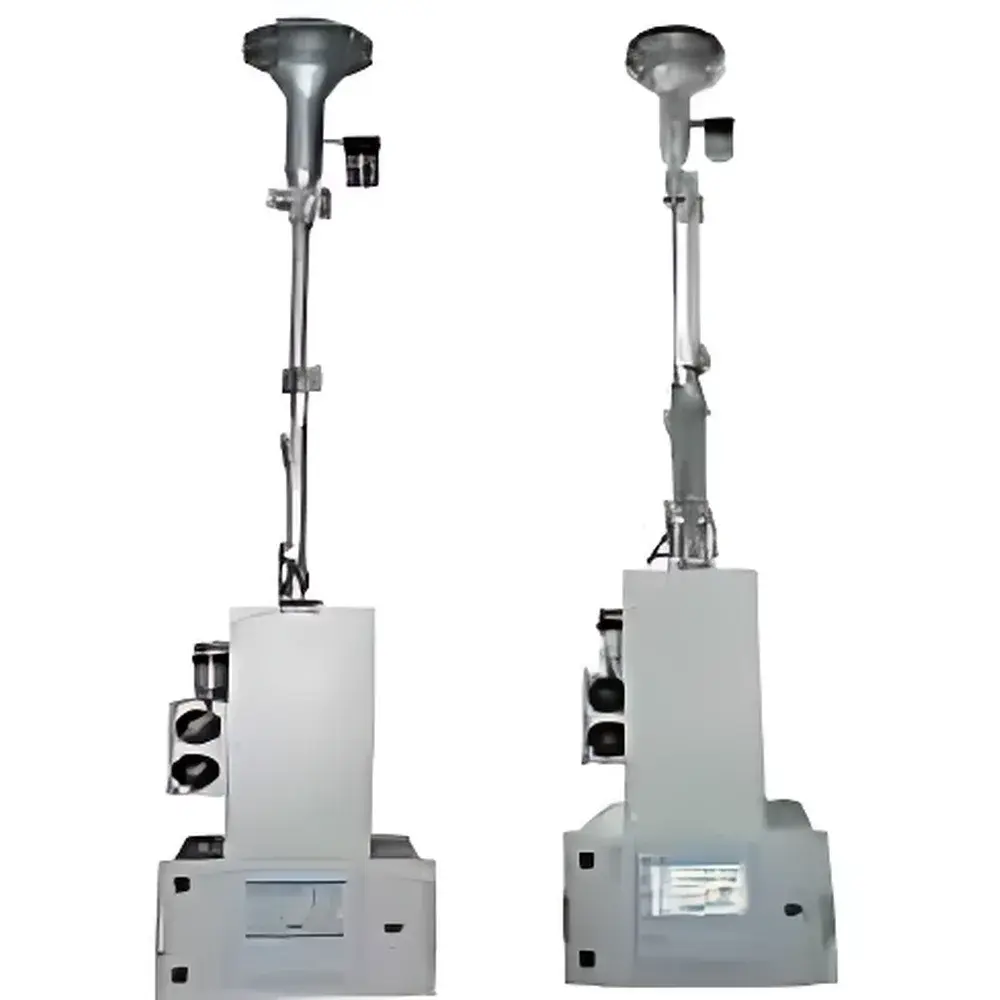
Yuhong TH-2000Z1 Tapered Element Oscillating Microbalance (TEOM) Particulate Matter Monitor
| Brand | Yuhong |
|---|---|
| Origin | Hubei, China |
| Model | TH-2000Z1 |
| Measurement Principle | Tapered Element Oscillating Microbalance (TEOM) |
| Measured Parameters | PM₁₀ and PM₂.₅ |
| Sample Inlet Options | TSP, PM₁₀, PM₅, PM₂.₅, PM₁ |
| Flow Control | Mass Flow Controller |
| Volatile Compensation | Integrated dual-cycle zero-gas reference compensation |
| Display | 8.4-inch industrial-grade TFT color touchscreen (Chinese UI) |
| Compliance Context | Designed for continuous ambient air quality monitoring per EPA EQOA guidance and ISO 12103-1 reference practices |
| Power Management | Programmable pump duty cycle for energy-efficient operation |
Overview
The Yuhong TH-2000Z1 is a continuous ambient particulate matter monitor engineered for regulatory-grade measurement of PM₁₀ and PM₂.₅ mass concentrations using the Tapered Element Oscillating Microbalance (TEOM) principle. This method relies on real-time gravimetric detection: airborne particles are drawn through a size-selective inlet—such as a cyclonic PM₂.₅ cutter—and deposited onto a vibrating tapered quartz element. The resonant frequency shift of the oscillating element is directly proportional to the accumulated particle mass, enabling high-temporal-resolution mass concentration calculation when combined with precisely metered sample volume. Unlike optical or beta-attenuation methods, TEOM provides true mass-based quantification without empirical calibration drift, making it suitable for long-term unattended deployment in national air quality networks and research-grade field studies.
Key Features
- True gravimetric measurement via micro-machined tapered oscillating quartz sensor with sub-microgram mass resolution
- Dual-cycle volatile compensation architecture: alternating sampling between raw ambient air and zero-air–purged reference mode enables correction for semi-volatile aerosol losses during collection
- Mass flow-controlled sampling system with closed-loop feedback ensures stable volumetric throughput across ambient temperature and pressure variations
- Modular inlet configuration supporting interchangeable impactors—including EPA-designated PM₂.₅ cyclones (15 L/min), PM₁₀ sharp-cut cyclones, and optional TSP/PM₁/PM₅ configurations
- Integrated low-loss分流 design minimizing particle bounce and re-entrainment, particularly critical for hygroscopic or low-density aerosols
- Industrial 8.4-inch capacitive touchscreen with localized Chinese firmware interface; supports real-time time-series plots, 3D status visualization, and event-triggered data logging
- Programmable pump sequencing reduces average power draw while maintaining compliance with minimum sampling duration requirements per EN 12341 and ISO 20983
Sample Compatibility & Compliance
The TH-2000Z1 accommodates standard regulatory inlets compliant with ISO 7708 (particle size selection), US EPA Reference Method PS-11 (for PM₂.₅), and EN 12341:2014 (ambient air—standardization of measurement methods for PM₁₀ and PM₂.₅). Its volatile compensation protocol aligns with the operational logic of EPA’s EQOA-TEOM methodology, addressing known underestimation biases associated with evaporative loss of ammonium nitrate and organic compounds. While not certified as a Federal Equivalent Method (FEM) device, its architecture follows core TEOM design principles validated in multiple intercomparison studies (e.g., EU ACTRIS campaigns). The instrument is intended for use in GLP-aligned environmental laboratories and municipal air quality stations where traceable, mass-based data integrity is prioritized over rapid-response optical proxies.
Software & Data Management
Data acquisition and instrument control are managed via embedded Linux-based firmware with configurable logging intervals (1-min to 1-hr averages). Raw frequency shift, temperature, pressure, flow rate, and mass accumulation signals are stored in ASCII-delimited files with UTC timestamps. Export formats include CSV and NetCDF v4.1 for interoperability with EPA AQS, EEA AirBase, and custom GIS-integrated platforms. Audit trails record all parameter changes, calibration events, and maintenance actions—supporting documentation requirements under ISO/IEC 17025:2017 Clause 7.7. Remote diagnostics and firmware updates are supported via Ethernet or optional 4G LTE module (not included), though no cloud synchronization or proprietary SaaS layer is implemented—ensuring full local data sovereignty.
Applications
- Ambient air quality monitoring networks requiring traceable gravimetric PM data for regulatory reporting
- Source apportionment studies where mass closure with chemical speciation (e.g., IC, XRF, OC/EC analyzers) is essential
- Indoor air quality assessments in occupational health settings with stringent exposure limit validation needs
- Field validation of low-cost sensor networks using TEOM-derived ground-truth references
- Research on aerosol volatility, hygroscopic growth, and phase-state effects under controlled environmental chambers
- Long-term trend analysis in urban, rural, and background sites per WHO Global Air Quality Guidelines
FAQ
Does the TH-2000Z1 meet U.S. EPA or European Union regulatory equivalency requirements?
No—this model is not designated as an EPA Federal Equivalent Method (FEM) or EU Type-Approved instrument. It implements TEOM physics but lacks formal third-party certification required for official compliance monitoring.
Can the instrument operate unattended for extended periods?
Yes—designed for continuous 24/7 operation with programmable pump cycling, internal diagnostics, and non-volatile memory retention during power interruption.
Is English-language firmware available?
The standard configuration ships with Chinese-language UI only; English localization requires OEM-level firmware revision and is not offered out-of-box.
What maintenance intervals are recommended for field deployment?
Filter tape replacement every 14–30 days depending on loading; quarterly verification of flow controller accuracy and annual quartz element recalibration against NIST-traceable mass standards.
How does the volatile compensation function differ from traditional TEOM designs?
It employs alternating ambient and zero-air sampling cycles on the same oscillating element, eliminating inter-element variability and enabling direct subtraction of volatile artifact—without requiring parallel filter-based reference channels.
Related Products







