
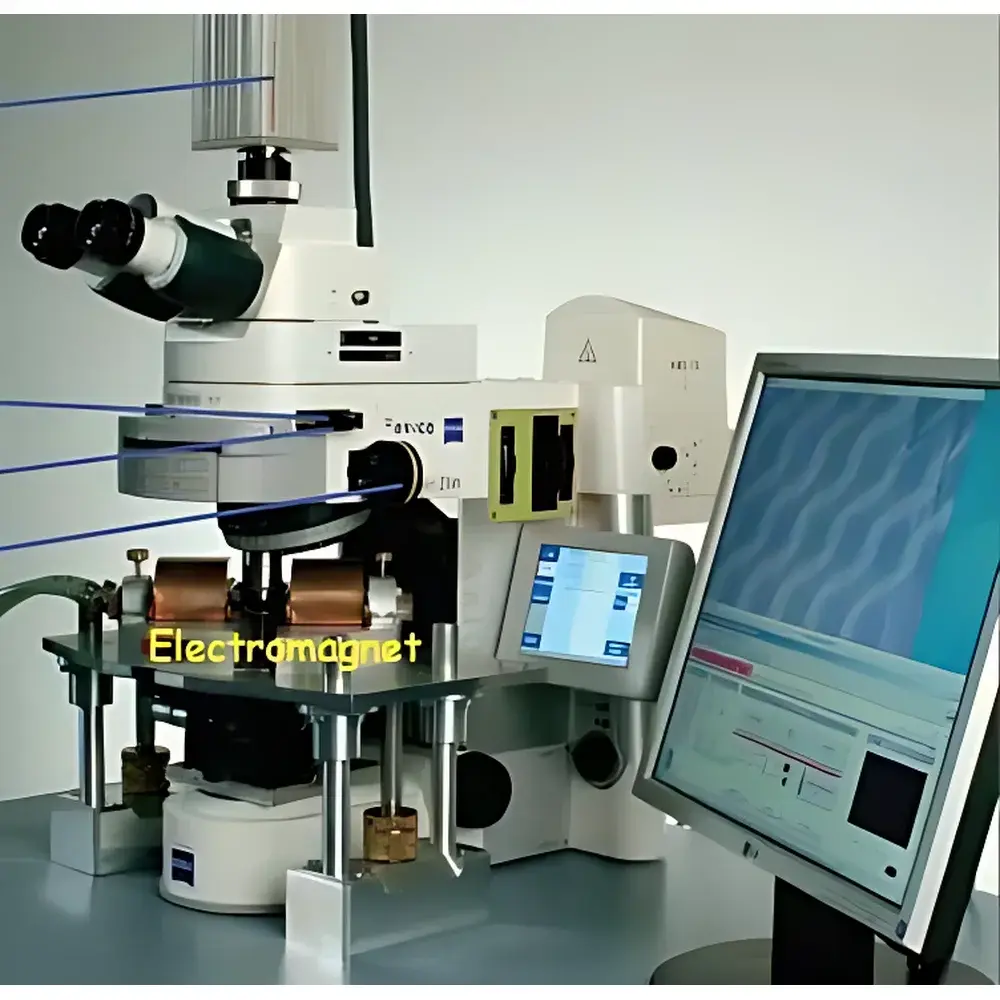
ZEISS Kerr Magnetooptic Microscope Axio Imager with Evico Electromagnetic Stage
| Key | Brand: ZEISS |
|---|---|
| Origin | Germany |
| Model | Axio Imager (Polarized Light Configuration) + Evico EM-800 Electromagnetic Stage |
| Max Magnetic Field | 800 kA/m (DC/AC) |
| Illumination | Colibri LED |
| Polarization Optics | Rotatable 360° polarizer with adjustable λ/4 plate and analyzer |
| Objective Compatibility | High-NA polarizing objectives including oil immersion and conoscopy-capable objectives |
| Sample Stage | Motorized X-Y translation with lockable precision platform |
| Software | ZEN Core with magnetooptic domain acquisition & time-resolved analysis module |
| Compliance | Designed for ISO/IEC 17025-compliant labs |
Overview
The ZEISS Kerr Magnetooptic Microscope Axio Imager is a research-grade optical system engineered for quantitative, real-time observation of magnetic domain structures and dynamics in ferromagnetic and ferrimagnetic materials. It operates on the magneto-optic Kerr effect (MOKE), where linearly polarized light reflected from a magnetized surface undergoes polarization rotation proportional to the local magnetization vector component perpendicular (polar MOKE), in-plane longitudinal (longitudinal MOKE), or transverse (transverse MOKE) to the incident plane. Unlike Lorentz microscopy or Bitter pattern techniques, MOKE-based imaging imposes no topographic perturbation, requires no conductive coating, and preserves intrinsic magnetic behavior—enabling non-invasive, high-temporal-resolution (<1 ms frame interval) domain tracking under controlled thermal, magnetic, and mechanical stimuli. This system integrates ZEISS’s Axio Imager optical platform—a Class I CE-certified polarized light microscope—with a purpose-built electromagnetic stage from Evico GmbH, delivering field homogeneity <±1.5% over 10 mm × 10 mm sample area and precise DC/AC field modulation up to 1 kHz.
Key Features
- ZEISS Axio Imager optical base equipped with apochromatic polarizing objectives (5×–100×, NA up to 0.90), including strain-free oil-immersion and conoscopy-optimized lenses for birefringence and extinction angle analysis.
- Colibri LED illumination system with stable intensity control (0.1–100% stepless), spectral stability ±0.5 nm, and integrated neutral density filters for optimal signal-to-noise ratio in low-contrast domain imaging.
- Full polarization train: motorized 360° rotatable polarizer, precision-adjustable λ/4 compensator (±0.01λ resolution), and independently tiltable analyzer—enabling quantitative retardation mapping and vector magnetization decomposition.
- Evico EM-800 electromagnetic stage featuring dual-coil architecture for orthogonal field generation, calibrated field output up to 800 kA/m (≈10 kOe), programmable ramp rates (0.1–500 A/s), and synchronized trigger I/O for external data acquisition systems.
- High-stability granite optical base with vibration-damped air-isolation platform, ensuring sub-micron positional repeatability during long-duration domain evolution studies.
- ZEN Core software with dedicated MOKE acquisition module supporting time-lapse domain imaging, hysteresis loop reconstruction (B-H or M-H), domain wall velocity calculation, and automated domain boundary segmentation using gradient-threshold algorithms.
Sample Compatibility & Compliance
The system accommodates planar specimens up to 50 mm × 50 mm × 5 mm (thickness), including single-crystal thin films, sputtered multilayers, bulk ferrites, Heusler alloys, and soft magnetic composites. No vacuum or cryogenic integration is required for ambient operation; optional cryo-stage (LN₂-cooled, 80–400 K) and heating stage (RT–600 °C) are available as certified add-ons. All optical components comply with DIN EN ISO 10110-7 for polarizing element wavefront distortion and ZEISS’ internal manufacturing standards for stress birefringence (<5 nm/cm). The electromagnetic stage conforms to IEC 61000-4-8 (power frequency magnetic field immunity) and carries CE marking for laboratory use in EU member states. System documentation supports GLP/GMP validation protocols, including IQ/OQ/PQ templates and electronic audit trail configuration per FDA 21 CFR Part 11 Annex 11.
Software & Data Management
ZEN Core v3.5+ provides native support for MOKE-specific workflows: synchronized field ramping and image capture (up to 100 fps at 12-bit depth), pixel-wise Kerr rotation angle calibration via reference sample measurement, and export of time-resolved domain maps in TIFF/OME-TIFF format compliant with Bio-Formats. Data integrity safeguards include immutable metadata embedding (field amplitude, polarity, exposure, polarization state), user-access-controlled project folders, and encrypted database logging. Raw datasets integrate with MATLAB, Python (via ZEN Python API), and commercial micromagnetic simulation platforms (OOMMF, MuMax3) for cross-validation of domain wall nucleation models and Landau–Lifshitz–Gilbert equation fitting.
Applications
- In-situ observation of domain wall pinning/depinning in exchange-biased bilayers under cyclic field application.
- Quantification of coercivity distribution across polycrystalline NdFeB magnets via localized hysteresis loop extraction.
- Temperature-dependent domain morphology analysis across Curie transitions in MnBi and FePt L10 thin films.
- Dynamic imaging of vortex core reversal in Permalloy nanodisks under pulsed magnetic fields.
- Correlation of magnetostrictive strain (via interferometric fringe shift) with domain reorientation in Terfenol-D composites.
- Validation of micromagnetic simulations against experimental domain patterns under complex multi-axis field trajectories.
FAQ
What magnetic field uniformity can be achieved over a 10 mm × 10 mm region?
Field homogeneity is better than ±1.5% across a 10 mm × 10 mm central area when operated at ≤500 kA/m, verified by Hall probe mapping prior to system commissioning.
Is the system compatible with external temperature control stages?
Yes—standard mounting interfaces support third-party cryogenic (liquid nitrogen or closed-cycle) and resistive heating stages with electrical feedthroughs and thermal shielding options.
Can domain wall velocity be measured quantitatively?
Yes—using time-resolved image sequences and sub-pixel centroid tracking algorithms embedded in ZEN Core, velocities down to 0.1 µm/s are resolvable with statistical confidence intervals derived from frame-to-frame displacement variance.
Does the software support automated hysteresis loop generation?
Yes—ZEN Core enables synchronized field sweep and image acquisition, followed by pixel-wise intensity-to-magnetization conversion and loop plotting with coercivity, remanence, and saturation magnetization annotation.
Are calibration standards provided for Kerr rotation angle quantification?
A NIST-traceable Ni reference film (known Kerr rotation of 0.32° at 633 nm) is included with full calibration certificate and SOP documentation for routine verification.




