
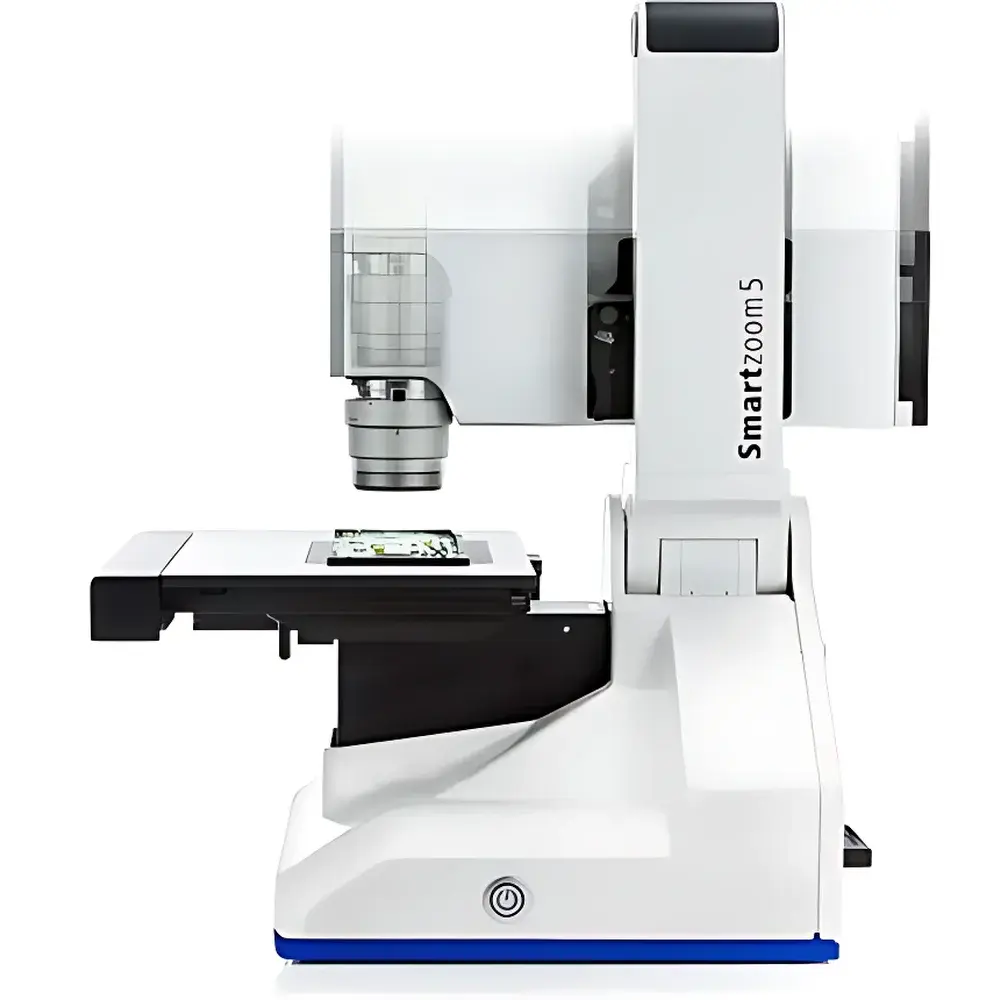
ZEISS Smartzoom 5 Automated Digital Microscope
| Brand | ZEISS |
|---|---|
| Origin | Germany |
| Model | Smartzoom 5 |
| Zoom Range | 10×–1,011× (with three interchangeable objectives) |
| Illumination | Integrated segmented LED ring light with objective-mounted power contact |
| Safety | Motorized collision avoidance (objective-sample and objective-hand detection) |
| Software | ZEISS ZEN Core with macro recording, real-time image enhancement (HDR, noise reduction, sharpening, image stabilization), GLP-compliant audit trail, user permission management, Word report export |
| Compliance | Designed for ISO/IEC 17025, ASTM E2928, USP <1118>, and FDA 21 CFR Part 11–ready workflows |
Overview
The ZEISS Smartzoom 5 Automated Digital Microscope is a purpose-built optical inspection platform engineered for high-reliability quality assurance (QA) and quality control (QC) laboratories in precision manufacturing, electronics, medical device, and materials science environments. Operating on a coaxial telecentric optical architecture with motorized zoom and focus, the system delivers consistent magnification across its full 10× to 1,011× range—achieved through three user-swappable objectives calibrated with geometric correction data stored directly in each lens. Unlike conventional stereo or compound microscopes, the Smartzoom 5 integrates a unified optical engine combining continuous zoom, panoramic tiling, and coaxial LED illumination into a single mechanical unit. This design eliminates parallax error during multi-scale navigation and ensures traceable, repeatable imaging under standardized lighting conditions. Its core measurement capability relies on digital image analysis rather than ocular observation, enabling objective, operator-independent evaluation aligned with metrology-grade documentation requirements.
Key Features
- Motorized zoom and focus with closed-loop positional feedback for sub-micron repeatability
- Three field-proven objectives (0.5×, 1.0×, 2.0×) offering calibrated magnification ranges from macro to high-resolution micro-inspection
- Segmented LED ring light powered via objective-integrated contacts—enabling dynamic, geometry-aware illumination control per lens
- Collision-sensing motor drive that halts movement upon physical contact with sample surface or operator hand, meeting IEC 61000-4-2 and EN 60601-1 safety expectations
- Real-time image processing suite including HDR compositing, adaptive noise suppression, edge-aware sharpening, and motion-compensated image stabilization
- ZEN Core software with macro recording functionality for automated replication of multi-step QA workflows (e.g., region-of-interest selection → focus stacking → measurement → annotation → report generation)
Sample Compatibility & Compliance
The Smartzoom 5 accommodates flat, curved, reflective, translucent, and textured samples up to 300 mm × 200 mm without stage modification. Its large working distance (up to 120 mm at lowest magnification) supports in situ inspection of assembled PCBs, machined components, coated substrates, and polymer films. The system complies with ISO 9001:2015 process control requirements and supports implementation of ISO/IEC 17025:2017 clause 7.7 (assuring measurement traceability). All calibration data—including lens distortion maps, illumination uniformity profiles, and pixel-to-length conversion factors—are embedded and auto-loaded. For regulated industries, ZEN Core provides electronic signatures, role-based access control, and immutable audit trails compliant with FDA 21 CFR Part 11 Annex 11 and EU GMP Annex 11 guidelines.
Software & Data Management
ZEN Core serves as the central interface for instrument control, image acquisition, measurement, and reporting. It features a gesture-enabled GUI optimized for glove-compatible operation in cleanroom or production-floor settings. Every captured image retains metadata: timestamp, objective ID, illumination settings, focus position, environmental temperature/humidity (when connected to optional sensors), and user identity. Measurement data—including area, length, angle, particle count, and coating thickness—is exported in CSV or XML formats compatible with LIMS and MES platforms. Report templates are fully customizable in Microsoft Word (.dotx), supporting company branding, regulatory disclaimers, and automatic insertion of annotated images with scale bars and statistical summaries. All user actions—including parameter changes, macro execution, and report exports—are logged with ISO 13485–aligned traceability.
Applications
- Defect classification and root-cause analysis in semiconductor packaging and SMT assembly
- Surface finish verification per ISO 4287 and ASTM E2928 standards
- Coating thickness assessment on medical implants using edge-detection algorithms
- Wire bond integrity inspection in aerospace avionics modules
- Particle contamination mapping on optical lenses and display panels
- Failure analysis of lithium-ion battery electrodes post-cycling
FAQ
Does the Smartzoom 5 support automated focus stacking?
Yes—the system performs motorized z-axis scanning with real-time contrast optimization to generate extended-depth-of-field composites. Stack parameters (step size, range, algorithm weighting) are configurable per application.
Can measurement results be integrated into our existing LIMS?
All quantitative outputs are exportable via structured XML or CSV files with defined schemas. Optional API integration enables direct push to LabVantage, Thermo Fisher SampleManager, or STARLIMS.
Is calibration traceable to national standards?
ZEISS provides factory calibration certificates traceable to PTB (Physikalisch-Technische Bundesanstalt) for magnification, illumination uniformity, and spatial resolution—valid for 12 months under standard operating conditions.
How is user accountability enforced in regulated environments?
ZEN Core implements four-tier permission levels (Viewer, Operator, Supervisor, Administrator), enforces mandatory electronic signatures for critical actions, and maintains tamper-evident audit logs with SHA-256 hashing.
What maintenance intervals are recommended?
Optical alignment verification every 6 months; LED output intensity validation annually; full system recalibration recommended biannually or after mechanical impact events.





