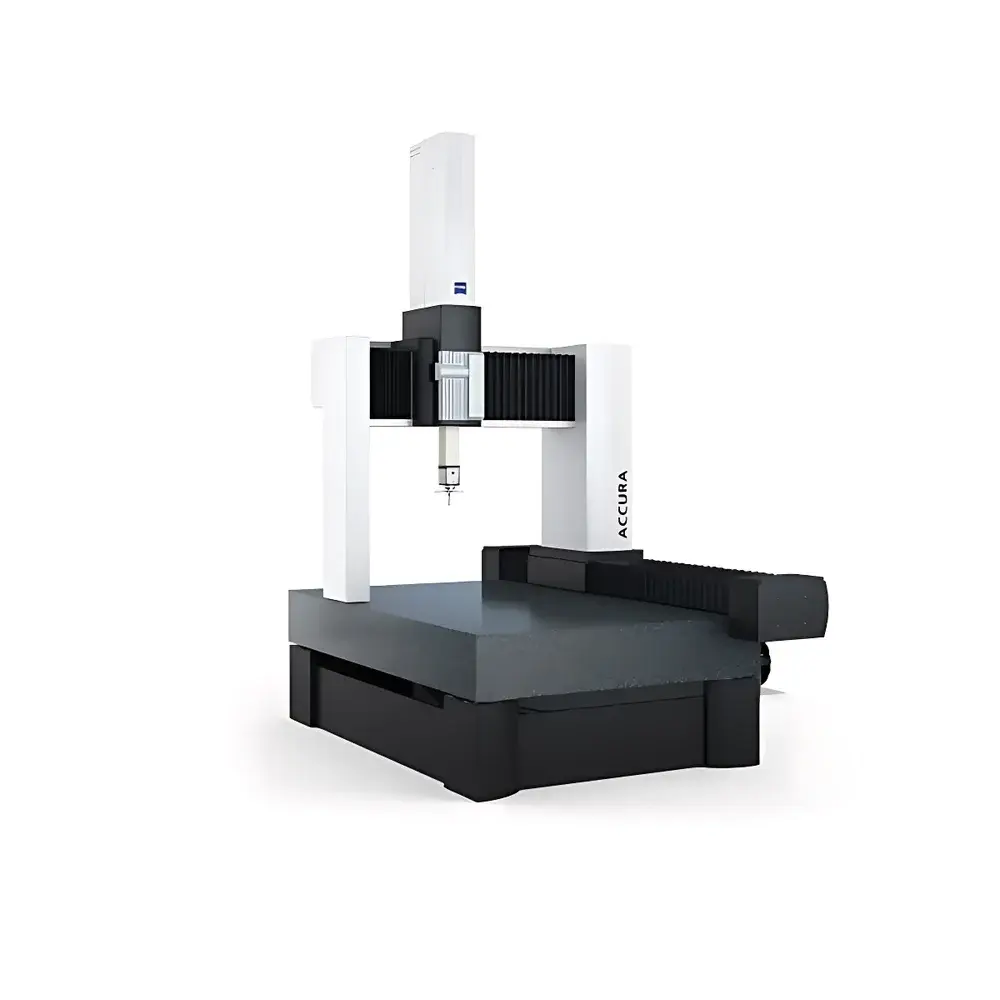
ZEISS Spectrum Automated Bridge Coordinate Measuring Machine
| Brand | ZEISS |
|---|---|
| Origin | Germany |
| Model | ZEISS Spectrum |
| Configuration | Bridge-type CMM |
| Operation Mode | Fully Automatic |
| Application Class | Shop-floor CMM |
| Measurement Method | Contact-based (Tactile) |
| Measurement Volume Range | 500 × 500 × 600 mm to 1000 × 1600 × 600 mm |
| Maximum Permissible Error (MPE<sub>E</sub>) | 1.9 + L/250 µm |
| Standard Operating Temperature | +17 °C to +35 °C |
| Probe Compatibility | ZEISS XDT direct, ZEISS VAST XXT direct, ZEISS VAST XT gold (Spectrum plus), ZEISS RDS-C5 with CAA, ZEISS RDS-C with CAA |
Overview
The ZEISS Spectrum is a high-performance, fully automated bridge-type coordinate measuring machine (CMM) engineered for precision geometric metrology in demanding production and quality assurance environments. Designed and manufactured in Oberkochen, Germany, the system operates on the fundamental principle of tactile coordinate measurement—using calibrated mechanical probes to physically contact part surfaces and reconstruct 3D geometry via Cartesian coordinate acquisition. Its rigid granite base, thermally stable bridge structure, and integrated passive vibration isolation ensure consistent mechanical integrity under shop-floor conditions. The ZEISS Spectrum meets international metrological standards including ISO 10360-2 (CMM performance verification) and ISO 15530-3 (calibration using calibrated workpieces), and supports compliance with ISO 9001, IATF 16949, and AS9100 quality management systems through traceable, auditable measurement processes.
Key Features
- Modular probe ecosystem supporting ZEISS XDT direct (for rapid single-point inspection), ZEISS VAST XXT direct (high-speed scanning with real-time path correction), and ZEISS VAST XT gold (active scanning with simultaneous single-point capability)
- Computational Accuracy Assurance (CAA) technology integrated with ZEISS RDS-C5 and RDS-C rotary probe heads—enabling up to 5,184 (RDS-C5) or 20,736 (RDS-C) discrete angular positions with interpolated calibration for enhanced repeatability and reduced requalification time
- Shop-floor optimized architecture: compact backpack-style control cabinet, seismic protection, and passive damping system for stable operation without external air suspension or climate-controlled rooms
- Thermal operating range extended to +17 °C–+35 °C, validated per ISO 10360-3, enabling deployment directly on manufacturing floors adjacent to CNC machining centers or assembly lines
- MPEE specification of 1.9 + L/250 µm (where L is measured length in mm) verified in accordance with ISO 10360-2, ensuring traceability to national metrology institutes via ZEISS-certified calibration artifacts
Sample Compatibility & Compliance
The ZEISS Spectrum accommodates a broad spectrum of industrial components—from small machined inserts and injection-molded housings (≥5 mm feature size) to large structural castings and welded assemblies up to 1,600 mm in length. Its configurable probe systems support styli ranging from 0.3 mm ruby spheres to 50 mm extended shafts with custom kinematic mounts. All probe qualification routines adhere to ISO 10360-5 and are fully documented within the ZEISS CALYPSO software environment. The system supports full GLP/GMP audit trails when operated with ZEISS CALYPSO v7.10 or later, including electronic signatures, change logs, and 21 CFR Part 11-compliant user access controls. Measurement reports conform to ISO 1101 (geometrical tolerancing) and ASME Y14.5 standards, with GD&T evaluation modules certified per VDA 5 and AIAG CQI-9 guidelines.
Software & Data Management
Controlled exclusively by ZEISS CALYPSO—the industry-standard metrology software platform—the Spectrum integrates seamlessly into enterprise data ecosystems via OPC UA, MTConnect, and RESTful API interfaces. CALYPSO provides full GD&T evaluation (form, orientation, location, runout), statistical process control (SPC) dashboards with Cp/Cpk calculation, and automated report generation in PDF, Excel, and XML formats. All measurement programs include embedded uncertainty budgets per GUM (JCGM 100:2008), and raw point-cloud data is stored in native .ZCP format with full metadata (temperature, humidity, probe ID, calibration timestamp). Software validation packages—including IQ/OQ documentation and installation qualification protocols—are available for regulated industries requiring FDA or EMA audit readiness.
Applications
The ZEISS Spectrum serves as a primary dimensional verification tool across aerospace (turbine blade root profiles, bracket hole patterns), automotive (engine block bores, EV battery tray flatness), medical device (orthopedic implant surface finish, catheter hub concentricity), and precision optics (lens mount alignment, housing parallelism). Its scanning capability enables full-profile analysis of gear teeth per ISO 1328-1, camshaft lobes per DIN 3960, and turbine airfoil sections per ISO 21848. In-process applications include first-article inspection (FAI) per AS9102, supplier PPAP submissions, and automated SPC feedback loops integrated with MES platforms such as Siemens Opcenter or Rockwell FactoryTalk.
FAQ
What environmental conditions are required for optimal accuracy?
The system is rated for operation between +17 °C and +35 °C with ≤60% relative humidity (non-condensing); thermal drift compensation is applied in real time using internal temperature sensors per ISO 10360-3 Annex D.
Is the ZEISS Spectrum compatible with existing metrology networks?
Yes—it supports standard industrial communication protocols including OPC UA, MTConnect, and Ethernet/IP for integration with factory-wide data infrastructure and digital twin frameworks.
How frequently must probe systems be recalibrated?
With CAA-enabled RDS-C5, full probe qualification takes ~12 minutes; requalification after stylus change requires ~5 minutes. Calibration intervals follow ISO 17025 recommendations and are typically defined per internal QA procedures or customer-specific PPAP requirements.
Can the system perform non-contact measurements?
No—the ZEISS Spectrum is a tactile-only CMM. For hybrid metrology, ZEISS recommends pairing with the ZEISS METROTOM series (CT) or ZEISS FOCUS SDK (structured light) in multi-sensor cells.
Does the system support automated part loading?
While the base Spectrum model is manually loaded, it is fully compatible with third-party robotic loaders (e.g., Stäubli TX2-90, Universal Robots UR10e) via standardized I/O and safety-rated PLC interface modules.